
How to choose your next sales channel instead of opening one out of FOMO
October 3, 2026
It almost always starts in a WhatsApp group. Someone mentions they opened a new channel and that in the first month they sold a number that sounds good. Nobody mentions the margin, or the inventory they had to commit, or the weeks spent loading product data. By the next day half the group is applying.
That is FOMO applied to expansion: you decide on the revenue you can see and ignore the cost you cannot. And the cost is real. A new channel is not just another source of orders; it is another catalog to maintain, another fee table, another promotions calendar, another report to reconcile, and another inventory row that can run dry exactly when the main channel needed it.
The right question is not “should I sell in more places?” but “which channel is next, measured against the ones I already run, and what would have to be true for it to be worth it?” That second question can be answered with your own numbers, without guessing and without market data nobody publishes well.
This article proposes a framework with four criteria you can calculate from what your operation already has, plus one exit test. There are no magic scores here: there is arithmetic you do before instead of after.
why FOMO is a bad criterion
FOMO decides on the wrong metric: gross revenue. It is the easiest number to brag about and the easiest to produce, because you can always drop the price until something moves. What nobody brags about is profit per unit or the capital left sitting in boxes.
There is also a second-order effect nobody plans for: the new channel competes against the old one for your inventory. If you have 300 units and you list them in three places, you do not have 900; you have 300 spread across three storefronts, and any of them can drain the stock from the one with the best margin. Expansion without additional inventory does not multiply sales, it redistributes them.
And there is a third effect, the most expensive one: attention. A new channel consumes decisions. Every hour spent fighting a platform’s catalog upload for a channel that is not selling yet is an hour not spent optimizing the one that is. That cost shows up in no report and is usually the biggest of them all.
None of this means you should not expand. It means the decision deserves the same discipline as a large purchase order.
criterion 1: the margin that absorbs the commission
This is the filter that eliminates the most candidates, and the easiest to calculate. The question is simple: if my product enters a channel with a higher commission and a different shipping cost, what is left?
An example with example numbers, not market data. A product you sell at 899 pesos, with a cost of goods of 420 and a shipping cost of 95. If your current channel charges 14%, that is 125.86 pesos. Costs add up to 640.86 and you keep 258.14, which is 28.7% margin.
Now the candidate channel. Assume an 18% commission — 161.82 pesos — and shipping of 110 because its logistics prices differently. Costs add up to 691.82 and you keep 207.18, or 23.0%. You lost 5.7 points and 51 pesos per unit.
That does not disqualify the channel: it puts it in perspective. If the new channel moves enough volume, 51 pesos less per unit can be worth it. If it moves half the volume, it is not. What you cannot do is enter without knowing which of the two cases is yours.
The practical rule: calculate your floor before you look at the ceiling. If the price the candidate channel will tolerate leaves you below your minimum profitable price, the conversation is over, no matter how much traffic it promises.
Glossary: real net margin, with everything deducted →criterion 2: real logistics capacity
The second criterion is not about cost, it is about whether you can deliver. Every channel imposes its own delivery-time standard, its own returns handling and its own account health metrics. A channel that punishes late shipments with reduced visibility is not a channel where you can experiment casually.
Ask yourself four things before saying yes:
- Can you meet its delivery promise without changing your operation? If the answer involves hiring people or moving warehouses, that cost belongs in criterion 1.
- Does its own fulfillment program serve you or trap you? Putting inventory in the marketplace’s warehouse speeds up delivery, but it commits stock that stops being available to your other channels.
- What happens with returns? Every platform processes them differently, and a high return rate in a thin-margin channel turns into a loss quickly.
- How much longer does replenishment get? If the new channel requires sending inventory ahead of demand, your effective lead time grows and your reorder point has to rise with it.
The trap here is planning for the normal week. The week that matters is Buen Fin: the day all three channels sell at once and your warehouse has to answer to every one of them.
criterion 3: the catalog that fits
This criterion is answered by your own history and almost nobody checks it. Not all of your catalog belongs everywhere, and the classic mistake is uploading all thousand SKUs because you are already in there.
A new channel opens with the subset of products that has a reason to win there, and that reason is usually one of three: the category is strong on that platform, your product has a differentiator beyond price, or your volume-to-price ratio keeps shipping from killing the deal.
On the other side, there are clear signals of products that should not cross over:
- The ones already stuck in a price war on your current channel. A new channel does not end a price war, it extends it.
- Slow movers. If a SKU takes four months to sell where you already have traffic, it will take longer on a channel with none, and it will age the same.
- The ones that need heavy product data — many variants, dimensions, certifications — if you do not have that information structured. Loading cost explodes.
- The ones that depend on a single supplier with unstable deliveries. A stockout on a new channel costs double, because on top of the lost sale the algorithm punishes you.
A reasonable rule to start: open with the SKUs that account for most of your profit, not most of your revenue. There are fewer of them, you know them well, and their margin can absorb the experiment.
Glossary: unified catalog, one real product and many listings →criterion 4: working capital
This is where most well-intentioned expansions die. A new channel consumes cash before it returns any, and it consumes it on three fronts at once.
Additional inventory. If you are going to list without risking stockouts on your main channel, you need extra units. With the example above, 200 units at a cost of 420 pesos is 84,000 pesos leaving your account and not coming back until they sell.
Payout cycle. Every platform deposits on its own calendar and with its own withholdings. That lag stacks on top of the time your money spends as cardboard boxes.
Launch investment. Photos, product data, possibly codes, and very likely advertising to get the first sales and the first reviews. All of that spending happens while the channel is still selling nothing.
The math to do is how many months of operation you can survive with that money out. If the answer is “barely enough”, the correct decision is to wait a quarter, not to enter tighter. A channel opened without a cushion turns into pressure to cut prices, and that is exactly when expansion starts destroying the margin that was supposed to justify it.
how to score the four criteria without inventing numbers
You do not need a complicated model. What works is a four-row scorecard built from your own data, plus a decision rule agreed on before you look at it.
For each candidate channel, answer with a number of yours, not an impression:
- Margin: net margin per unit for a representative SKU on that channel, calculated with its commission and its shipping cost, compared against your current channel.
- Logistics: how many days your effective lead time grows, and how many units you have to send ahead to meet its delivery promise.
- Catalog: how many of your SKUs pass the filter in the previous section. If it is fewer than ten, it is probably not a channel, it is a test.
- Capital: the exact peso amount of inventory, launch and payout lag, and how many months you can sustain it.
The decision rule that prevents self-deception is deciding in advance what would make you close the channel. For example: “if in four months it does not reach a certain number of monthly units at a margin above my floor, it closes.” Writing that down beforehand is what separates a test from a bet.
One note on outside data: it is tempting to look for public traffic or market-share figures to decide with. Across Mexican marketplaces those numbers are rarely comparable — everyone measures what suits them, with different methodology — so they are useful for sensing trends, not for deciding. Your own sales velocity in a controlled test is worth more than any third-party chart.
how a new channel reads in iqseller
There is an expansion cost that appears in none of the four criteria and shows up on day one: the panels multiply. Two channels already meant cross-checking two reports; three turn Monday into a morning of exporting CSVs and pasting them into a spreadsheet just to answer something as basic as what your profit was last week.
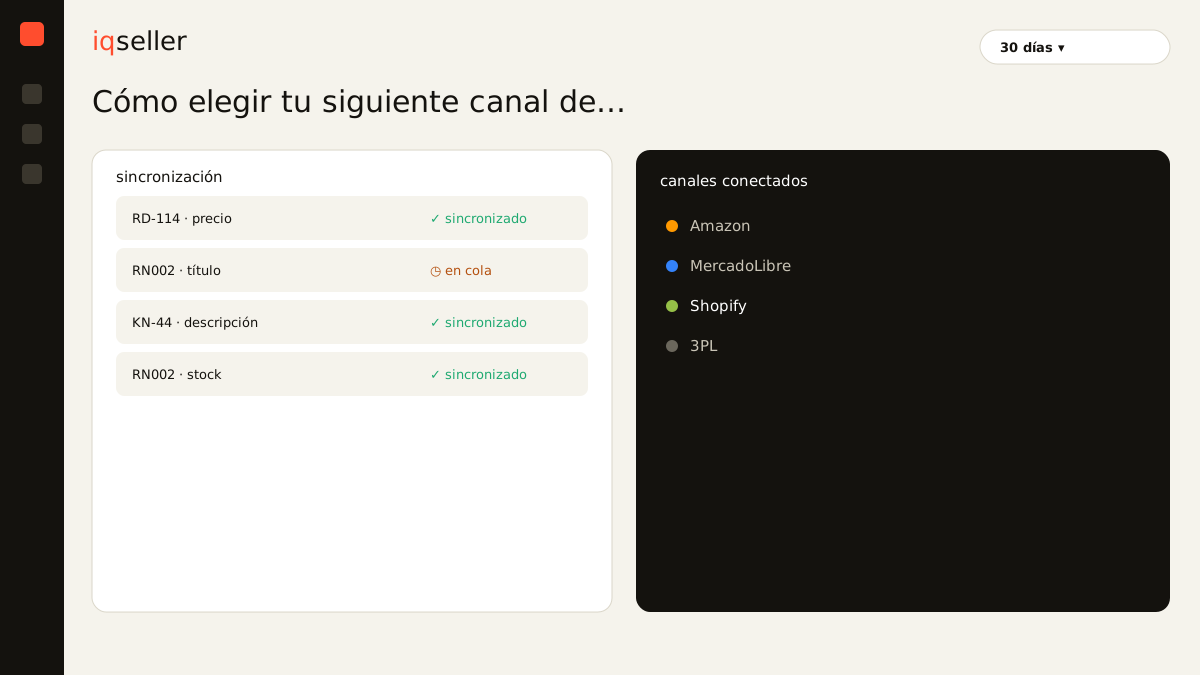
In iqseller the product exists once in the Catalog, with its Parent → Model → SKU tree, and every channel listing hangs off the same master SKU. That is what makes the rest possible: if the product is unified, sales from three channels add to the same line instead of living in three files.
Inventory shows one stock split by location — FBA, Full, 3PL, your own warehouse — with its valuation, so the new channel never invents stock you do not have. That is exactly the criterion 2 risk, solved with a view instead of a spreadsheet.
Profitability answers the criterion 1 question once the channel is live. Net margin per SKU is built from the COGS you load plus what each platform actually deducted: Amazon settlement commissions, MercadoLibre order commissions, FBA and Full fees, shipping, advertising, and the VAT and withholding breakdown. Seeing the same product’s margin side by side, channel against channel, is what turns a hunch into a decision.
Pricing lets you hold different prices per channel without losing sight of each one’s floor, and Forecast and Alerts warn you when the new channel is about to leave you out of stock on the old one. None of that is another channel to check: it is the same panel with one more column.
the exit question
Before you submit the application, answer this out loud: if this channel works exactly as I expect, what am I going to stop doing in order to serve it?
If there is no answer, the channel is not ready to open. Expansion that works is not the kind that stacks sales on top of a saturated operation, but the kind that arrives when there is margin, inventory, catalog and capital to receive it. The four criteria above can be calculated in one afternoon with your own data; FOMO only answers to a meeting and a well-built spreadsheet.