
Master SKU vs channel SKU: how to structure a unified catalog
July 20, 2026
A unified catalog is built on one simple distinction that almost nobody makes explicit: the master SKU is the real product, the physical box that exists in your warehouse; the channel SKU is how that product appears published on Amazon, MercadoLibre, Shopify or your 3PL. There is exactly one master, and it never repeats. There are several channel SKUs, and they all hang off the master. Designing that hierarchy well — master on top, channels below, all pointing at the same inventory and cost truth — is what stops you from duplicating products and finally makes your numbers reconcile at the same second.
The pain you are living has a name: you are treating every listing as if it were a separate product. On Amazon the black medium knee brace is an ASIN. On Meli it is an MLM. On Shopify it is a handle with its own SKU. In the 3PL panel it is an internal code nobody else recognizes. When each channel is its own “product,” you end up with four inventories that never agree, four prices you update by hand, and a 3 a.m. spreadsheet where you try to reconcile yesterday’s figures to decide today’s price. The uncertainty does not come from missing information; it comes from information split into pieces that do not talk to each other.
This article teaches you to design the right hierarchy. You will see why the master SKU is the ground floor of any healthy catalog, how channel SKUs hang off it without duplicating, what happens with size and color variants, and why real time — not the spreadsheet — is the only thing that keeps that structure alive when you sell in four places at once.
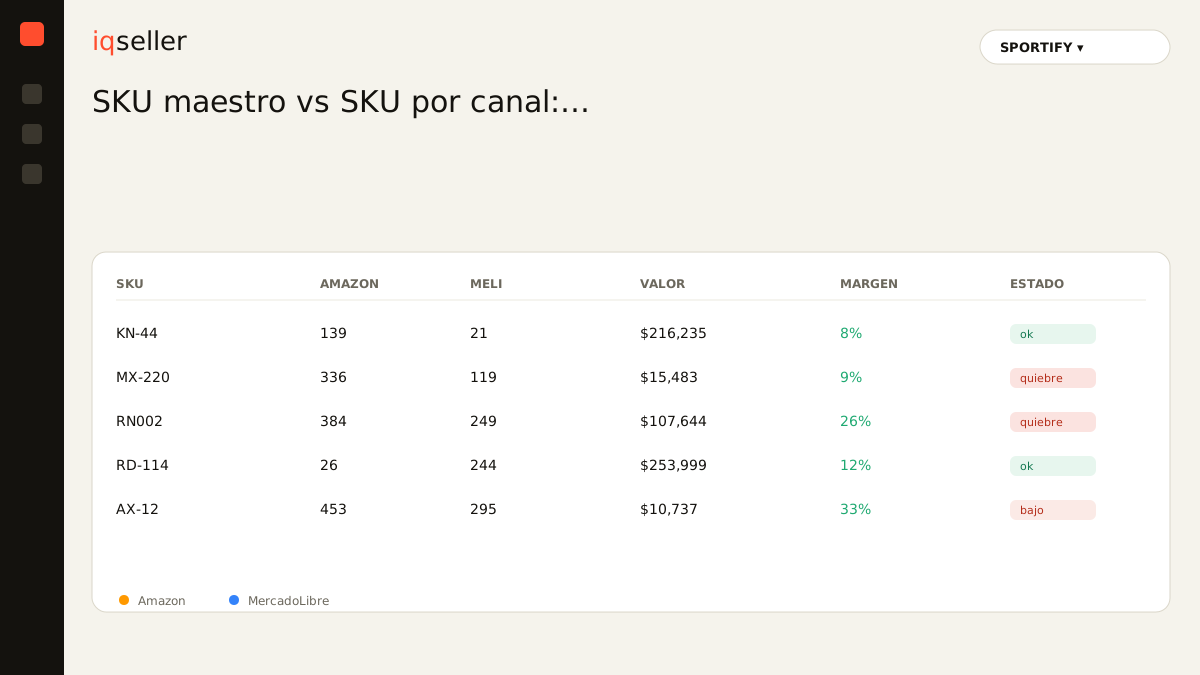
what a master SKU is and why it is the ground floor
The master SKU is the unique identifier of the real physical product, the one that exists regardless of where you sell it. The compression knee brace, size M, color black, is a single master SKU: KNE-BLK-M. That box exists once. It has a purchase cost, a weight, dimensions, and a physical availability that is a concrete number, not an opinion.
The key is that the master knows nothing about channels. It does not care whether that knee brace sells through FBA, through MercadoLibre Full, or through your Shopify store shipped from the 3PL. The master knows one thing only: how many physical units exist and what each one cost. It is the source of truth for inventory and cost. Everything else — price, commissions, titles, photos — lives one layer below, in the channels.
Glossary: a unified catalog is the structure where each physical product exists exactly once as a master SKU, and all of its channel listings hang off it, sharing inventory and cost in real time.When you establish the master first, everything else falls into place by gravity. Every sale on any channel deducts from the same physical availability. Every cost update reflects across all channels at once. Without this ground floor, you are adding pears from one channel to apples from another, and no downstream report means anything.
what a channel SKU is and how it differs
The channel SKU is the representation of the product inside a specific marketplace. It is Amazon’s ASIN, Meli’s MLM, Shopify’s SKU. Each one carries the information specific to that channel: the title optimized for Amazon’s search, MercadoLibre’s category commission, the decision to offer installments, the effective price after fees.
The difference from the master is one of nature, not degree. The master answers “what is this product and how many do I have?” The channel SKU answers “what is it called, what does it cost, and how much does it leave me on this specific marketplace?” The same master can have a healthy margin on Shopify — where you pay no marketplace commission — and a tight margin on Meli, where the category commission plus Full shipping eat a good chunk of the sticker price. That same analysis feeds what you decide about pricing and ads; when you review your ACoS by channel, you need the base cost to come from the master and the commissions to come from the channel, or the math will lie to you.
The classic mistake is capturing the purchase cost inside each listing. You do it four times, each with a slightly different number, and suddenly the same knee brace “costs” three different figures depending on which tab you open. Cost lives in the master. Period. The channel only adds what the channel charges.
the hierarchy: how channels hang off the master
The correct structure is a two-level tree. On top, the master SKU. Below, one or several channel SKUs linked to it. Each link is an explicit statement: “this ASIN, this MLM, and this Shopify handle are the same physical box.”
That act of linking is the heart of the catalog. When you link correctly, a sale of 30 units on Amazon deducts 30 from the master’s availability, and those 30 instantly disappear from the stock that Meli and Shopify can sell. No overselling, no cancellations, no customer call asking where their order is for a product you no longer had.
Glossary: the EAN/GTIN is the product’s global barcode; it works as an anchor to automatically link listings from different channels to the same master SKU when they share the same code.The EAN or GTIN is your best ally for linking without errors. If three listings share the same GTIN, they are almost certainly the same physical product, and the system can suggest the link for you. When there is no GTIN — bundles, kits, products without a code — the link is made by hand once and recorded forever. What matters is that the hierarchy is explicit and does not live only in your head.
variants: size and color without duplicating the master
This is where most catalogs break. The knee brace exists in sizes S, M, L and in black and blue. That is six distinct physical products, six master SKUs: KNE-BLK-S, KNE-BLK-M, KNE-BLK-L, KNE-BLU-S, and so on. Each one has its own availability, because the black M and the blue L are separate boxes in your warehouse.
The mistake is treating “the knee brace” as a single master with six variants blended together, or worse, creating one master per combination per channel, ending up with twenty-four entries for six real products. The rule is clean: every unique combination of attributes that occupies a distinct physical spot in your warehouse is one master SKU. Variants are grouped visually — the product page in Shopify shows the size selector — but each option in the selector points to its own master with its own stock.
This topic has enough depth that we dedicate a full article to how to manage sizes and colors in your catalog without losing stock control. The short version is that a unified catalog groups variants to present them, but never fuses them into the same inventory. If it does, you sell an L when you only had an M left.
why real time is what keeps the structure alive
You can have the perfect hierarchy on paper and still suffer if you maintain it by hand. A structure of master SKU and channel SKU only works if availability propagates the moment the sale happens, not when you sit down to update the spreadsheet.
Glossary: real availability is the quantity of physical units of a master SKU counted only once, with reservations from every channel already deducted — what you can actually sell right now.Picture the typical scenario: it is Friday, you have three units of the black M knee brace. An order comes in on Amazon at 10:02 and another on Meli at 10:03. If availability syncs every six hours, between 10:02 and the next sync Meli still believes it has three units and sells two more than exist. Real time closes that window: the moment Amazon sells, the master’s availability drops and Meli knows it within seconds.
Real time is also what gives you back the hours lost to the 3 a.m. spreadsheet. When the master is the source of truth and the channels hang off it, you reconcile nothing: you ask the system how many KNE-BLK-M you have and the answer is a number, not a sum of four tabs with different dates.
how to migrate your current catalog to this structure
If you already sell across several channels, you are not starting from zero, and that is good. The path is: first, list every real physical product and assign it a stable master SKU — use a readable convention like category-color-size and never change it. Second, pull all your listings from each channel. Third, link each listing to its master, leaning on the GTIN where it exists and by hand where it does not.
The step people skip is auditing the duplicates you already have. You almost always discover the same product is published twice in the same channel — an old one and a new one — competing against itself. Consolidating that under a single master not only tidies inventory; sometimes it recovers Buy Box you were splitting between your own listings.
Once the structure is up, the discipline is simple: every new product is born as a master before it is published anywhere, and every listing is linked on day one. A unified catalog is not a project you finish; it is a rule you follow. And the reward is that you decide with today’s numbers, not yesterday’s, confident that every figure points to a single real box in your warehouse.