
What is an EAN or GTIN and why Amazon and MercadoLibre require it
July 5, 2026
An EAN GTIN is the standard barcode that uniquely identifies a product anywhere in the world. GTIN (Global Trade Item Number) is the generic name for the identifier; EAN (European Article Number) is the 13-digit format you’ll use most of the time in Mexico and Latin America. Put simply: GTIN is the category and EAN is one of its types. When Amazon or MercadoLibre asks you for “the product code,” they’re asking for a valid GTIN, and the 13-digit EAN is the one you’ll type in most cases.
Why do they require it? Because that number is the key the marketplace uses to know your item is the same item already in its global catalog. They don’t want every seller inventing their own listing for the same product: they want a single listing per real product, and the GTIN is what lets them recognize it and match your offer to that listing. Without that identifier, the system can’t tell whether your “black bluetooth headphones” are the same ones ten other sellers already list or a different product entirely.
For you, as a multichannel seller, this goes beyond a requirement to publish. The EAN or GTIN is the thread that connects the same product across Amazon, MercadoLibre, your Shopify and your 3PL. When that code is captured correctly and matches across channels, your listings link almost on their own and your inventory reads from a single source. When it doesn’t match, you’re back to separate dashboards, manual spreadsheets and the uncertainty of not knowing how much stock you actually have.
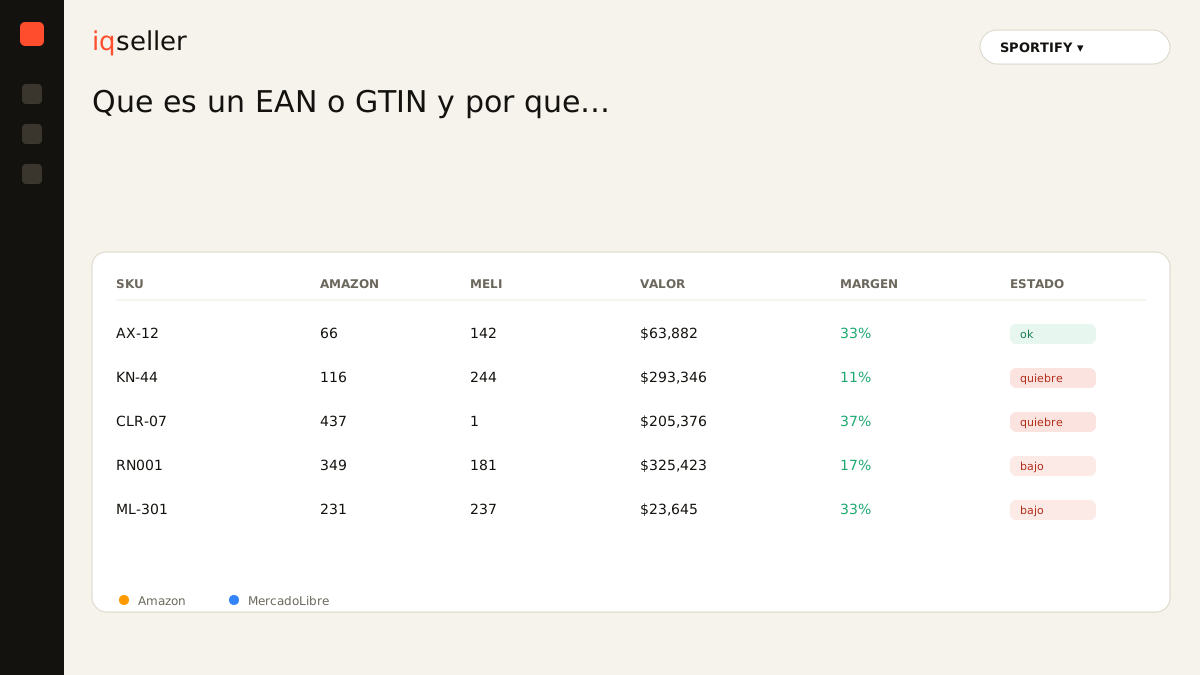
what a GTIN is and what an EAN is
The GTIN is the global standard managed by GS1, the organization that hands out the barcodes you see on any package. It’s not a number you make up: it’s an identifier issued under rules so it’s unique across the whole planet. Under that umbrella sit several formats depending on how many digits they have, and that’s where the names that confuse people come from.
The 13-digit EAN (technically GTIN-13) is the most common in Mexico and Latin America. The 12-digit UPC (GTIN-12) dominates in the United States. There’s also the shorter EAN-8 for small packages, and the GTIN-14 used for cases and logistics groupings. They’re all “GTIN”; what changes is the length and the region where they were born. So when Amazon asks for a GTIN and you have a 13-digit EAN, there’s no conflict: your EAN already is a GTIN.
The key thing about this hierarchy is that you don’t have to choose between one and the other. If your product already carries a barcode printed by the manufacturer, it’s almost always an EAN or a UPC, and that’s the number you capture. If you’re the one manufacturing or importing a product without a code, then you do need to get a legitimate one, a topic we cover separately in how to get legitimate EAN or GTIN codes.
Glossary: the EAN and GTIN are the product’s standard barcode; GTIN is the generic name and the 13-digit EAN is the format most used in Mexico.why Amazon requires it
Amazon organizes its entire catalog around the ASIN, its internal identifier. But to create an ASIN, or to attach yourself to one that already exists, Amazon first needs a valid GTIN that confirms which physical product you’re talking about. The GTIN is the entry point; the ASIN is what Amazon generates afterward for its own world.
When you list a new product, Amazon takes your EAN or UPC, validates it against the GS1 database and decides whether to create a new listing or add you to an existing one. If the code is already in its system, your offer lands directly on that ASIN and you compete for the Buy Box with the other sellers. If it isn’t, you generate a new listing. A mis-captured GTIN breaks this logic: it creates a duplicate ASIN, your product ends up split off from the main listing, and you lose all the reputation and reviews that listing already had.
Amazon tightened this validation over the years precisely to stop invented codes or the cheap bulk packs that aren’t registered to your name in GS1. If the EAN doesn’t validate, the listing is rejected or suspended later. That’s why getting the right code isn’t a minor formality: it’s what holds up your entire catalog on the platform. We break down the difference between these identifiers in EAN, UPC, ISBN and ASIN.
why MercadoLibre requires it
MercadoLibre came to the mandatory EAN GTIN later than Amazon, but today it asks for it just as firmly in most categories. Its catalog engine works similarly: it uses the code to group every listing of the same product into a single catalog page, the one where multiple sellers compete to win the featured listing.
For MercadoLibre, the GTIN is the key that decides whether your listing enters the shared catalog or stays as a standalone listing. Entering the catalog gives you visibility and puts you in the competition for the winning price; staying out leaves you isolated, with less traffic and none of the advantage of the shared page. In categories where the code is mandatory, you can’t even complete the listing without capturing it, and if you enter an invalid one the system flags it.
The pain shows up when the same product has a different EAN on MercadoLibre and on Amazon: one captured with an extra zero, another inherited from a supplier, another left blank months ago. At that moment your two channels stop talking about the same item even though in your warehouse it’s a single box, and all the reconciliation turns manual.
the EAN GTIN as the bridge between your channels
This is where the topic stops being an administrative requirement and becomes the center of your operation. If you sell the same product on Amazon, MercadoLibre, Shopify and ship it from a 3PL, you have four representations of a single physical box. The EAN or GTIN is the most reliable signal to tell a system that all those representations are, in reality, the same SKU of yours.
When the code matches across channels, the link is suggested almost on its own and you can build a unified catalog: one real product at the center and each listing hanging off it. That lets you calculate stock once against the total physical inventory, instead of manually adding up what each listing shows and overselling without noticing.
Glossary: the unified catalog is the model where a physical product is the central entity and each marketplace listing is only one of its representations, linked by its EAN or GTIN.The problem is that the code rarely matches cleanly in practice. One channel has it with an extra digit, another left it empty, another captured it by eye. That’s why a healthy operation doesn’t depend on a single signal: it cross-checks the EAN with your internal SKU, with the normalized title and with the specific variant. When several signals point to the same product, confidence goes up; when they contradict each other, you review before merging, because linking wrong is worse than not linking.
what happens when the code is wrong or missing
A wrong EAN GTIN doesn’t fail loudly on day one; it fails slowly and expensively. On Amazon it generates a duplicate ASIN that starts with no reviews and no history. On MercadoLibre it leaves you out of the shared catalog and you lose the competition for the winning price. In your multichannel inventory it breaks the link, and that’s the most expensive effect of all.
When the link breaks, your channels stop sharing the same stock number. You sell 30 units on Amazon, 10 are left, but MercadoLibre keeps offering 40 because it never found out: that’s an oversell waiting to happen, with its cancellation and its hit to your reputation. The number that really matters, the true available, stops being calculable because the system no longer knows those listings are the same product.
Glossary: the true available is the inventory you can sell right now, after subtracting what’s committed across all channels, not the sum of what each listing shows.That’s why it pays to treat the EAN as a first-class piece of data and not a field you rush to fill just to be able to publish. A correct code, consistent across channels, is what separates an operation that reconciles itself from one where you spend hours each week piecing figures together by hand.
what the work looks like when the EAN is set right
The practical change isn’t that you see more data, but that you see fewer screens. Instead of opening Seller Central, the MercadoLibre listing, your Shopify and the 3PL panel to assemble the story of a single SKU, you open the product and there are all its listings, its reconciled stock and its margin per channel, because the EAN keeps them tied to the same real product.
This doesn’t eliminate the marketplaces or spare you from understanding their rules. What it eliminates is the glue work: those hours spent copying figures between dashboards and wondering whether your spreadsheet is still true. Real time lets the channels report their events to the central product while you read a single, already-reconciled source, so you decide with today’s situation, not yesterday’s. That same discipline of reading a single reliable number is what helps you control ad spend; we cover it in what is ACoS.
In the end, understanding what an EAN or GTIN is means more than knowing why Amazon and MercadoLibre require it. It means understanding that this small code is the column holding up your multichannel catalog: set right, your listings recognize each other and your inventory tells a single truth; set wrong, each channel lives on its own island and you become the human integrator running to put out fires.