
How to connect Shopify and MercadoLibre to sell on both without double work
August 19, 2026
Connecting Shopify and MercadoLibre to sell on both without double work means making each product live once —with its cost, its SKU, and its inventory— and letting each platform be nothing more than a different face of that same product. Instead of building the listing in Shopify and then rebuilding it in MercadoLibre, you define the catalog in one central place and publish and sync the listings from there. When a unit sells on either channel, stock drops for both at the same time, and sales arrive already added up on a single dashboard. That, in one sentence, is what you’re after.
The pain that brought you here is familiar. You have your D2C store on Shopify, where you own the brand and pay no marketplace commission, and you have your presence on MercadoLibre, where the traffic you’ll never generate on your own already lives. On paper, it’s the ideal combination. In practice it’s two dashboards open all day, two ways to load a product, two inventory counts that don’t talk to each other, and Sunday night spent building a spreadsheet just to figure out how much you sold in total. The second channel didn’t add sales: it added hours, and it added uncertainty.
This article is about closing that leak. It isn’t about working faster in two places — it’s about no longer working in two places. When the catalog, the inventory, and the numbers live in a single source of truth, connecting Shopify and MercadoLibre stops being a second part-time job and becomes one operation with two storefronts.
why Shopify and MercadoLibre together, and why it hurts
Shopify and MercadoLibre don’t compete: they complement each other. Shopify is your direct-to-consumer (D2C) channel: your domain, your customer data, your margin with no platform commission, full control of the look. MercadoLibre is the marketplace: a river of purchase-intent traffic you’d be hard pressed to match on your own, in exchange for commission, its own rules, and less control over the buyer relationship. Having both is the right play, and we lay it out in the pillar on what a marketplace and D2C strategy is and how to combine them without cannibalizing sales.
The problem isn’t the strategy; it’s the plumbing. Each platform has its own panel, its own way of structuring a product, its own fees, and its own logistics. Shopify thinks in products with variants and SKUs; MercadoLibre thinks in listings with attributes, a category, and sometimes a catalog. If you manage them separately, every change —a new cost, a better photo, a price adjustment— you do twice. And every time you do it twice, the odds go up that one day the two drift out of sync.
The right question isn’t “should I also publish on MercadoLibre?” but “can I publish it without cloning the operation I already have on Shopify?” The answer comes down to one thing: whether your information lives in one central place or scattered across each platform.
the unified catalog: one product, two storefronts
The first place work gets duplicated is the catalog. In your head, a product is a product: one box, one cost, one supplier. In the reality of the platforms, that same product is an object in Shopify and a listing in MercadoLibre, each with its own title, description, price, and key. Managing them as if they were two different products is the root of the double work.
The way out is to treat the product as one real entity behind several listings. You define the product once —cost, internal SKU, dimensions, EAN, family— and each channel is just a face of that entity. Connecting Shopify and MercadoLibre, done right, isn’t re-capturing your whole store on another platform: it’s linking the product that already exists to one more listing. Cataloging happens once, not per channel.
For that link to be reliable you need a common key that identifies the same product on both sides. That’s where the barcode comes in: see what is an EAN or GTIN and why Amazon and MercadoLibre require it, because it’s exactly what lets the system recognize “this Shopify product” and “this MercadoLibre listing” as the same SKU rather than two separate things.
Glossary: what an EAN or GTIN is and why it’s the key that ties the same product across channels → Glossary: what a unified catalog is and how it keeps one product behind several listings →inventory has to be a single count
Here’s the most expensive mistake when selling on Shopify and MercadoLibre at once: keeping two stock counts. If Shopify thinks you have 30 units and MercadoLibre also thinks it has 30 —when there are only 30 in the warehouse total— you’re offering twice what exists. It works until two buyers land the same day: then you cancel, eat the penalty, and take a reputation hit, especially on MercadoLibre, where selling and not delivering weighs heavily.
Real inventory is a single number: what’s in your warehouse or your 3PL. Channels shouldn’t have “their own” stock; they should read from the same figure. When a unit sells on Shopify, the available count drops on MercadoLibre in that moment, and vice versa. This is what turns the second channel into an extension of your operation instead of a parallel operation competing against the first for the same physical units.
The concept that holds all of this together is real availability: the number left after subtracting what’s committed but not yet shipped from physical stock, adding up demand from both channels. Without a single real-availability figure, syncing becomes guesswork and overselling is only a matter of time.
Glossary: what real availability is and why a single count prevents overselling across channels →the numbers have to add themselves up, not in a spreadsheet
The classic symptom of a seller with two unintegrated channels is the Sunday spreadsheet. You download the Shopify report, download the MercadoLibre report, paste them together, fight with formats and currencies, try to line up the dates, and end up with a blurry picture from several days ago. You decide the coming week with data that already aged.
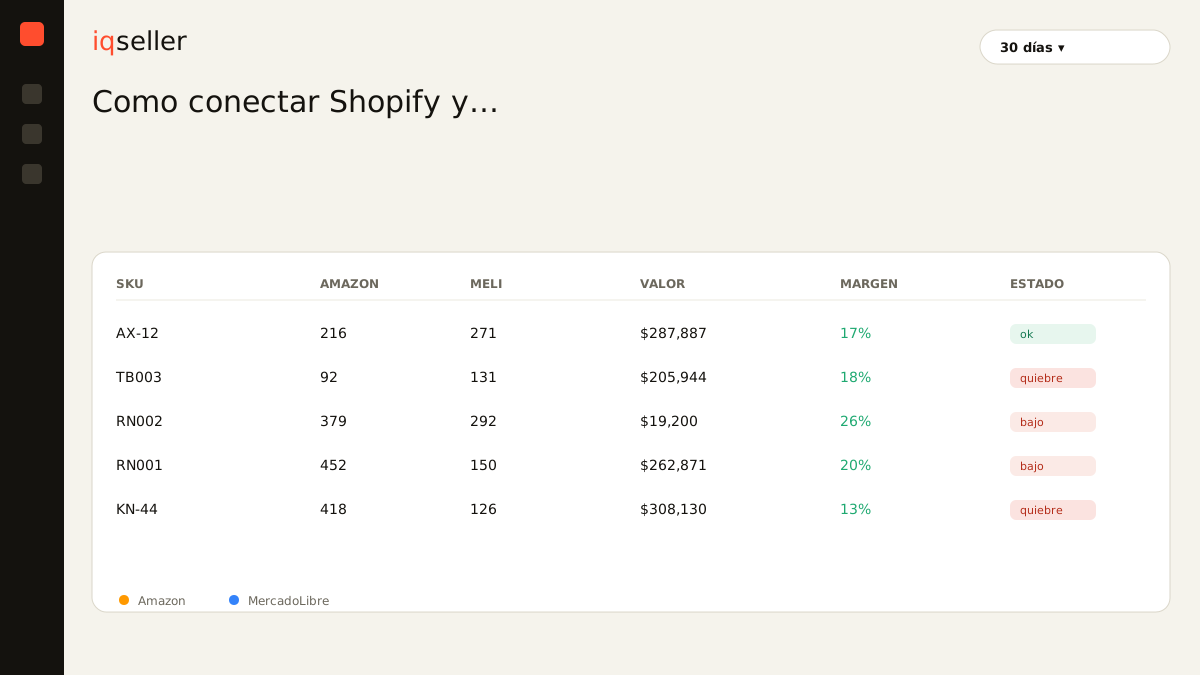
Connecting Shopify and MercadoLibre without double work means the sales from both channels arrive already added up, in real time, on a single dashboard. Not “export and consolidate”: see. How much you sold today in total, which product pulls on which channel, where margin is eroding. That single source of truth is what lets you truly compare —not by feel— whether your D2C store is growing or whether all your sales depend on the marketplace.
And comparing for real includes understanding acquisition cost. On MercadoLibre you pay commission and sometimes ads; on Shopify there’s no marketplace commission but there is ad spend to drive traffic to your domain. That’s why it pays to read both channels through the same profitability lens: see what is ACoS so you don’t confuse a channel that sells a lot with a channel that keeps a lot.
real availability and price don’t copy from one channel to the other
A natural —and costly— reflex is to copy Shopify’s price straight to MercadoLibre. But the fees aren’t the same: on MercadoLibre you pay a percentage per sale (plus shipping cost depending on the listing type), while on Shopify your variable cost is mainly the payment gateway and advertising. The same list price can leave you 28% margin in your own store and 11% on the marketplace.
Connecting the two channels properly includes translating your price into the right pricing for each platform: you start from the net margin you want to keep, subtract that channel’s specific fees and its logistics, and only then set that listing’s price. Doing this by hand per SKU and per channel is exactly the kind of work that duplicates. Doing it from a single cost model that already knows Shopify’s and MercadoLibre’s fees is what makes it sustainable when you have dozens or hundreds of products.
protect the brand: same product, different tone per channel
Unifying the catalog doesn’t mean cloning the listing word for word. On Shopify you write for your brand: your own tone, storytelling, lifestyle photos, the voice you built. On MercadoLibre you write for the algorithm and for a buyer who’s comparing: a title with the terms people search, complete attributes, a clear spec sheet, the right category.
The key is to separate what must be identical from what can vary. Identical: the physical product, the cost, the EAN, the inventory, the internal SKU. Can vary: title, long description, photo order, price per channel. With a unified catalog you define the identical part once and adjust per channel only what makes sense to adjust, without re-capturing anything. That keeps “keeping both storefronts consistent” from becoming another manual Sunday chore.
start with your best SKUs, not the whole catalog
You don’t have to move your entire Shopify store to MercadoLibre on day one. The way to connect the two channels without blowing up your operation is in layers: start with a handful of products you already know sell and that have healthy inventory, publish them on MercadoLibre linked to the ones that already exist in Shopify, measure them, learn how that audience behaves, and only then add the rest.
A unified catalog makes this trivial, because adding a channel is adding a face to products that already exist, not re-capturing them. And if you plan to launch MercadoLibre ahead of a strong season, don’t open it at the peak: connect it earlier, with a few SKUs, and let the system build sales history from both channels so your restocking reacts to the combined pace and not to one side alone.
from two dashboards to one operation
The real shift is a mindset one. MercadoLibre isn’t “another account to tend” on top of your Shopify; it’s another storefront onto the same inventory, the same catalog, and the same numbers. When those three pieces live in a single source of truth, connecting Shopify and MercadoLibre stops duplicating the effort and starts multiplying the reach with the work you already do.
For the Mexican seller who sells —or wants to sell— on Shopify, MercadoLibre, Amazon, and through a 3PL, this is what separates growing from just getting tired. The goal of iqseller isn’t to hand you one more dashboard; it’s to take away the loose dashboards and leave you a single one, in real time, where publishing on another channel is a business decision and not an operational sentence.