
How to Prevent Overselling Between Amazon and MercadoLibre
August 20, 2026
There is only one real way to prevent overselling between Amazon and MercadoLibre: make both channels read the same available-stock number, so that a sale on either one deducts instantly on the other. As long as Amazon keeps its own count on one side and MercadoLibre keeps its own on the other, there will always be a window where two buyers can grab the last unit at the same time. The fix is not to publish fewer units out of fear, nor to reconcile your inventory by hand every morning: it is to have a single source of availability that both marketplaces respect in real time.
If you sell the same product on Amazon and on MercadoLibre, each platform has its own snapshot of how many units you have left. Those snapshots are not taken at the same moment. You sell three units on Amazon on a Tuesday afternoon, and until your system tells MercadoLibre, that channel still believes all three units are available. In that gap —seconds or minutes, depending on how everything is connected— someone buys something on MercadoLibre that no longer exists. Nobody cheated; the two channels simply never shared the same number.
This article is a practical guide to closing that window. You will understand exactly why overselling happens between these two marketplaces, what it costs you when you ignore it, and how syncing based on real available stock eliminates it without forcing you to undersell out of caution.
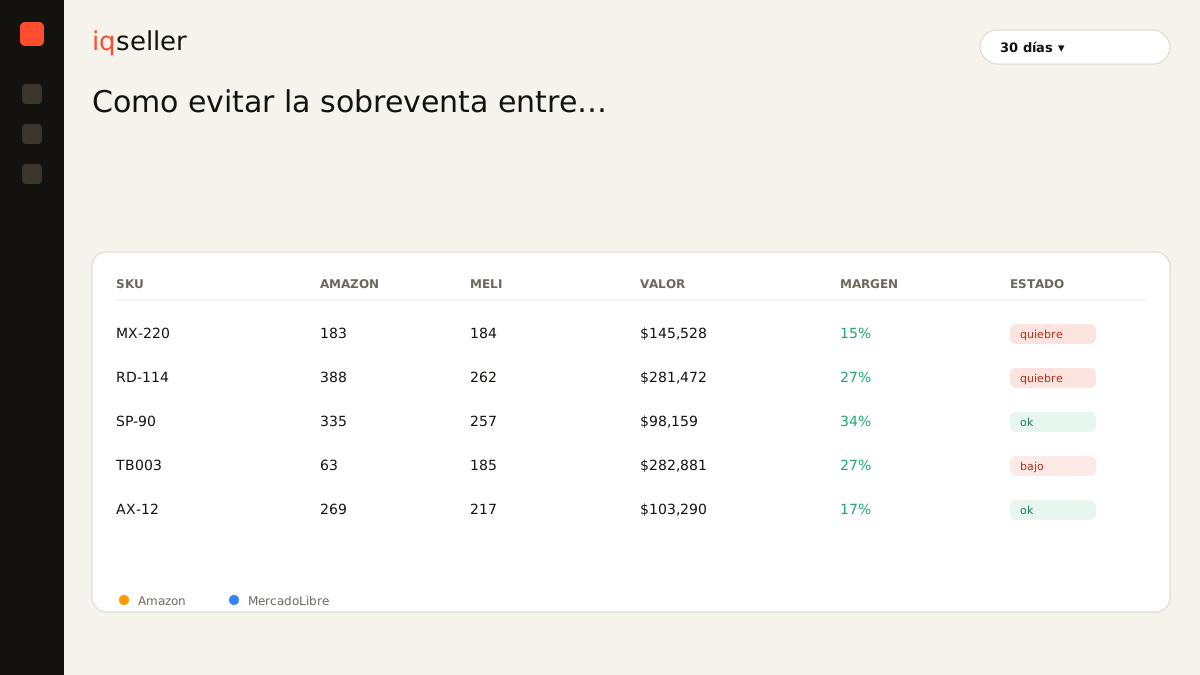
why overselling is born between two channels, not one
A single channel almost never oversells itself. Amazon knows how many units it has and deducts them one by one; MercadoLibre does the same with its own. The problem shows up when the same physical stock —the units sitting in your warehouse or at a 3PL— is offered in two places that don’t talk to each other.
Imagine you have 5 units of a SKU and you list them in full on both channels: 5 on Amazon and 5 on MercadoLibre. On paper it looks like you have 10, but physically there are only 5. All it takes is for 3 to sell on one channel and 3 on the other at nearly the same time, and you have promised 6 units out of 5. That sixth sale is the oversell, and no mistake of yours caused it: it was caused by neither marketplace knowing what was happening on the other.
The immediate temptation is to split the stock by hand —“I’ll put 2 on Amazon and 3 on MercadoLibre”— but that only swaps one problem for another. Now you sell fast on Amazon, the 2 run out, and you have 3 units stranded on MercadoLibre that you can’t move because you reserved them there. Splitting inventory kills overselling in exchange for lost sales. It’s not a solution; it’s a bad trade.
the duplicated-inventory mistake
Almost every multichannel seller starts out making the same mistake without realizing it: they publish the total number on each channel. It’s logical, because each platform asks “how many units do you have?” and you answer with the truth —5— without thinking that you already gave that same truth somewhere else.
The result is a phantom inventory: the sum of what you publish is larger than what exists. As long as you sell slowly, nothing happens and you think everything is fine. Overselling is treacherous precisely because it doesn’t show up on quiet days. It shows up the day the product gets popular, or during a peak like Hot Sale or Buen Fin, when simultaneous sales on both channels spike and the duplicated inventory settles all its accounts at once.
That’s why overselling isn’t a “set the numbers right once” problem. It’s an architecture problem: as long as each channel keeps its own count, today’s correct number will be the wrong number two hours from now. What you need isn’t better reconciling, but a single place where stock lives and that both channels only read from.
what each oversell costs you
The most direct cost of overselling is the cancellation, and it’s no minor formality. On Amazon, canceling for lack of stock hits your seller cancellation rate, a metric the platform watches closely; stacking up cancellations can end in account suspension. On MercadoLibre, failing to fulfill a sale hurts your reputation and your position in the listing, which is exactly what holds up your visibility. A mishandled Glossary: stockout → doesn’t just cost that sale: it costs the next ones, because you get pushed down in the results.
There’s a second cost, quieter. Because you don’t trust your number, you start operating out of fear: you publish fewer units than you have so you don’t risk it, or you split the stock across channels as in the example above. That caution has a real price in sales you leave on the table. Overselling, then, charges you twice: when you sell too much and have to cancel, and when you sell too little out of fear it will happen again.
And there’s the cost of your time. Without a single source, your routine becomes opening Amazon Seller Central, opening the MercadoLibre panel, exporting to Excel, and reconciling by hand how many units you really have left. That daily ritual of pulling the information together is the invisible tax paid by whoever doesn’t have inventory synced. And it’s a tax that grows with every SKU and every new channel.
real available stock, not paper availability
The key piece to end overselling is distinguishing between what you say you have and what you actually can sell right now. Glossary: real available → is the number left after subtracting everything already committed: paid orders not yet shipped, set-aside units, reservations from another channel. That is the only number both marketplaces should see.
When Amazon and MercadoLibre read real available stock instead of paper availability, overselling stops being possible by design. A sale on Amazon lowers the real available, and MercadoLibre sees that lower number immediately. There are no two counts to reconcile because there’s only one. You publish 5 on both channels knowing they represent the same 5 units, not 10, because the moment one sells, both listings show 4.
The difference between real available and paper availability is the difference between operating with the truth and operating with an optimistic sum. The optimistic sum works until two buyers arrive at the same time; the truth works always.
why real time is what closes the window
Having a single number isn’t enough if that number takes time to propagate. The overselling window measures exactly the time between selling on one channel and the other finding out. If that propagation takes seconds, the window is so small that two sales almost never fit inside it; if it takes several minutes, during a peak many fit.
This is where it helps to understand that “real time” is a range, not an instant promise, and that lag is not a defect but the physics of integrations. How long it takes depends on the connection mode —webhooks that notify instantly versus polling that asks every so often—, on the call limits the Amazon and MercadoLibre APIs impose, and on how many SKUs you’re moving. It’s worth measuring your real lag and understanding how often your inventory updates and why the lag matters, because that number tells you how exposed you are.
The rule is simple: lag only matters relative to your sales speed. A product you sell once an hour tolerates a lag of minutes without risk. A product you sell every minute with only 3 units left needs the tightest possible sync, because you’re right at the edge. That’s where Glossary: days of inventory → helps you prioritize: the SKUs with few days of inventory and fast sales are the ones that demand fine-grained real time, and the ones that will hurt most if they oversell.
how a single source of stock solves it
The way to kill overselling between Amazon and MercadoLibre isn’t updating each channel separately more often, but having a central inventory both draw from. Instead of Amazon and MercadoLibre each keeping their own count and then trying to reconcile, there’s a single source of availability that deducts the unit at the instant of sale and pushes the new number to both channels at once.
With that model, the question changes. It’s no longer “how do I split my 5 units across channels?” but “I publish all 5 on both and the system makes sure no more than 5 sell in total.” Inventory stops being a sum of counts you have to watch and becomes a single number that propagates on its own. That’s what iqseller does: keep a single source of real available stock so that Amazon and MercadoLibre always see the same inventory, without you opening three dashboards or reconciling anything in Excel.
The result isn’t magic or “zero lag” —that doesn’t exist— but an overselling window so short and so known that it stops being a risk. You publish your entire inventory on both channels without fear, you stop splitting units and losing sales, and you stop discovering at the worst moment that you sold someone something you no longer had. That, in the end, is the point of syncing Amazon and MercadoLibre: not promising the word “instant,” but making sure the two channels never fight over your last unit.