
What Is Real-Time Inventory and Why It Changes Your Selling Decisions
July 4, 2026
Real-time inventory is a count of your available units that updates the instant a movement happens: a sale on Amazon, an order on MercadoLibre, a return coming back to the warehouse, an adjustment from your 3PL. It is not a report you download every morning or a spreadsheet you refresh when you remember. It is a live number that reflects what you actually have right now, not what you had six hours ago. That gap between “now” and “six hours ago” is exactly where your two worst headaches are born: running out of a product without noticing, and selling someone something that no longer exists.
For a multichannel seller the problem is not missing information, it is that the information is split. The same knee brace lives as an ASIN in Seller Central, as a listing with its own MLM in MercadoLibre, and as a stock line in the 3PL dashboard. Each one counts on its own and none of them tells the others when something moves. When you stitch it together by hand — three tabs open, figures copied into a spreadsheet — the number you use to set today’s price and reorder was already stale the moment you wrote it down. Real-time inventory changes your selling decisions because it removes that lag: you stop working with the echo of yesterday’s sales and start deciding on what is happening this second.
In this article we will define what it actually is, how it works underneath, how it differs from an inventory that is merely “updated daily,” and above all why that change in timing transforms concrete decisions: when to reorder, what price to set, how much to publish on each channel, and when to stop selling something before it gets you in trouble.
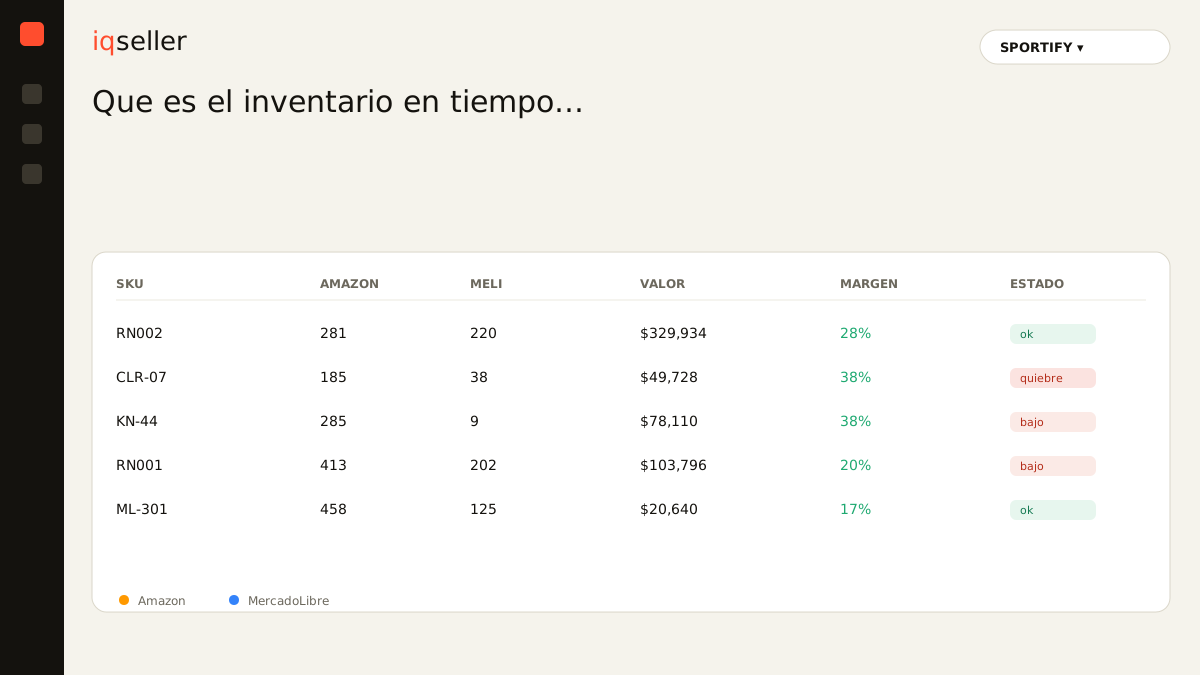
what “real-time” means and what it doesn’t
“Real-time” does not mean magical or instant to the nanosecond. It means the system reacts to the event, not to the clock. A traditional inventory works in batches: at 6 a.m. a job runs, gathers yesterday’s sales, and leaves you a number that is true for a few minutes and wrong for the rest of the day. A real-time inventory works by events: when Amazon confirms a sale, that webhook arrives, the unit is deducted, and the number changes for every channel at the same time, without waiting for sunrise.
The distinction matters because your sales do not happen in batches. They happen when the buyer decides, often in bursts: five orders in ten minutes during a promotion, three cancellations in a row, a return that comes back in. A batch count averages all of that away and hides the spikes precisely when they are most dangerous. Real-time inventory does not average: it shows you the jump the moment it happens.
It is worth being clear that “real-time” always carries some latency: the time it takes the marketplace’s notice to arrive and be processed. Handled well, that latency is seconds or a few minutes, not hours. The difference between seconds and hours is what decides whether you oversell or not, which is why it pays to understand how often it updates and why the lag matters.
Glossary: available real is the sum of the physical units of a master SKU, counted once and with committed orders already deducted, no matter how many channels it is published on.the single pool: why 40 is not 40 plus 40
Here is the heart of it. Say you have 40 black medium knee braces at the 3PL. The temptation is to publish 40 on Amazon and 40 on MercadoLibre, because each channel asks for a number and you have 40. But you do not have 80 units: you have 40 that either channel can sell. When you sell 30 on Amazon, you have 10 left in reality, but Meli still shows 40 because it never found out. Order number 35 on Meli comes in, you have nothing to fulfill it with, and you eat a cancellation that hurts your reputation.
Real-time inventory solves this by treating the 40 units as a single pool that is deducted wherever the sale comes from. Amazon sells, the 40 drops to 39 for everyone; Meli sells, it drops to 38 for everyone. Each channel always offers what is truly left, not an optimistic copy of the number. Overselling stops being a structural possibility and becomes a mistake the system prevents on its own.
What makes this hard to do by hand is not the subtraction — anyone can subtract — it is the speed. By the time you copied the new number into your spreadsheet and pushed it to both channels, you already sold three more units and your adjustment was born wrong. Real-time closes that window: the deduction and the sync happen together, with no hands in between.
from a live number to a decision: reordering
An up-to-date number is useless if it does not change what you do. The first decision it transforms is reordering. With batch inventory, you find out you are running short when it is already late: the morning report says 8 units, but by the time you read it you already sold 6 and you are on the edge of a stockout. With real-time you watch the available count fall live and, more importantly, you see the speed at which it falls.
That speed is what turns a number into a date. If you have 40 units and sell 5 a day, you have eight days of inventory; if you suddenly sell 12 a day because you entered a promo, you have a little over three. Real-time inventory feeds that calculation with fresh data instead of last month’s average, which is why the reorder alert reaches you while you can still do something about it. For a step-by-step way to work out that coverage, see the guide on how to calculate stock coverage for your products.
Glossary: days of inventory is how many days of sales you have left at the current pace; you get it by dividing available real by the daily sell-through rate.the pricing decision depends on stock too
We tend to think of price as a matter of margin and competition, and we forget that stock rules as much as the fee. A product with two days of inventory and a product with ninety days should not share the same pricing strategy, even if they cost the same. Do not drop the price on the one that is running out to sell it faster: you will burn through it before you can restock and lose sales you already had won. The one you have too much of is worth moving, even at some margin sacrifice, so storage does not eat it.
Without real-time inventory this logic is impossible to apply well, because you do not confidently know which situation each SKU is in right now. You set the price with yesterday’s stock and end up cutting the price on exactly the one you barely have left. With the live number, price and availability are read together: you raise the price on the one that is running out to slow the outflow and protect the last units, and you push the one you have in surplus. Real-time inventory turns price into an informed lever rather than a hunch.
when to stop selling: the controlled stockout
There is a moment every seller hates and almost nobody manages well: the instant when you should stop selling. Without live data, that instant catches you by surprise; it arrives as an order you cannot fulfill. With real-time inventory you can decide it yourself: when available real hits a certain floor, the system can pause the listing or lower the published quantity before the order that would break you comes in.
That is a controlled stockout instead of an accident. You would far rather have a product show as out of stock for a few hours — something the marketplace understands and does not penalize — than sell it and cancel, which does penalize you and does upset the buyer. The difference between the two is, again, timing: you can only stop in time if the number you see is the one for now.
Glossary: a stockout is running out of available units of a SKU; controlled, it is you who pauses the sale; accidental, it is the marketplace that cancels the order for you.what you actually need to have it
Having real-time inventory is not just flipping a switch; it takes three things fitted together. First, a master SKU that recognizes the ASIN, the MLM and the 3PL code as the same box; without that there is no pool to sync. Second, event-based connections to each channel — webhooks or frequent polling — so the sale registers immediately, not in the morning cutoff. Third, a clear deduction and reservation rule: what happens when an order is paid but not shipped, how returns coming back in are handled, how committed units are set aside so they are not sold twice.
When those three pieces are in place, the effect is that you stop managing three parallel inventories and start managing a single one that spreads across channels. No more tabs, no more spreadsheet that goes stale while you type it, no more decisions made with yesterday’s echo. That, at bottom, is why real-time inventory changes your selling decisions: it does not give you more numbers, it gives you the right ones at the only moment they help, which is before you decide.