
Real-time inventory: the end of 'yesterday's stock'
June 9, 2026
Ask any multichannel seller how much inventory they have of their best product, right now, and you’ll get an awkward pause. Almost nobody knows for sure. They know what the morning spreadsheet said, or what Amazon showed last time they logged in, or what the 3PL reported by email on Friday. All of that is yesterday’s stock. And in e-commerce, selling on yesterday’s data is like driving while looking in the rear-view mirror.
Real-time inventory changes that relationship. It’s not a technical luxury: it’s the difference between promising what you have and promising what you had.
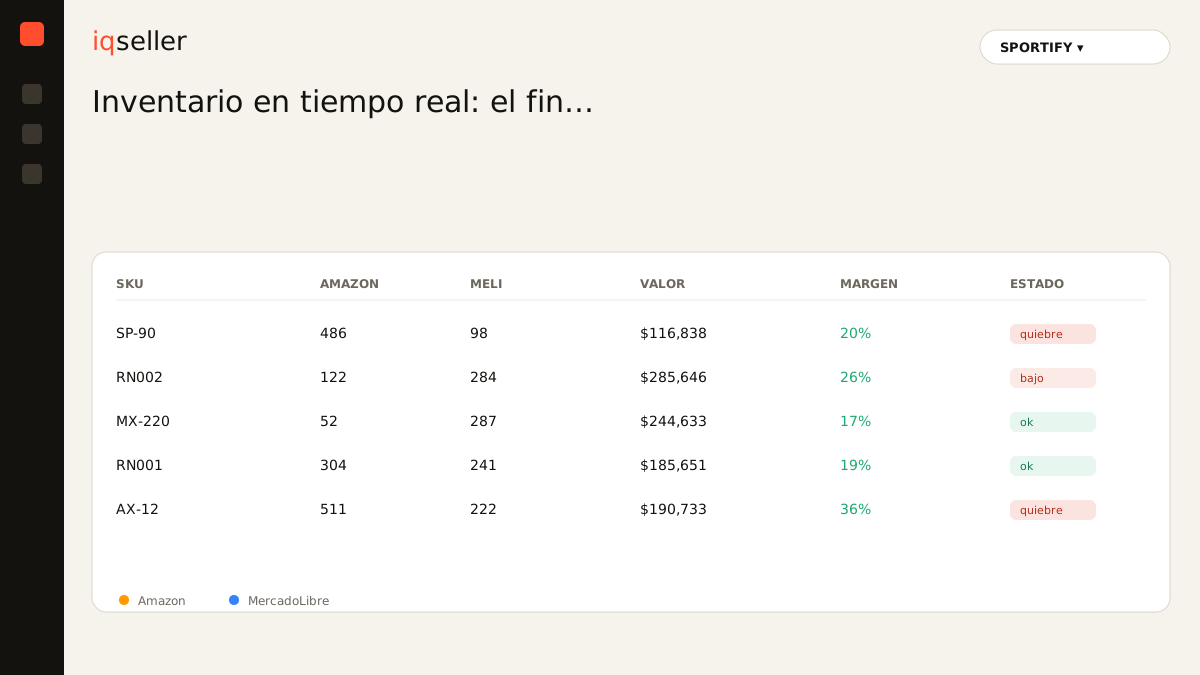
The “yesterday’s stock” problem
When the same physical product lives in Amazon FBA, MercadoLibre Full and a 3PL, its inventory is split. To get a complete picture you have to log into each panel, jot down numbers, and sum them in a sheet. By the time you finish, you’ve sold three more units on one channel and gotten two returns on another. The snapshot was born stale.
That lag has two expensive consequences: overselling (you promise something that’s gone, and cancel) and invisible stockouts (you run out of sellable stock without noticing until the listing pauses). Both hit the same thing: your reputation and your ranking.
Dictionary: what real-time sync is →Real available, not total stock
The metric that matters isn’t “how many units do I have in total,” but how many can I promise today without overselling. That’s real available: total minus reserved, in-transit and non-sellable. Naïvely summing what each channel reports inflates the number and leads you to error.
Real-time inventory starts from a unified catalog —the same physical product identified by EAN/GTIN across all its listings— and computes the consolidated real available. Only then do the numbers mean something.
Dictionary: real available vs total stock →Real-time valuation: how much capital is tied up
There’s a question almost never answered in time: how much is my inventory worth right now, and where is it? Most people know at month-end, when they can no longer do anything about it. Real-time inventory valuation shows you the monetary value of your available stock —per product and per channel— live.
That changes concrete decisions: you see how much capital is “asleep” in a 3PL, which SKUs concentrate your money, and where you have excess worth moving with a laddered offer before it becomes dead inventory.
Dictionary: real-time inventory valuation →Detecting stockouts in time
The most tangible advantage of real time is anticipating the stockout. With real available and sales velocity, the panel computes each product’s days of inventory and fires an alert when they cross your threshold —not when they already hit zero—. The difference is huge: restocking in time vs. losing ranking and paying weeks to recover it.
A stockout caught in time also gives you options: redirect sales to another channel that does have stock, expedite an order, or pause ads on a product about to run out so you don’t waste the spend.
Dictionary: stockout and why it costs double →Real time connects everything
Real-time inventory doesn’t live alone. It’s the data that feeds the forecast (without real available, the reorder point lies) and the price calendar (an offer that ignores stock is a recipe to run out mid-demand). It is, literally, the operation’s source of truth.
And for the team, it means no more arguing “how many do we have?” with three different figures on the table. There’s one figure, live, the same for everyone.
From uncertainty to certainty
The deep change is emotional as well as operational: uncertainty ends. You stop guessing how much you have, stop discovering stockouts late, stop closing the month just to learn where your capital is. You see your business as it is today, not as it was yesterday.
For a growing seller, that change is what makes it possible to scale from 100 to 1,000 SKUs without losing control: because control no longer depends on how many tabs you can review, but on a panel that’s always up to date.