
Automatic price calendar: drop to sell, raise to win margin
June 11, 2026
Price is the fastest lever a seller has to move profitability. It’s also the easiest to ruin. Most multichannel sellers manage price “by hand”: they drop it for a promo, forget to raise it back, and weeks later discover their best product has spent a month selling at the offer margin. Profit evaporates in silence.
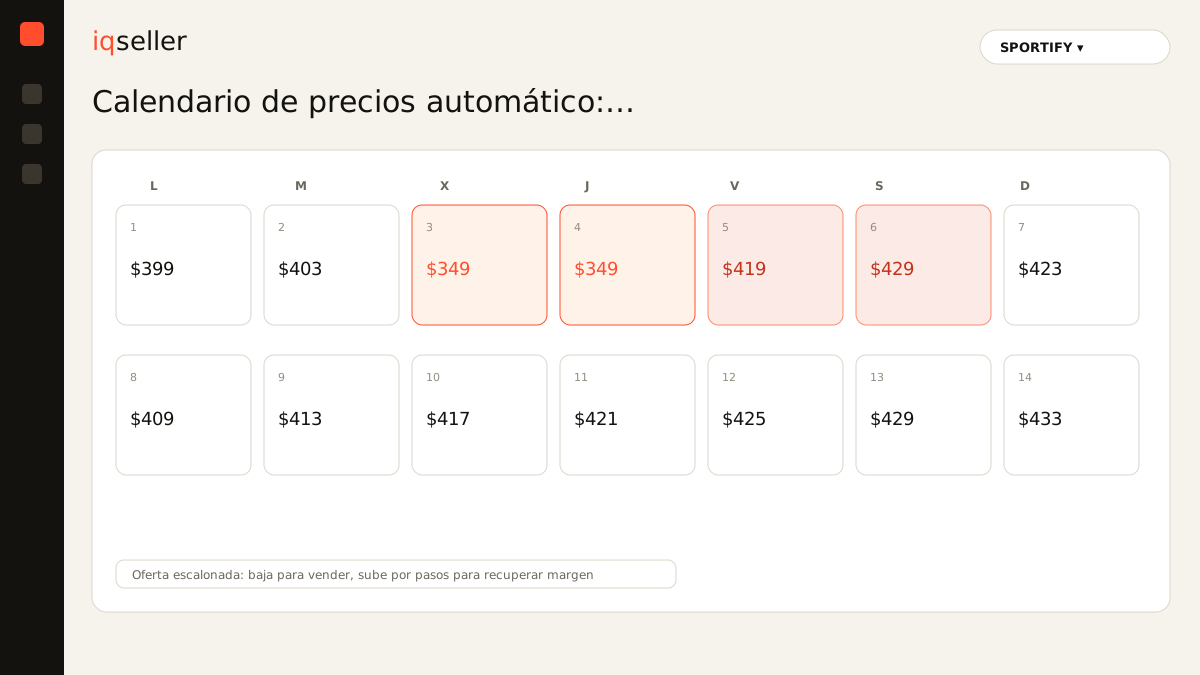
An automatic price calendar exists so that doesn’t happen. It’s not just scheduling a discount; it’s designing a sequence of prices over time —per product and per channel— that captures demand while it’s hot and recovers margin afterward, without you having to remember anything.
The problem with moving prices by hand
When you sell on Amazon and MercadoLibre at once, each platform has its own screen to change prices, its own promotions and its own fees. Coordinating a “flat” offer across both channels, remembering to revert it, and doing it for dozens of SKUs… is exactly the kind of task that falls through. A price you forgot to raise is money left on the table, every day, until someone notices.
Dictionary: what a price calendar is and why to automate it →The laddered offer: drop to sell, raise to win
The core idea is simple and powerful. A laddered offer does three things in sequence:
- Drops the price for a few days to drive sales and gain traction —more units, better ranking, more reviews—.
- Raises the price in steps, not all at once. Instead of jumping from $449 to $539, it passes through $469, $489, $519… The buyer doesn’t feel a jump and you don’t kill the sales momentum.
- Tracks the effect: how many units each step moved and what happened to margin at each level.
The result is that you capture the demand spike and end up selling at a higher price than the offer. It’s the difference between “I ran a promo” and “I designed a margin recovery.”
Dictionary: laddered offer, step by step →Why price is computed per channel
Here’s an expensive trap: setting the same price on every channel. Amazon and MercadoLibre fees differ, and FBA or Full costs differ too. A price that leaves 26% margin on one channel can leave 11% —or less— on the other. The calendar has to start from real net margin per channel, not a “pretty” flat number.
Dictionary: real net margin, with everything deducted →Product tracking: knowing what worked
Scheduling the offer is half of it. The other half is seeing the effect in real time. How many units did the $469 step move? Did margin hold when you raised to $519? At what point did velocity drop? Without that tracking, you repeat promos on intuition. With it, every campaign teaches you something for the next: the next peak season you don’t start from zero, you start with data.
And because the panel sees both channels together, you catch things you’d miss by hand: a price drop on MercadoLibre you didn’t make (a competitor, a catalog change) fires an alert before it erodes your margin.
The link to inventory
A price calendar that ignores inventory is dangerous. What good is an aggressive offer if you run out of stock halfway through? That’s why pricing and restocking have to talk: if your forecast says a product has 14 days of inventory, a promo that doubles velocity leaves it in a stockout within a week —and a stockout mid-offer is the worst thing that can happen: you’re paying ads to send traffic to something no one can buy—.
The smart play aligns all three pieces: offer price when stock is plenty, step the price up as inventory drops, and the restock already on the way before the calendar asks you to sell hard.
From uncertainty to control
The deep change isn’t “automating discounts.” It’s going from reacting to designing. Instead of remembering —or not— to raise a price, you define the sequence once and the panel executes it, measures it and alerts you. Margin stops depending on your memory.
For the seller on Amazon and MercadoLibre, where each channel pulls its own way, an automatic price calendar is one of the few tools that improves profitability without selling a single extra unit: it simply stops giving margin away.