
Inventory forecast in depth: from data to purchase order
June 12, 2026
There’s a scene every multichannel seller knows: it’s 11 p.m., you have five tabs open —Amazon Seller Central, MercadoLibre, your 3PL portal, the supplier email and, of course, a spreadsheet— and you’re trying to guess how much to order of your best product. It’s not a calculation, it’s a hunch. And the hunch costs you sooner or later: either you run out of stock during peak demand, or you bury your capital in goods that don’t move.
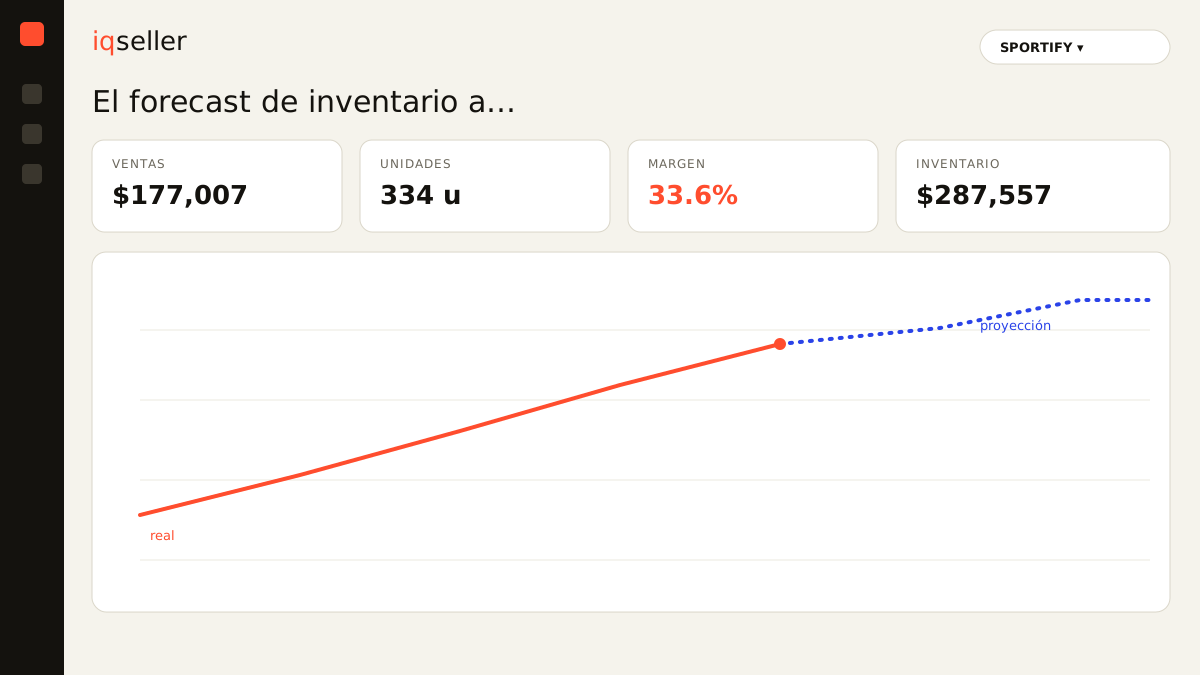
The inventory forecast exists to kill that hunch. But “forecast” sounds complicated, like a statistical model only a data scientist understands. It isn’t. A good forecast answers, per product and per channel, two concrete questions: when do I order? and how much do I order? Let’s go deep.
The three numbers that move everything
A forecast doesn’t need a hundred variables. It needs three, measured well:
- Sales velocity. How many units you sell per day, on average, ideally from recent weeks and not the whole year. A seasonal product misleads you if you average it over 12 months.
- Lead time. How many days pass from ordering until the product is sellable —not when it reaches your warehouse, but when Amazon or MercadoLibre receive and list it—. Includes production, transit and inbound.
- Safety stock. The buffer for days when you sell more than usual or the supplier is late.
When do I order? The reorder point
The first question has an exact answer:
Reorder point = (Sales velocity × Lead time) + Safety stock
When your real available hits that number, it’s time to order. Not earlier —you tie up money— nor later —you risk a stockout—. If you sell 8 units a day, your lead time is 30 days and you want a 5-day buffer, your reorder point is (8 × 30) + (8 × 5) = 280 units. The moment you drop below 280, the order should be going out.
The problem with the spreadsheet isn’t the formula —you copy that once—. The problem is that velocity changes every week, lead time changes with each supplier, and real available changes with every sale on every channel. Keeping 280 updated by hand for one SKU is tedious; for 300 SKUs it’s impossible. That’s why the calculation has to live in the panel, recalculating itself.
Dictionary: reorder point, the formula that avoids stockouts and overstock →How much do I order?
The second question is just as concrete. The simplest thing that works: cover the period between orders plus the lead time, and subtract what’s already on the way.
Quantity = Velocity × (Coverage days + Lead time) − Current stock − In transit
That “− In transit” is the detail almost no one puts in their spreadsheet, and the reason things get ordered twice. If you already have 200 units sailing, don’t order them again.
Why “real available” changes everything
Here’s the most expensive mistake: calculating the forecast on total stock instead of real available. The total sums everything each channel reports; real available subtracts reserved, in-transit and non-sellable units. If your forecast uses the total, you’ll believe you have more inventory than you can actually sell, and you’ll restock late.
In a multichannel operation this gets harder because the same physical product has split stock: part in Amazon FBA, part in MercadoLibre Full, part in your 3PL. Summing them naïvely lies. A serious forecast starts from inventory unified by physical product —not by listing—.
Dictionary: real available vs total stock →Days of inventory: your countdown
There’s a metric that turns the forecast into something you grasp at a glance: days of inventory.
Days of inventory = Real available ÷ Sales velocity
If you have 120 units and sell 8 a day, you have 15 days left. And if your restock lead time is 30, the conclusion is brutal: you’re already in a guaranteed stockout, you should have ordered two weeks ago. Seeing days of inventory per product, every day, is the difference between restocking in time and finding out when the listing already paused —with the ranking drop that takes weeks to recover—.
From uncertainty to purchase order
Put the pieces together and the picture changes. Instead of five tabs and an 11 p.m. hunch, you have a single view telling you: “RN001 is at 14 days of inventory, crossed its reorder point; at the current pace and with your lead time, order 600 units —minus the 0 in transit— this week.” That’s no longer guessing. It’s deciding.
And because the forecast feeds on real-time data, today’s recommendation isn’t yesterday’s snapshot. When a product takes off —a Hot Sale spike, a mention that goes viral— velocity rises, days of inventory drop and the alert fires before you fall short.
What a well-built forecast takes off your shoulders
- The restock spreadsheet only you understand, that breaks with every mis-pasted cell.
- The fear of running out of your best product right in season.
- The dead capital in goods that don’t move.
- Negotiating with your supplier blind: with real velocity and coverage, you order with arguments.
A forecast isn’t a big-company luxury. It’s the tool that gives the multichannel seller back control over the most expensive question in their operation: how much to order, and when.