
How to restock sizes and colors based on what actually sells
July 30, 2026
To restock sizes and colors correctly, there is exactly one rule: don’t restock by product, restock by combination. Size M in black and size M in red are two different SKUs that sell at different speeds, and treating them as “one model” is what leaves you with piles of the variant nobody wants and stockouts of the one everybody’s after. The short answer: measure the real sales of each size-color separately, calculate how many days of inventory each one has left, and order restock only for the ones that actually move.
The problem is that almost no seller does this, not because they don’t want to, but because pulling that information together by hand is a nightmare. Amazon shows you sales by SKU in one report, MercadoLibre in another, your Shopify store in a third, and the 3PL emails you a stock spreadsheet that was already stale on arrival. To know whether M-black is running out you have to open four screens, export, paste into a sheet, and cross-reference by hand. By the time you’re done, the numbers have already changed.
This article is about flipping that around: going from “restocking from memory” to restocking with real sales per variant in front of you, in real time and with channels summed together. It’s not magic — it’s just refusing to lose the signal you already have, scattered across dashboards.
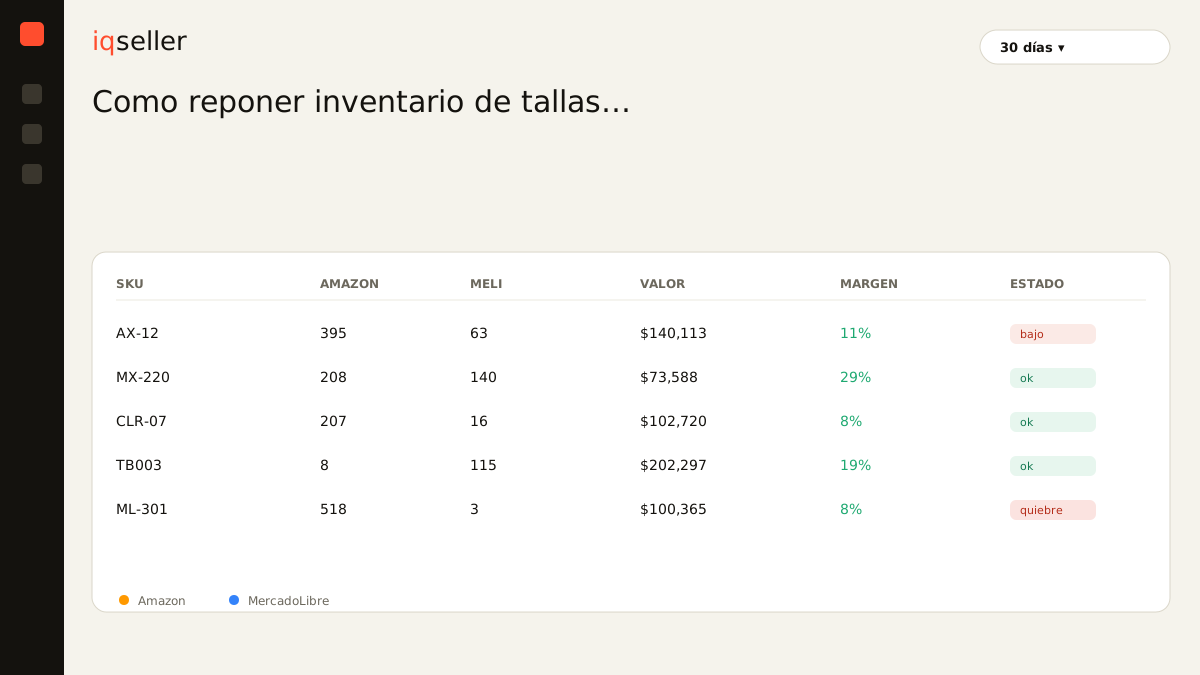
why the model average lies to you
When you see “Basic tee: 320 units sold this month” it feels like the product is doing great. But that 320 is an average that hides the truth. Inside it there might be 140 units of M-black, 90 of L-black, 60 of M-white… and 2 of XL-yellow that have been sitting there for four months. You restock “the tee” with the same logic across every size and color, and you end up buying more XL-yellow that will never move while you run out of M-black on a random Tuesday.
The model average is comfortable but dangerous. Demand doesn’t belong to the product, it belongs to the combination. A customer who wants M-black won’t buy XL-yellow just because “it’s the same tee”: either they find their size and color, or they leave. That’s why the smallest unit for a restock decision should never be the model, but each size-color as its own SKU with its own sales velocity.
Glossary: EAN / GTIN, the code that identifies each variant →measure sales velocity by size-color
The metric that matters isn’t “how many did I sell,” it’s “how fast do they go.” Sales velocity — units per day for each combination — is what tells you how much inventory you need and when. An M-black moving 6 units a day with 30 in stock has 5 days of life; an XL-yellow moving 0.1 a day with 12 in stock has four months of dead inventory.
To get it right you need that combination’s sales summed across all your channels. If you sell M-black on Amazon, on MercadoLibre and on your Shopify, its real velocity is the sum of all three, not the figure from a single channel in isolation. This is exactly where the multichannel seller gets stuck: each platform counts its own slice, and without a view that merges them, you underestimate demand for your best variants and come up short on precisely what sells most.
With unified sales by size-color you can sort your variants from fastest to slowest and see, at a glance, where your restock money should go. The ones at the top you reorder no matter what. The ones at the bottom, the ones that haven’t moved in weeks, are candidates to liquidate, not to buy again.
Glossary: unified catalog, one real product and many listings →calculate the restock: days of coverage, not round bundles
Once you have sales velocity per combination, restocking becomes simple arithmetic instead of a hunch. The base formula is: units to order = (daily velocity × desired days of coverage) + safety buffer − current stock − units already inbound.
“Days of coverage” depend on your lead time: how long your supplier or 3PL takes to make the merchandise sellable again. If restocking M-black takes 21 days, you need to cover at least those 21 days plus a buffer, or you’ll stock out before the restock arrives. That calculation has to be per variant, because each size-color sells differently: it makes no sense to order 21 days of XL-yellow (which would be 2 units) with the same urgency as 21 days of M-black (which would be 130).
The classic mistake is rounding to “bundles” or comfortable numbers: “I’ll order 100 of each size.” That ignores real demand and fills you back up with what doesn’t sell. The right quantity comes from each combination’s velocity, not from the supplier’s carton size. If you want to sharpen it further, this analysis gets far more powerful when you cross it with seasonality and with the automatic price calendar: a promo that doubles M-black’s velocity completely changes how much you need to restock that week.
don’t confuse “in stock” with “sellable right now”
There’s an expensive difference between the units your system reports and the ones a customer can actually buy this moment. Merchandise in transit, under inspection, reserved by orders already placed, stuck in customs or in a warehouse that hasn’t registered it yet: all of that shows up as “inventory” but it isn’t real availability. If you restock looking at the total number instead of the sellable one, you either overbuy (because you counted units already committed) or stock out (because you counted units you can’t yet sell).
For sizes and colors this hits harder, because a single combination can be spread across Amazon’s warehouse (FBA), your own storage for Shopify, and the 3PL for MercadoLibre. M-black might have 40 units “in total” but 0 available in the channel where it sells most. The picture you need to restock is real availability per combination and per channel, not a grand total that adds apples to oranges.
Glossary: real availability, what can truly be sold →the manual flow versus the real-time flow
Here’s what the manual flow looks like, the one the multichannel seller lives today: log into Seller Central and export sales by SKU; log into MercadoLibre and export another report; open the Shopify admin; ask the 3PL for its stock spreadsheet; paste all four into a sheet; try to match up SKUs that each platform names differently; calculate velocity and coverage by hand; and by the time you’re done — assuming you didn’t fat-finger a formula — the information has already aged a day or two. You repeat that every week, for dozens of variants, and still restock half-blind.
The real-time flow inverts all of it: a single view where each size-color carries its sales summed across every channel, its real stock per warehouse, its days of coverage already calculated, and a clear signal of what to reorder, what to hold, and what to liquidate. Instead of spending Monday morning building the spreadsheet, you spend it deciding. The information is still yours and your channels’; what changes is that you stop rebuilding it by hand every time.
That’s the heart of restocking sizes and colors well: no memorizing, no exporting, no cross-referencing sheets. See the real sales of each combination in front of you and let the numbers — not a hunch, not the model average — tell you exactly how much to order of each size and each color.
what to do with variants that don’t move
Restocking well isn’t only ordering what sells; it’s stopping the drag from what doesn’t. Every week an XL-yellow takes up space in your warehouse or in FBA it costs you storage, and worse, it hides capital you could have invested in M-black. The discipline of managing by combination forces you to look at the long tail: the zero- or near-zero-sales variants that have been stagnant for months.
For those there are three paths, and none of them is “reorder”: liquidate with an aggressive discount (here the price calendar helps you drop without wrecking your other SKUs), move the stock to the channel where that combination does move, or discontinue the variant and pull it from the active catalog. What you can’t do is leave it there and reorder “because it’s part of the set.” A good size-color restock system shows you these dead variants as clearly as it shows you the stars, and keeping stock and price in sync across channels while you liquidate them is its own topic — we cover it in size and color variants: keeping stock and price in sync.
In the end, managing sizes and colors is a capital decision: every dollar you put into one combination is a dollar not in another. Restocking based on what actually sells — per variant, with channels summed, against real availability — is the difference between an inventory that works and one that just gathers dust.