
Inventory Financing for Sellers in Mexico: The Options and How to Evaluate Them
October 4, 2026
There’s an uncomfortable moment nearly every Mexican seller hits sooner or later: the business is doing well, products are turning, margin is healthy, and there’s still no money for the next purchase order. It isn’t a contradiction or an accounting error. It’s the normal mechanics of a business that sells inventory, and it explains why so many healthy operations stall precisely when they should be accelerating.
The reason is timing. You pay the supplier today — or in thirty days if you’re lucky — the container takes weeks to arrive, the unit sits in the warehouse for a month or two before it sells, and the marketplace deposits your money several days after that. Four months can pass between the peso leaving and the peso coming back as a peso and a half. During those four months your profit exists on paper and not in the bank.
That’s where the question behind this article comes from: is it worth financing inventory? It isn’t a question of faith or of an aversion to debt. It’s an arithmetic question with a different answer for every seller, every SKU and every moment of the year. Financing inventory that turns fast and contributes well can be one of the most profitable decisions you make. Financing inventory that turns slowly is the most expensive way to buy yourself a problem.
This article is educational and is not financial advice, nor a recommendation of any product or institution. The goal is that you understand how the options you’ll be offered are built, what questions to ask and what math to run before signing. The decision, with your numbers and your context, belongs to you and your accountant or a financial advisor.
why inventory eats your cash even when you’re profitable
It’s worth understanding the mechanism before shopping for a solution, because many sellers try to fix a turnover problem with credit.
When you buy a unit, your money changes form: it stops being cash and becomes a box on a shelf. It’s still yours, it’s still worth the same or more, but it can no longer pay payroll or fund the next batch. That money is immobilized until someone buys the product and the marketplace pays you.
Growth makes it worse. If you sell 30% more this month than last, you need to buy more than 30% extra just to stay level, because on top of the extra volume you have to cover replenishment time. In other words: the faster you grow, the more cash you’re short, even when every individual sale leaves a good margin. It’s the paradox that sinks businesses whose income statement looks spotless.
Financing exists to bridge that gap in time. Not a gap in profitability. If your product doesn’t leave enough margin, credit doesn’t fix it — it just makes the descent faster.
Glossary: inventory valuation, the capital sitting still →the four families of options
What you’ll be offered, under different names and different packaging, almost always falls into one of four categories. Recognizing them matters, because each solves a different problem.
Supplier credit. The oldest form of financing and often the cheapest: your supplier gives you time to pay. Thirty, sixty or ninety days between receiving the goods and paying for them. No financial institution is involved, and the “cost” usually hides as an early-payment discount you give up. If your supplier offers 3% off for paying cash and you take 60 days instead, that 3% is what the term cost you, and annualized it isn’t trivial. You earn it with track record and volume, and it’s where your own sales data does the most work at the negotiating table.
Revolving credit lines. An authorized amount you draw on and repay as many times as you want within the term. It’s the instrument that fits the rhythm of inventory buying best, because you pay interest only on what you’ve drawn and the amount frees up as you collect. Lenders usually ask for financial statements, credit bureau history and sometimes collateral or a personal guarantee, and the cost moves with market reference rates.
Receivables factoring. Here you aren’t borrowing: you’re pulling forward the collection of something you already sold. In the traditional world, an invoice is assigned to a factor who pays you most of it today and collects from the client later. In the marketplace world, the equivalent is advancing pending Amazon or MercadoLibre deposits. Mexican factoring specialists describe in 2026 that a typical operation advances between 80% and 95% of the document’s value, and that the cost is charged as a fee plus a discount rate that depends on the term, the volume and the credit quality of whoever will pay. Those same sources put Mexican market discount rates in a low single-digit monthly range, but that’s a range published by providers of the service, not an official figure, and it changes deal by deal: the only number that matters is the one quoted to you in writing.
Financing from the platforms themselves. Both Amazon and MercadoLibre run their own seller lending programs. Amazon publicly documents Amazon Lending as an invitation-only program, where the platform extends offers to selected sellers based on performance metrics, sales history and account health. MercadoLibre operates Mercado Crédito, which documents requirements around time selling, a reputation in green and credit history, with installment terms and disbursement into the Mercado Pago account. The exact conditions, amounts and rates of both programs change frequently and depend on your account: confirm them in Seller Central and in MercadoLibre’s help center, not in an article.
What’s attractive about platform programs is that the underwriting leans on data the platform already has — your sales — and collection is usually deducted from your own deposits. What deserves a careful look is exactly that: having payment deducted before the money reaches your account changes your weekly cash flow, and having credit tied to your seller account concentrates two risks in one place.
what lenders will ask for
It varies by institution and instrument, but the package repeats. It’s worth assembling before you need it, because the moment money is urgent is the worst moment to start gathering paperwork.
- Time in operation and a consistent sales history, not an isolated spike.
- Financial statements or, at minimum, tax filings and several months of bank statements.
- Credit history for the company and frequently for the owner as guarantor.
- Account health on the marketplace: reputation, performance metrics, no active restrictions.
- Clarity on what the money is for. A concrete purchase order carries more weight than “working capital”.
- Sometimes collateral: the inventory itself, assigned receivables, or a pledge.
The point isn’t the list, it’s what it reveals: whoever lends is buying your ability to turn inventory into cash. The better documented that ability is — turnover per SKU, real margin, replenishment history — the better the conversation. A seller who shows up with inventory valuation, turnover and net margin per product is in a different category from one who shows up with a sales total.
how the cost of money is built
This is where most people get it wrong, because they compare instruments by the headline rate and the headline rate is almost never the real cost. The total cost of financing has several pieces:
- The interest rate, fixed or variable tied to a market reference.
- The origination fee, charged once on the amount, which on short terms weighs far more than it looks.
- Recurring fees: line availability, servicing, per-draw charges.
- Insurance or guarantees sometimes bundled in.
- The term and the repayment structure. A loan that amortizes from month one leaves you using, on average, far less money than you borrowed, even though interest accrues on the balance.
- VAT on fees and interest where it applies.
That’s why the CAT exists, the total annual cost that regulated institutions in Mexico are required to disclose on applicable credit. It’s imperfect, but it’s the only number that lets you compare like with like. Always ask for the CAT and the full amortization table before comparing two offers, and if an instrument doesn’t carry one, ask for a breakdown of every charge and the month-by-month payment flow.
A warning about short terms: a cost that sounds small expressed per month becomes enormous annualized. A 2% monthly charge is not 2% a year; compounded twelve times it’s around 27%. That conversion is exactly what you have to do before deciding, and it’s the one most often skipped.
the calculation that decides: cost of money against contribution per cycle
Here’s the part you can do on your own, and that no institution will do for you.
Inventory credit is repaid by what that inventory generates. So the question isn’t “is the rate high or low?”, it’s “how much does the cycle I’m financing leave, and how much does the money cost over that cycle?”
Take an example. You buy $200,000 of goods that, by your own history, sell through in 75 days. Your contribution margin on that purchase — already net of channel commission, fulfillment, shipping, attributable advertising and a returns provision — is $54,000. That’s 27% on cost, generated in 75 days.
Now the money. Suppose a credit offer for those $200,000 over 75 days charges you, between interest and fees, $9,400 in total. The math is direct:
- Cycle contribution: $54,000
- Financing cost for the cycle: −$9,400
- Net cycle contribution: $44,600
Still positive, and by a wide margin. Financing ate 17% of what the cycle generated and left you 83%. And if that money let you run a cycle you otherwise couldn’t have run, the real alternative was never “earn $54,000 for free” — it was earn nothing.
Now change one input: the same product turns in 180 days instead of 75. Contribution is still $54,000, but the cost of money runs for two and a half times as long, say $22,500. Net contribution drops to $31,500, and the risk that something goes wrong — market price falls, the season passes, the product goes stale — multiplies over those extra months. Turnover, not the rate, is the deciding variable.
And a third case, the one worth recognizing: a product with 9% contribution that turns in 120 days, financed at a cost equal to 7% of the amount over that term. Two points are left. That isn’t a financed business, it’s unpaid work with risk attached.
Glossary: real net margin, with everything deducted →questions worth asking before signing
None of these is a recommendation about what to contract. They’re the questions that let you compare and understand what you’re agreeing to.
- What is the CAT and what does it include? Can I see the full payment schedule?
- Is there a prepayment penalty? If I sell through early, can I settle without a charge?
- How is it collected? Direct debit, deducted from my marketplace deposits, by transfer?
- What happens in a month when I sell less than expected? Is there any room, or an immediate penalty?
- What collateral am I giving and what happens to it on default?
- Is the institution regulated and registered with Mexican financial authorities?
- Does the contract contain clauses that change the rate during the life of the credit?
- What reporting obligations does it impose, and how often?
And one question that isn’t for the institution but for you: what happens if the product doesn’t sell the way you expected? The credit gets repaid either way. That asymmetry — the upside is yours but so is the risk — is the essence of leverage, and it’s why financing new launches is a decision of a different nature from financing replenishment of a product with history.
how these numbers look in iqseller
None of the above can be evaluated without two figures many sellers struggle to have on hand: how much capital is tied up and how much each product actually leaves.
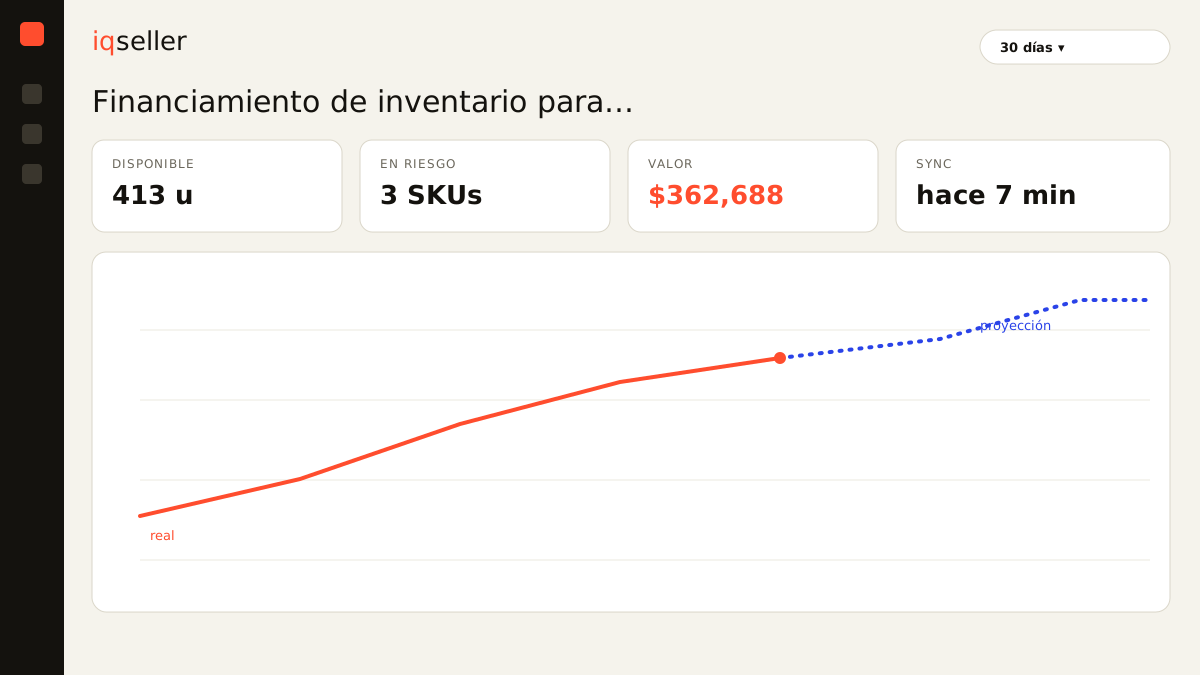
The Inventory module gives you real-time valuation: what’s sitting in FBA, in Full, in 3PL, in your own warehouse and in transit, at cost. That’s the amount you’re financing, with or without credit, and it’s the starting point of any conversation with an institution.
The Profitability module gives you net margin per SKU with everything deducted: the COGS you loaded, the real commissions from the Amazon settlement and from MercadoLibre orders, FBA and Full fees, shipping, advertising, and the VAT and withholding breakdown. That’s the number that has to absorb the cost of money, and it has to be the real one, not the estimate.
Crossed in the Parent → Model → SKU tree, the two together answer the question that matters: which part of your capital sits in products that turn fast and contribute well, and which part sits in products that haven’t moved in months. Financing the first is a growth decision. Financing the second is postponing a decision you should already have made.
where this article ends and your accountant begins
Everything above is structure: how the instruments work, what the cost is made of and what math to run. What isn’t here, and can’t be, is what’s right for you.
That depends on your tax regime, on whether interest is deductible in your case, on your corporate structure, on your currency exposure if you import, on commitments you already carry and on your real tolerance for risk. Those are questions for an accountant and, if the amount justifies it, for a financial advisor who sees your full statements.
Bring three things to that conversation and they’re worth ten: your inventory valuation up to date, your real margin per product and your turnover per SKU. With those, the discussion stops being “should I take on debt?” and becomes “which part of my inventory justifies borrowed capital, at what maximum cost, and for how long?”. That question does have an answer.