
Is Amazon Storage Expensive for FBA Sellers
July 20, 2026
If you’re wondering whether Amazon storage is expensive, the short answer is: it isn’t expensive on its own — it becomes expensive when your inventory moves slowly. The monthly FBA storage fee is relatively low while your product turns over; the pain shows up when stock sits for months and the aged-inventory surcharges and long-term storage fees kick in. That’s how a warehouse that “barely cost anything” starts eating your margin without ever showing up on your main dashboard.
Put differently: the cost of storing depends not just on how much space you take up, but on how long you take it up. Amazon charges per cubic foot per month, but it also penalizes old inventory and stock that exceeds your utilization limit. A seller with healthy turnover pays cents per unit; a seller with dead SKUs pays surcharges that double or triple that base. So the right question isn’t “is it expensive?” — it’s “how much does this product cost me given how fast it sells?”
And that answer is almost never at your fingertips. Amazon reports storage in one place, sales in another, and long-term inventory in a third report. If you also sell on MercadoLibre or move stock through a 3PL, the real number lives scattered across dashboards and spreadsheets you update by hand. By the time you finally piece it together, the monthly billing cycle has already closed.
how fba storage is actually billed
The base FBA storage fee is charged per cubic foot occupied, prorated monthly based on your average daily inventory volume. You don’t pay per unit or per box — you pay for the physical space your products occupy in the fulfillment center, measured day by day. A small, lightweight product takes up little volume, so its monthly storage tends to be minimal.
The trap is that this cost looks cheap in isolation. A few cents per unit per month scares no one. But multiply that by units that haven’t sold in six months, add the long-term storage surcharges, and suddenly “cheap” has become a recurring charge coming straight out of your profit. Storage isn’t expensive because of the list price; it’s expensive because of silent accumulation.
the real cost: inventory that doesn’t turn
The charge that actually hurts isn’t normal monthly storage — it’s the aged-inventory surcharge and long-term storage. Amazon applies extra fees to units that have sat in its warehouses for a long time (typically past 6 and 12 months) and to stock that exceeds your inventory utilization ratio. The logic is simple: they want turnover, not free warehousing.
This is where sellers ask the wrong question. It doesn’t matter whether storage is “expensive” in general; it matters which of your SKUs are generating those surcharges. A hero product that turns every two weeks never sees a long-term fee. A SKU you over-ordered during the last peak season has been racking up charges for months and, on top of that, occupies space you could use for something that actually sells. The cost of storing badly isn’t just the fee — it’s the frozen capital and the wasted space.
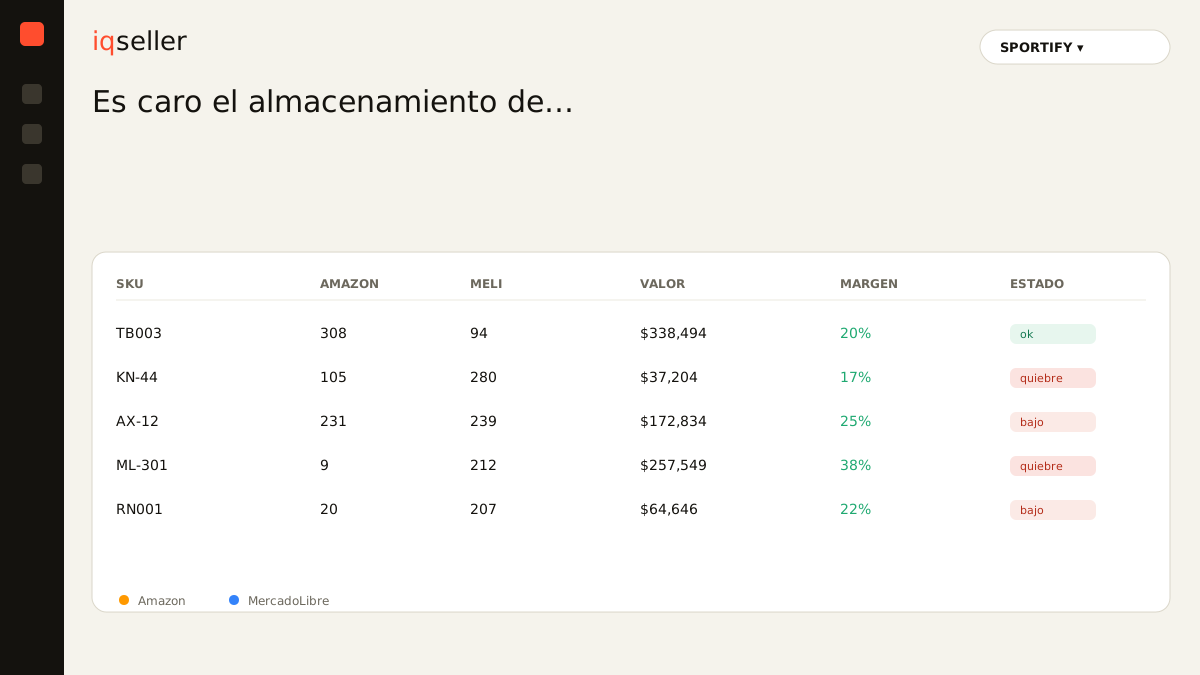
To size it up you need to cross three things: how much stock you have, how long it’s been there, and how fast it sells. That’s exactly what a good real-time inventory view shows you without building the report by hand.
what quietly inflates your storage cost
Several factors bloat storage cost and rarely appear together in one place:
- Seasonal over-stock. You bought for the peak, the peak passed, and you’re left with units now paying rent every month.
- Low-turnover SKUs mixed in with the good ones. A large catalog hides dead products that drag your average storage cost up.
- Bulky, lightweight products. They take up a lot of volume and weigh little, so storage weighs more on their margin than the fulfillment fee itself.
- Low inventory-utilization surcharges. If the ratio between what you sell and what you store is poor, Amazon charges extra for hoarding space.
- Returns that go back into inventory. Units that come back, get re-listed, and keep adding to stored volume.
The point is that none of these factors shouts “I’m expensive!” on its own. They accumulate. And because they live in separate reports, most sellers only spot the problem when they see the total charge on the statement — too late to react.
storage and margin: the number that matters
Asking “is Amazon storage expensive?” in the abstract doesn’t help you. What helps is knowing how much storage eats from the margin of each product. A SKU with 40% gross margin absorbs a storage fee without flinching; one with 8% margin can turn into a loss just by adding a few months of warehouse rent.
That’s why storage has to be read inside your real net margin, not as a stray line. Once you subtract the referral fee, the FBA fee, prorated storage, inbound, returns and tax, the ranking of your “profitable” products changes completely. That SKU you thought was a winner may have spent half a year paying storage that no one booked against its sales.
If you sell the same product across several channels, the picture gets harder. FBA storage cost only applies to the units sitting in Amazon, but your decision about how much stock to send there depends on how demand splits across marketplaces. This is where the idea of a unified catalog comes in: one real product with listings across different channels, whose inventory and costs you need to see together to decide well.
how to reduce storage cost
The good news is that storage is one of the most controllable costs you have, because it depends directly on your buying and replenishment decisions. A few concrete levers:
- Send only what turns to FBA. Don’t use Amazon’s fulfillment center as a general warehouse. Ship batches aligned to your real sell-through, not your optimism.
- Find and clear dead inventory before the long-term cutoffs. Drop the price, run a promotion, or remove the stock before it hits the months that trigger the surcharge.
- Watch your inventory-utilization ratio. Keeping it healthy avoids space-hoarding surcharges and frees capacity for what actually sells.
- Use margin to drive replenishment, not gut feel. Reorder first what earns after storage; hold back what only adds volume.
- Redistribute across channels. If a SKU sells better on MercadoLibre, don’t let it sit paying storage in Amazon.
All of this requires seeing, in one place, which product turns, how long it’s been stored, and what margin it leaves with storage already subtracted. It’s the same discipline you apply when you start your operation right — something we cover in how to sell on Amazon step by step from scratch: measure first, then decide.
why real time changes the answer
The underlying problem isn’t the price of storage — it’s blindness. When your sales, inventory and fee data live in separate reports and you piece them together by hand each month, you always react late: the long-term surcharge already hit, the capital already froze, the space was already wasted. That’s also where the buy box suffers, because stock stuck on one side leaves you out of product where it actually sells.
Seeing storage in real time, cross-referenced with turnover and margin per SKU, turns a vague question (“is it expensive?”) into a concrete decision (“this SKU has been here 5 months, clear it before the cutoff; this other one turns, replenish it”). You don’t need a giant spreadsheet or three dashboards to reconcile — you need the number to arrive on its own, updated, by product and by channel. That’s the difference between paying storage as an unavoidable cost and managing it as a profitability lever.
In short: Amazon FBA storage isn’t expensive when your inventory turns; it gets expensive when it doesn’t and you don’t find out in time. The answer to whether Amazon storage is expensive depends entirely on your sell-through speed and your ability to see it product by product. iqseller brings sales, inventory and costs from your channels into a single real-time view, so storage stops being an end-of-month surprise.