
MercadoLibre catalog listings: how the top spot is won
November 19, 2026
There is an uncomfortable moment nearly every MercadoLibre seller eventually lives through: you open your listing — the one you built with your own photos, a worked title and bullets rewritten three times — and discover it is no longer your listing. It is the same page five other sellers share, with the same photo and the same description, and your offer parked below under “other buying options”. The sales went somewhere else and you are still paying for ads to drive traffic to a page you no longer control.
That is MercadoLibre’s catalog. It is not a section or a filter: it is a change in the unit of competition. Before, you competed listing against listing, with your title and your photos as weapons. Inside the catalog, the product is a single shared page and what competes are each seller’s selling conditions. Price, shipping, installments, reputation, stock. Nothing else.
For a seller who built their MercadoLibre business on beautiful listings, that shift is brutal, because the levers they mastered stopped working. For a seller who never invested in listing content, it is an opportunity: you can join a page that already ranks, with reviews already accumulated, without building anything. Winning there depends on things visible in a spreadsheet, not in Photoshop.
This piece explains the mechanism, which factors MercadoLibre says it uses to assign the top spot, why “winning” is not a single state, what you give up by joining, and when it makes sense to stay out while you still can.
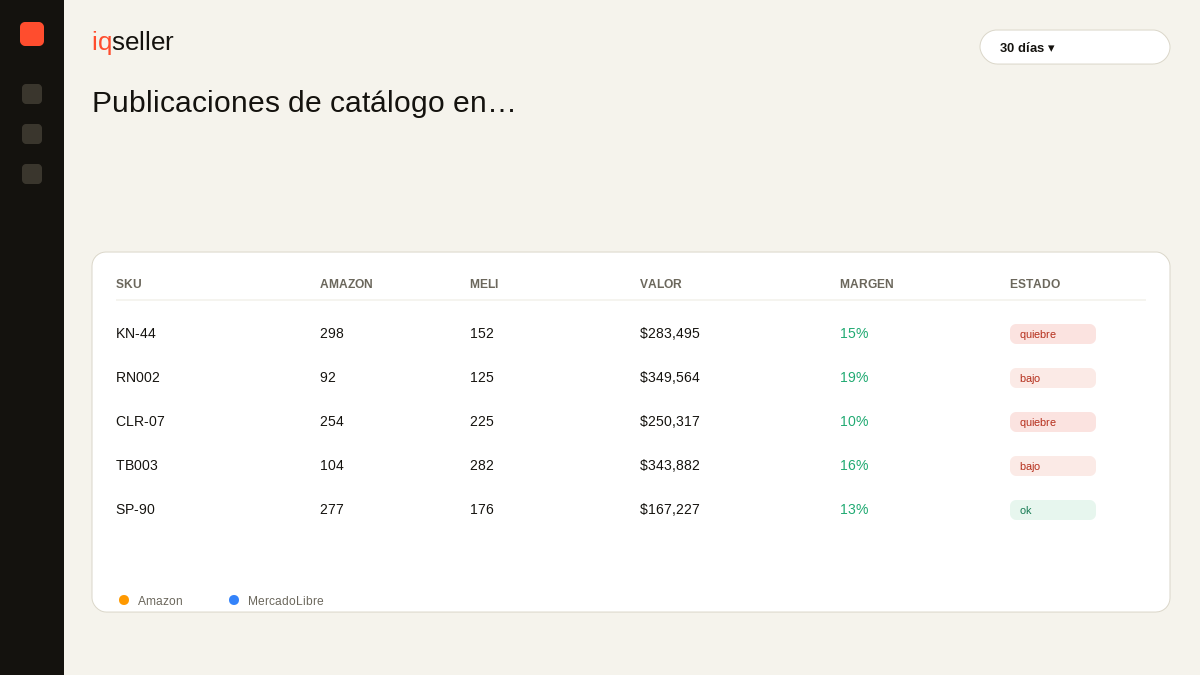
what a catalog listing is
A catalog page is a product page MercadoLibre builds and administers: a specific model, with its photos, its spec sheet and its reviews. That page exists independently of who sells it. Beneath it hang the offers of every seller who listed that same product.
Of all those offers, one occupies the visible slot: it is the one the buyer sees on arrival, with its price, its shipping and its buy button. The rest sit in a secondary list very few people ever open. In practice, whoever holds the spot takes the large majority of that product’s sales.
The difference from a traditional listing is worth underlining, because it changes your whole strategy:
- The photos and description are no longer yours. They belong to the page. If you spot an error, MercadoLibre lets you suggest corrections to the product data, but those suggestions go through review and, if approved, apply to every listing attached to the page, not only yours.
- Reviews accumulate on the product, not on your account. You inherit the good ones left by whoever sold before you, and the bad ones too.
- Your differentiation shrinks to commercial conditions. What you can move is price, shipping method, installments and availability.
- It is not always optional. Third-party guides report that in several categories, once MercadoLibre notifies you that your product can be listed in the catalog, listing it becomes mandatory. That varies by category and country and should be confirmed in MercadoLibre Mexico’s help center, because it is exactly the kind of rule that gets adjusted.
how the top spot gets decided
The way MercadoLibre explains it in its own help pages is that the top spot goes to the listing offering the best buying experience, measured through a set of objective parameters. The ones listed are these:
- Price of the offer.
- Interest-free installments offered to the buyer.
- Shipping conditions, including speed and whether it is free.
- Seller reputation.
- Available stock.
One detail the same documentation makes explicit matters a lot: listings from sellers with orange or red reputation can participate in the catalog, but cannot win it. Reputation is not one more factor adding points; it is a gate. If your color is red or orange, everything else is irrelevant, and fixing reputation becomes the prerequisite before any price move.
What MercadoLibre does not publish is the weighting. There is no stated percentage for how much price counts against shipping against reputation, and I found no official source that gives one. Third-party tool guides agree that in heavily commoditized products price ends up being decisive in practice, but that is market observation, not a documented rule. If someone sells you an exact formula of weights, they are selling you a guess.
Glossary: Buy Box, the buy slot and how it is won →“winning” is not a single state
This is the catalog’s most expensive misunderstanding, and it is a technical detail with business consequences.
In MercadoLibre’s API, every catalog listing carries a competition status. The documented ones include winning (holding the page’s visibility and sales), sharing_first_place, and competing — which means losing. When you are not winning, the API also returns a reason field explaining why, designed precisely so you know what to fix.
The subtle part is that this status is not the same for every buyer. MercadoLibre’s own seller guidance says it plainly: you will always be winning or losing for a group of buyers, depending on their location, their Mercado Puntos level and other buyer-side conditions. Two people can open the same page at the same moment and see different offers.
That explains an experience that baffles a lot of sellers: your panel says you are winning, an acquaintance sends you a screenshot showing someone else, and you are both right. It also explains why “winning the catalog” is not a switch but a proportion. You can be winning 70% of buyers and losing the 30% who live far from your warehouse, and the way to move that 30% is not a lower price, it is different logistics.
The practical corollary: if your status says competing, read the reason before touching price. In a good share of cases the reason is not price, and cutting it only costs you margin without moving the position.
the real levers, in order of return
Since the variables are few, it pays to attack them in the order that returns the most per point of margin surrendered:
- Reputation first. Orange or red means you cannot win. Full stop. Fix cancellations, claims and handling times before thinking about price.
- Logistics second. Moving to a faster delivery mode shifts your position without touching unit margin. It is the most underrated lever, because it costs operations rather than discount.
- Interest-free installments. They are listed as a factor. Careful: offering them is not free, and the cost depends on your listing type, so check what they do to the SKU’s net margin before switching them on.
- Sufficient, steady stock. Going to zero takes you out of the fight, and regaining position afterwards is costly. A catalog SKU with recurring stockouts never stabilizes at the top.
- Price last. Not because it does not matter, but because it is the only lever that bills you straight out of margin and the only one a competitor can match in minutes.
That order feels wrong precisely because price is the only thing you can change in thirty seconds. Which is exactly why it is the worst first answer: what gets matched quickly builds no advantage.
the race to the bottom
The catalog has a dynamic that punishes anyone who does not know their own number. When several sellers compete for one page with the same product and price is the easiest thing to move, equilibrium drifts down toward the cost of the most desperate seller.
One detail amplifies the problem: in some interfaces MercadoLibre shows you a comparison against the best competitor and, according to third-party guides, even suggests a specific price to reach in order to win. That is useful information, but it is also a permanent nudge downward. Accept the suggestion without checking it against your own floor and the system will walk you precisely to the point where you stop making money.
The antidote is not heroic resistance: it is having each SKU’s minimum profitable price calculated, with category commission, listing-type cost, logistics, allocated returns, advertising and withholdings. With that number in view, losing the catalog becomes a decision instead of a defeat. There are SKUs where the top spot is not worth what it costs, and knowing that is part of operating well.
An invented arithmetic example to make it concrete: if a product sells at $899 and your calculated profitable floor is $812, you have 87 pesos of runway to compete with. If a competitor sits at $789, the question is not “do I cut or not” — it is “what other lever do I have left”, because below $812 you are paying to sell. Without that $812 calculated, the same situation feels like an invitation to match.
when to join and when to stay out
The catalog is neither good nor bad: it suits one kind of product and damages another.
Joining makes sense when:
- You sell a standard product of someone else’s brand, where the buyer searches for the model and not for you.
- Your advantage is in acquisition cost or logistics, not in listing content.
- The page already has traffic and reviews you would otherwise have to build from zero.
- Your reputation is green and your stock is steady, meaning you can hold the spot rather than win it for a week.
Staying out makes sense, while the category allows it, when:
- Your product is your own brand and your listing is part of your differentiation. Pushing it into a shared page gives your content work away.
- Your margin is thin and your acquisition cost is not competitive. You are entering a price fight you cannot win.
- Your product has variants or a bundle the standard page does not represent well. Joining forces you to sell as though you were something you are not.
- Your own reviews are an asset. Inside the catalog they become the product’s, and you inherit everyone else’s.
One warning worth stating: several guides note that in practice, joining the catalog from an existing listing is hard to reverse. Before doing it, check in MercadoLibre Mexico’s help center what your category allows today, rather than assuming you can back out whenever you like.
Glossary: EAN and GTIN, the key that ties your product across channels →how to track it without losing your mind
A catalog of fourteen SKUs can be reviewed by hand. One of four hundred cannot, and that is where most sellers lose position without noticing. What you should be able to answer any morning, without opening five tabs:
- How many of my catalog SKUs are winning today and how many are not.
- Of those that are not, what reason the platform reports: price, shipping, stock, reputation.
- Of those that are winning, which are winning below their profitable floor — the most dangerous case, because it looks like success.
- Which SKU lost position this week, and whether it coincides with a stockout of my own.
That last question dismantles a surprising share of catalog losses. You did not lose on price: you ran out of available inventory, the status flipped, and you never read it again.
which part of this iqseller solves
Clear from the start: iqseller does not compete for you in the catalog. It is not a repricer that moves your price automatically to win the page, it does not change your offer, and it does not decide whether you join or stay out. That decision is yours and the execution lives in MercadoLibre.
What iqseller solves is the number you need in order to decide without guessing. In Profitability you see net margin per SKU with the COGS you load and everything the platform deducts: commissions arriving through MercadoLibre orders, Full fees, shipping, advertising, and the VAT and withholding breakdown. That is where your real per-product floor comes from — exactly the figure you are missing when the platform suggests a lower price.
In Catalog, the Parent → Model → SKU tree gathers one real product with its listings across every channel, so a model living in several listings and several MLM reads as a single thing. That makes the question of which models are in the catalog, under what conditions, manageable instead of a listing-by-listing hunt.
Inventory shows availability per warehouse and per mode, which is the variable that most often explains a lost position without anyone connecting the two. Alerts fires when a SKU drops below the stock threshold you set or when its net margin falls under your minimum, and Pricing holds different prices per channel when the cost to serve differs. Forecast projects replenishment from real sales velocity, which is what prevents the stockout that drops you off the page.
What it does not do: it does not read the page’s competition status or the reason MercadoLibre reports, does not suggest the price to win, and does not push price changes to the platform for you. What it does is make sure that when you look at that suggestion, you know whether you can accept it.
closing thought
The catalog changes the question from “how do I make a better listing?” to “can I sustain better conditions than everyone else, given my cost structure?”. That is a financial question dressed as a marketing one, which is why the seller who joins without their numbers loses even while selling more units.
The healthy path is short to state: fix reputation if it is orange or red, calculate each SKU’s profitable floor before fighting for position, use logistics and installments before using price, and accept that some pages are not worth winning. Choosing not to compete on a SKU is a legitimate decision when you have the number to back it.
And the usual warning, which applies to the catalog more than to any other topic: catalog rules, assignment criteria and per-category obligations change and vary by country. Confirm every point in MercadoLibre Mexico’s help center and in your own seller panel before you move anything.