
One product, many MLM: MercadoLibre listing chaos
April 27, 2026
You have one product. Just one. The same box, the same SKU, the same supplier. But when you open MercadoLibre and search for your own item, you find three, four, sometimes six different MLM all pointing at the same thing sitting in your warehouse. You listed one a year ago. Your partner created another when they “couldn’t find” the first. A third came out of a bulk import you ran with an Excel file you no longer remember. And the remaining two are MercadoLibre catalogs you attached yourself to without quite noticing. They all sell the same thing. None of them tell the same story.
That is the chaos almost nobody warns you about when you start selling seriously on MercadoLibre. It isn’t a “publish the listing correctly” problem. It’s structural: the marketplace lets a single physical product live under several identifiers at once, and you, as a multichannel seller, end up managing a constellation of listings that contradict each other. Different price, different stock, different photo, different description, different reputation. Meanwhile, in another tab, your Amazon Seller Central shows one clean ASIN for the same item, which makes the mess feel exclusive to MercadoLibre. It isn’t entirely, but it hurts more there.
The daily routine turns into detective work. Which MLM did the sale land on? Why does this one, with the better photo, sell less than that one with the half-finished description? Which do I discount? Which do I pause? And when you finally decide to act, you do it with yesterday’s data, exported by hand, pasted into a sheet that goes stale the moment you save it.
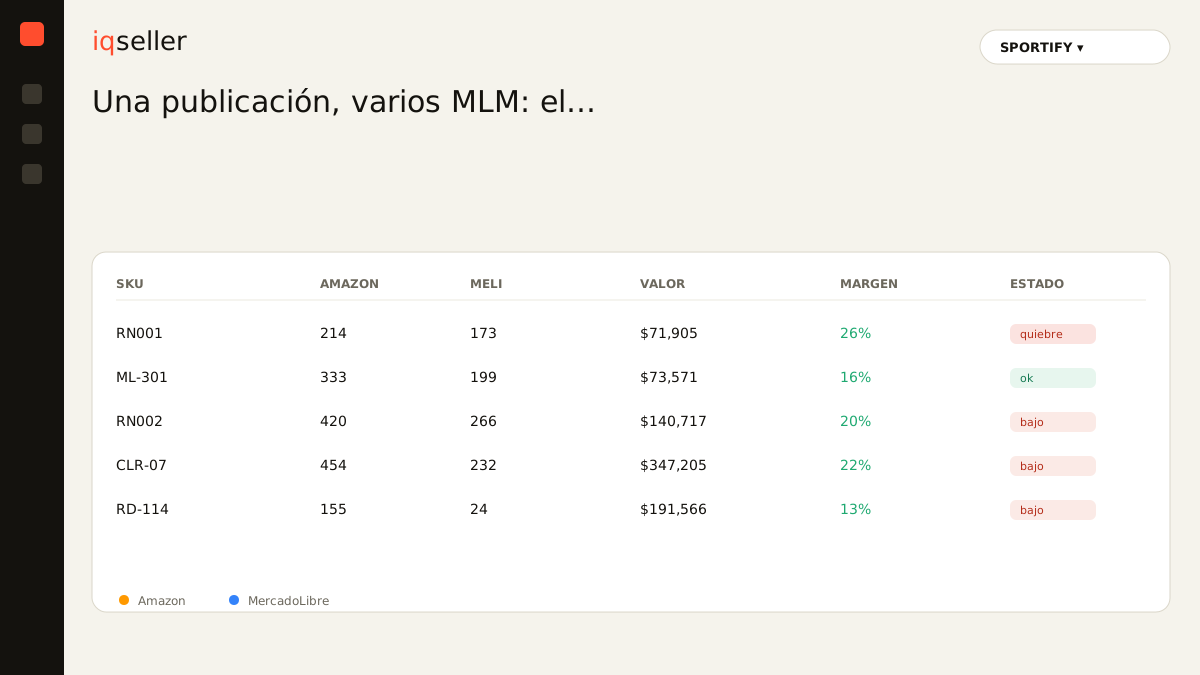
why one product ends up with several MLM
The MLM (each listing’s identifier on MercadoLibre) is not a product code in the strict sense. It’s the listing’s code. And that’s the trap: a listing is an editorial object, not a physical one. Every time someone creates a new one, a new MLM is born, even when the exact same item you already sell sits behind it.
The causes pile up over time. You listed a “classic” variant and a “premium” one for the same product because you wanted to test pricing. You joined the MercadoLibre catalog for visibility but kept your own listing “just in case.” You migrated accounts, ran a bulk upload, inherited listings from a teammate who’s no longer around. Each decision, reasonable at the time, left an orphaned MLM living on its own.
The result is that your real inventory (say, 40 units in your 3PL) is conceptually scattered across listings that don’t talk to each other. If you don’t link them to a single internal SKU, every MLM thinks it owns its own stock, and you end up overselling or, worse, throttling sales out of fear of overselling.
Dictionary: a unified catalog is the idea that one physical product should have a single internal master record, no matter how many listings exist across each marketplace.the invisible cost of duplication
The expensive part isn’t having several MLM. The expensive part is deciding as if you didn’t have them. When three listings of the same product compete with each other, you fragment your own demand: reviews split, sales history dilutes, and no single listing accumulates enough signal to stand out. It’s internal competition disguised as coverage.
Then comes the operational cost. Changing a product’s price means opening every MLM and editing it one by one, praying you don’t forget any. Applying a seasonal promotion becomes a manual checklist. And when your supplier raises the cost, recalculating margin across six listings is exactly the kind of task nobody does well at 11 p.m.
The third cost is trust in your own numbers. If you export sales by MLM and add them up in Excel, are you measuring the profitability of the product or of a listing? They’re different things. A product can be profitable even if one of its MLM is losing money. Without a consolidated view, you optimize the symptom instead of the cause.
the multichannel puzzle: when MercadoLibre isn’t alone
Now add that MercadoLibre isn’t your only channel. On Amazon you have ASINs, on Shopify you have your own handles, and your 3PL runs its own SKU nomenclature. The same product, SPORTIFY for example, can be an ASIN on Amazon, three MLM on MercadoLibre, a product in your store, and an inventory line in the warehouse. Five representations of a single box.
The multichannel seller lives jumping between Amazon Seller Central, the MercadoLibre panel, and the 3PL portal, copying figures by hand to assemble the full picture. Each dashboard speaks its own language, each updates at its own pace, and the only way to merge them is export, paste, and cross-reference columns. By the time you finish the sheet, the sales have already changed. You decide on an old snapshot.
The way out isn’t better spreadsheets. It’s a single source of truth where that product exists once, with all its listings hanging beneath it as children. Where real-time inventory draws down from the same pool no matter which MLM the sale came through, and where price and margin are reasoned at the product level, not across scattered listings.
what it means to truly link listings
Linking isn’t just slapping on a label. It’s establishing that MLM A, MLM B, the MercadoLibre catalog, and the Amazon ASIN are the same physical entity, and that any stock movement in one affects what’s available in all of them. It’s the difference between “I have six lists” and “I have one product published in six places.”
The technical bridge that makes this possible is usually the product’s standard identifier. When your item carries a code that travels with it across channels, reconciliation stops being guesswork.
Dictionary: the EAN/GTIN is the product’s standard barcode; it acts as the key to recognize that two different listings are, physically, the same thing.With that key, a dashboard can automatically group every MLM that shares a product and finally surface the question that matters: of all these listings, which one is carrying the sale and which one is just in the way?
the fight for position inside your own catalog
Inside MercadoLibre there’s a mechanism similar to Amazon’s: when several sellers offer the same item in a catalog, MercadoLibre picks one to feature prominently. The problem is that sometimes you compete not against other sellers but against your own other listing. Your own MLM cannibalize each other’s visibility.
Dictionary: the Buy Box (or winning catalog listing) is the featured slot the marketplace assigns to a single offer; winning it concentrates the majority of that product’s sales.To compete well for that position you need to know, in real time, which MLM has the best price, the best reputation, and the fastest shipping, and to concentrate your efforts there instead of splitting them. If your information lives in yesterday’s exports, you arrive late to a fight that’s won by the hour. And all of this without losing sight of fees and commissions, because winning the slot while selling at a negative margin is winning nothing.
how to tame the chaos without breaking what already works
You don’t need to delete listings recklessly. Order starts by taking an inventory of your inventories: list every MLM, identify which physical product it corresponds to, and mark which one is primary. Then you define one master record per product and hang all its listings beneath it, on MercadoLibre and on the other channels.
From there, the rules get simple. Stock is managed once and reflected everywhere. Price is decided at the product level and propagated, with each marketplace’s own adjustments. Profitability is read consolidated, summing sales across all MLM but subtracting the real costs of each channel. And when a duplicate MLM no longer contributes, you pause it with data, not hunches.
That’s exactly what a unified panel embodies: it promises no magic, it removes the manual chore of pasting columns and leaves you a clean decision. You stop asking “which MLM did the sale land on?” and start asking “this product, as a whole, is it set up the way it should be?” MercadoLibre’s chaos doesn’t vanish by magic; it becomes manageable when you stop looking at loose listings and start looking at products.