
MercadoLibre's Resale Model: What Changes in Your Profit
August 24, 2026
Every MercadoLibre seller knows the scene: you sell a product for $1,160, you check the deposit, and that figure is nowhere to be found. Between commission, logistics and withholdings, the number that lands in your account looks very little like the one on the sale. The commissions you had budgeted for. The withholdings — 8% VAT and 2.5% income tax — are the confusing part, because technically they aren’t a cost and they still feel exactly like one.
MercadoLibre launched a new model, reventa (resale), that targets precisely that. The promise is written on their own page: “up to 10.5% more liquidity.” That 10.5% didn’t come out of nowhere; it’s 8 plus 2.5. In other words, the program isn’t promising lower commissions or better logistics: it’s promising that the withheld slice reaches your account in full from day one.
It’s worth understanding what it is and what it isn’t, because seller groups are mixing it up with the 1P vendor model — where the marketplace buys from you wholesale, demands front margin, ad spend and long payment terms — and they’re different things. This article explains the mechanism, why that 10.5% hurts the marketplace-only seller in particular, and how to read your profit before and after withholding so you decide with numbers instead of with the landing page’s promise.
what the resale model actually is
In the usual direct sale, you sell to the end buyer. You list, someone buys, you issue the invoice to the buyer, and MercadoLibre acts as the intermediary that collects on your behalf, deducts its commission and — by law — withholds part of your taxes before depositing.
Under resale, ownership changes hands halfway through. When the buyer clicks “buy,” you sell the product to MercadoLibre, and MercadoLibre is the one who invoices the end buyer. You stop being the seller in that transaction and become a supplier. You invoice Meli for the net value of the product; they handle the sale to the consumer.
The details that define the program, as MercadoLibre publishes them, are these:
- It applies only to selected Full listings, chosen on criteria like competitive pricing and catalog variety. Not all of your inventory qualifies.
- The stock stays yours until the buyer buys. There’s no wholesale purchase up front and nobody pays you in advance to fill a warehouse.
- The listing keeps your brand, but the buyer sees the product as “sold by Mercado Libre.”
- Invoicing to Meli is issued free and automatically through their invoicing tool, which you set up once.
- You can keep selling directly with the rest of your catalog, pull specific listings out of the program, and leave whenever you want.
- Participating carries no cost.
That last list matters because it marks the difference with the classic 1P model. In a traditional vendor arrangement the marketplace buys volume, negotiates a front margin, asks for ad investment and pays you in 60 or 90 days. Here there’s no advance purchase, no volume commitment, and the operation stays sale by sale. It’s a tax-and-cash-flow layer bolted onto your Full operation, not a change of business model.
where the 10.5% comes from
When you sell through a marketplace, the platform is required to withhold part of your taxes and remit them to the tax authority on your behalf. For an individual seller under Mexico’s digital-platform regime, in 2026 that’s two pieces: half of the VAT you charged — 16% divided by two, so 8% of the sale value — and 2.5% of income tax on the proceeds from the sale of goods.
Add them and you get 10.5%. That’s the number MercadoLibre turned into the headline on its landing page, and it’s honest: under resale those withholdings don’t apply, because you’re no longer selling through the platform — you’re selling to the platform.
On a $1,160 sale to the buyer — a $1,000 base plus $160 of VAT — the arithmetic looks like this, before commissions enter the picture:
- Direct sale: you charge $1,160, they withhold $80 of VAT and $25 of income tax. You’re left with $1,055 before commission.
- Resale: you invoice MercadoLibre $1,000 plus VAT. You receive $1,160 before commission.
The $105 difference is 10.5% of the base. That’s not small: for a catalog billing two million pesos a month, we’re talking about more than two hundred thousand pesos of cash flow changing places.
Glossary: inventory valuation, how much capital is sitting idle →the fine point: this is not a tax saving
Here’s where precision matters, because it’s easy to read “10.5% more” as “I pay 10.5% less tax,” and that isn’t it.
Withholding is not an additional tax: it’s an advance on your own tax that someone else paid for you. On your return you credit it and, in theory, it evens out. MercadoLibre’s own page says it plainly: “you receive the value of the product and invoice us for that same amount. You then manage the taxes.” Under resale the money arrives in full, but you still owe the VAT and income tax on that revenue.
So why does it feel like a cost? For two very concrete reasons.
The first is that withholding is calculated on gross revenue, before commissions. MercadoLibre charges its commission on the sale price, but the income tax withholding applies to 100% of that price, not to what you were left with. If your operating margin is 15% and 2.5% of gross is withheld, that 2.5% weighs far more than it sounds.
The second is the structural problem of the pure reseller. Whoever manufactures or imports has plenty of creditable VAT: customs, inputs, freight, services. That creditable VAT offsets what was charged and the balance tends to work out. Whoever resells domestic product bought with an invoice has a much flatter structure, and if they also sell almost everything through a marketplace, a credit balance piles up month after month that can only be recovered by filing for a refund — a process that takes months, demands impeccable paperwork, and that many small sellers simply never start.
That’s the honest translation: withholding isn’t an extra tax, it’s your own capital parked with the tax authority. For a business that finances its inventory out of its own cash flow, parked capital and lost capital look fairly similar in practice. That, and not a tax discount, is what resale offers.
what resale does not change
This deserves to be spelled out, because it’s where most of the confusion lives: resale does not improve your product’s profitability. What changes is when you have the money, not how much you make.
You still pay the channel commission. You still pay Full’s logistics. You still pay for your advertising if you use it, and your cost of goods is exactly the same. Operating profit per unit — base revenue minus COGS, commission, logistics and ads — is identical under both models.
There’s also one condition that does carry a cost: to join the program it’s a requirement to suggest competitive prices. MercadoLibre frames it as an explicit trade — you have more liquidity, so you can lower prices without giving up profit. It’s a reasonable trade, but it is a trade: if you end up cutting price by more than you gained in cash flow, the net result is negative. And that calculation is only possible if you know your real floor per SKU.
Glossary: real net margin, with everything deducted →profit before and after withholding, in one place
This is the kind of decision that in iqseller gets made in the Profitability module, because that’s where both figures live together.
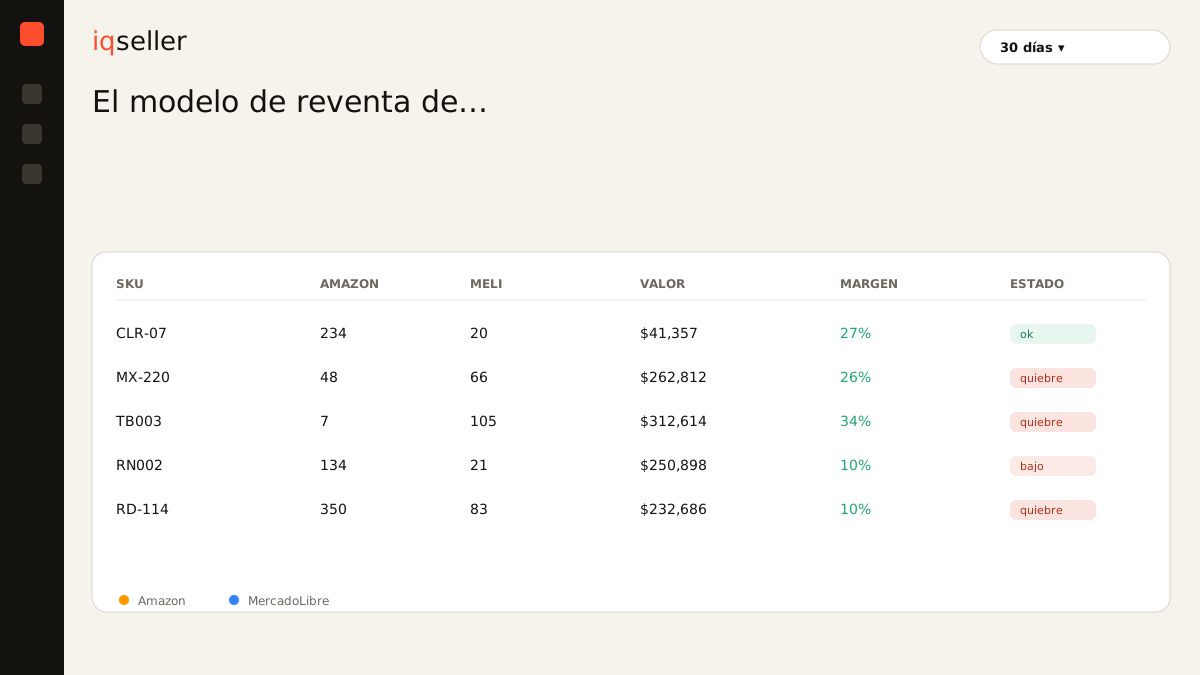
The panel doesn’t start from the shelf price: it separates the base from VAT and works on the base, which is the only part that was ever yours. On that base it deducts the COGS you uploaded, each channel’s actual commission, fulfillment fees, shipping and advertising, and out of that comes net margin per SKU and per model. That’s your operating profit: the one resale doesn’t change.
At the same time, the tax breakdown — the VAT you charged and what each platform withheld, taken from Amazon’s settlement and MercadoLibre’s order data — sits next to those same numbers. Putting the two readings side by side is what reveals the real effect on your pocket. Following the example above, with a COGS of $600, commission of $140 and logistics of $82 on the $1,000 base:
- Operating profit: $178 per unit, or 17.8% of base. The same under both models.
- Profit after withholding, direct sale: $73 that month, or 7.3%. The remaining $105 is withheld.
- Profit after withholding, resale: the same $178, available now.
Profit didn’t double: the money is in both columns. But that second line is the one that tells you what you can count on to restock this week, and it’s exactly the one a hand-built spreadsheet never shows, because whoever fills it in gave up long ago on cross-referencing the sales report against the withholding report.
Seeing those two figures together, per product and per channel, is what turns the decision into arithmetic: how much cash you free up on the SKUs Meli selected, how much price you’d have to sacrifice to qualify, and whether the trade suits you. None of those three answers is the same across your whole catalog, and that’s precisely the point.
how to decide without the landing page
Resale is neither good nor bad in the abstract. It’s a cash-flow instrument, and its value depends on how tight yours is.
If your business lives on recycling the same capital — buy, sell, rebuy — and a good share of your sales goes through Full, freeing 10.5% of gross on those SKUs is a real change in your purchasing rhythm. If instead you have capital to spare, you already recover your credit balances with your accountant on schedule, or your sales are diversified beyond the marketplace, the benefit thins out and the competitive-pricing condition may weigh more than the liquidity you gain.
Either way, the decision comes down to three numbers you should already have at hand: your operating profit per SKU, how much was withheld last month on the listings Meli selected, and how much price you’d be willing to give up. And as always when taxes are involved, the conversation ends with your accountant — the exact effect depends on your tax regime, and this text is no substitute for that advice.
What is yours, and depends on no program, is seeing the full number: what each product earns, what each channel takes, and how much of your money is waiting somewhere. With that in view, any new model someone offers you stops being a promise and becomes a calculation you can run in five minutes.