
Mexican customs: what to know before importing your first container
September 28, 2026
Almost every seller reaches the same border. You started buying from a local distributor, the product worked, and suddenly the math says that buying straight from the factory in Asia cuts your unit cost in half. Then someone hands you a contact, a container gets quoted, and the word customs enters the conversation as if it were just another errand.
It is not. Importing into Mexico is not a transaction, it is a process with legal roles, mandatory documents, a tax regime, and a chain of responsibility in which the party answering to the authority is you — not your supplier and not your broker. And the real cost of that container is not the price the factory quoted: it is that price plus duties, plus services, plus handling, plus whatever your mistakes end up costing.
Here is the failure mode that ruins more first imports than any other: the seller calculates margin using the supplier’s invoice price and lists products with that cost loaded. Then the duty, the import VAT, the broker’s fee, port storage and inland trucking arrive, and the real cost per unit turns out to be substantially higher. The margin their dashboard was showing never existed.
This is an educational primer so you arrive at your first meeting with a customs broker knowing what to ask. It does not replace advice from a licensed customs broker or from your accountant, who are the ones who must validate your specific case.
who is who in an import
The first confusion for a beginner is not knowing who owns what. These are the roles you will meet:
- The importer of record. That is you, or your company. You appear on the customs declaration, you pay the duties and taxes, and you are legally responsible for the goods and their paperwork being in order. That responsibility cannot be delegated.
- The customs broker (agente aduanal). A professional licensed by the authority to clear goods in your name. They prepare and validate the pedimento, classify the merchandise, calculate the contributions and coordinate the customs inspection. They charge a fee, usually a percentage of the operation’s value with a floor, and they bill you separately for costs they advance on your behalf.
- The supplier or exporter. Issues the commercial invoice and the origin documents. Their responsibility ends wherever the agreed incoterm says it ends.
- The carrier or shipping line. Moves the cargo and issues the transport document: the bill of lading for ocean freight, the air waybill for air.
- The freight forwarder. Contracts and coordinates international transport. This is not the same thing as the customs broker, even though many firms sell both services.
- The port terminal and the bonded warehouse. They hold your container while clearance is completed, and they charge for every day it sits there.
Confusing the freight forwarder with the customs broker is one of the most common early mistakes. They are two contracts, two invoices and two different responsibilities.
the pedimento and the importer registry: the two steps you cannot skip
The pedimento is the tax declaration of the operation: the document that records what you imported, from where, under which tariff code, at what value, and how much you paid in contributions. The broker prepares it, and it is the document that ties your entire import cost to your accounting. Without a pedimento your accountant cannot deduct the purchase or credit the VAT you paid at the border.
Before any of that you must be registered in the SAT’s Padrón de Importadores, the importer registry. It is what authorizes you to import; without it the operation simply cannot happen. The basic requirements published by the authority revolve around being registered for tax purposes, being current on your tax obligations, holding a valid e.firma, and having a locatable fiscal address. There are additional sector-specific registries for certain goods — textiles, footwear, chemicals and others — and requirements have been tightening: current rules ask brokers to build more robust client files, with documentary evidence backing the operation. Confirm with your broker whether your product falls under a sector registry before you wire the deposit to your supplier.
Glossary: lead time, the real clock from purchase order to sale →the documents you will be asked for
The list varies by product and by regime, but the core repeats:
- Commercial invoice from the supplier, with description, quantities, unit values and terms of sale.
- Transport document: bill of lading or air waybill.
- Packing list: what is in each carton, with weights and dimensions.
- Certificate of origin, whenever you want to claim a trade agreement’s preferential rate. Without it you pay the general rate even if the goods would have qualified.
- Non-tariff regulation documents: permits, Mexican official standards (NOMs), labeling, health notices. This is where most people trip.
- Encargo conferido: the document authorizing that specific broker to act on your behalf.
The labeling point deserves its own paragraph. Many consumer goods require Spanish-language labeling with specific commercial information, and compliance can be checked before the goods leave customs. A full container arriving without conforming labels gets held, and fixing it — relabeling unit by unit inside an authorized facility — costs time and money precisely while the storage meter is running.
how the cost is built: customs value, duty, processing fee and VAT
It is worth understanding the mechanics here, because the specific percentages depend on your tariff code and your country of origin, and they change.
Everything starts with the customs value. It is not simply the invoice price: Mexican customs law defines transaction value as the price paid or payable plus additions, which include international freight, insurance and other transport-related charges up to the point of entry. That is why the incoterm you negotiated changes the number: if you bought FOB, the freight you pay separately gets added; if you bought CIF, it is already inside.
On top of that customs value, in order:
- IGI (general import duty): the tariff itself. Its rate depends on the tariff classification assigned to your product and on the origin of the goods. It can be zero when a trade agreement’s preference applies and you hold the certificate of origin.
- DTA (customs processing fee): a fee for the procedure. Specialized publications describe for 2026 a rate of roughly 0.8 per thousand of customs value for definitive imports with a duty above zero, and a fixed per-declaration amount for operations under a trade agreement. Your broker confirms the exact figure against the rules in force on the day of clearance.
- Import VAT: 16% on a base that is not the customs value alone, but the customs value plus the duty, plus the processing fee, plus excise taxes and countervailing duties where applicable. In other words, VAT is calculated on top of the previous taxes, not alongside them.
That import VAT is, in principle, creditable for a taxpayer with taxable activity, just like the VAT you pay any supplier. It is not a sunk cost if your tax situation lets you credit it, and that is exactly the kind of detail your accountant should review before you build your unit cost. The duty and the processing fee, by contrast, are cost: they belong in the value of your inventory.
the tariff classification: the number that decides almost everything
If there is one data point worth understanding before you buy, it is the tariff classification. It is the code under which your goods are classified in the schedule, and it drives the duty rate, the permits, the applicable standards and the trade-agreement preferences. Two products that look identical to you can fall under different codes and pay very different rates.
And it is not a stable data point. In late 2025 a decree was published in the official gazette modifying 1,463 tariff lines, effective 1 January 2026 with no transition period, applying to goods originating in countries with which Mexico has no trade agreement in force — China, India, South Korea, Brazil and Russia among them. Reported new rates range, depending on the line, from around 5% up to 50%, and the sectors covered include textiles, footwear, plastics, steel, home appliances, toys, furniture, perfumery and auto parts. The bulk of the affected lines sits in textiles and in iron and steel products.
For a seller importing from Asia, that is not a technical footnote: it can be the difference between a profitable product and one that is not. And because trade policy keeps moving, the only sensible way to work is to get the classification in writing before you buy, not after the container is on the water. A broker can give you the likely code and applicable duty from a technical description and a sample. That consultation is cheap compared to a misclassified container.
the expensive beginner mistakes
The ones that repeat, roughly in order of how much they cost:
- Calculating margin from the supplier’s FOB price. Mistake number one. The factory price is a fraction of the landed cost in your warehouse. Publishing prices with that cost loaded is selling on an imaginary margin.
- Not verifying the tariff classification before buying. Discovering the real duty once the goods are at the border leaves you with no options.
- Ignoring non-tariff regulations. Labeling, standards, permits, notices. One unmet requirement holds the container while the storage clock keeps running.
- Underestimating free days. Shipping lines and terminals grant a grace period — typically a handful of days — before they start charging demurrage for use of the container and storage for the space. Industry publications cite daily charges that add up fast. If your clearance stalls, every day costs.
- Paying the deposit before the paperwork is clear. If your supplier cannot issue a certificate of origin or an invoice with the correct description, better to find out before you transfer.
- Not reserving working capital for the taxes. Duty, processing fee and VAT are paid before the goods leave customs. Many first-timers spend all their cash on the purchase and the freight, and run dry at the last step.
- Buying too much on the first order. A full container looks more efficient per unit, but if the product does not turn you end up with frozen capital and, in FBA or Full, paying long-term storage.
how this reads in iqseller
None of the above matters if the real cost never lands in the number you use to decide. In the panel, that landing happens in two places.
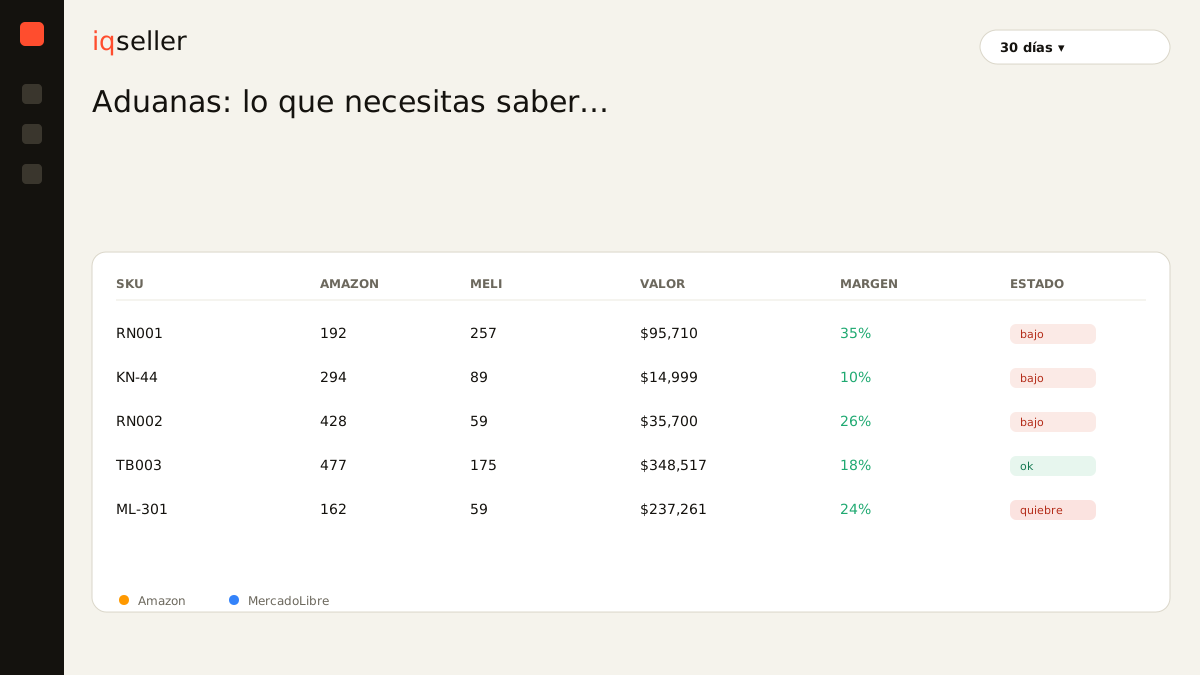
In Profitability, every SKU carries the COGS you load yourself. That is where the landed cost belongs — product, international freight, duty, processing fee, broker fees, handling, inland trucking — divided across the units in the lot. With that COGS right, the net margin per SKU you see already has Amazon settlement commissions and MercadoLibre order fees deducted, along with FBA and Full fees, shipping and advertising. With a COGS that only carries the supplier’s price, that same margin is inflated and nothing tells you so.
The panel also breaks out VAT and withholdings, which is the other side of the tax story: what the marketplaces hold back and how it relates to what you paid. And in Inventory, the valuation tells you how much capital is parked, which after a large import is exactly the question that matters.
The Parent → Model → SKU tree helps spread a lot’s cost across variants: a container carrying eight sizes does not have a single unit cost when weight and volume differ between them.
before you sign the first order
A short list to arrive prepared:
- Have your importer registry in place, and confirm whether your product needs a sector registry.
- Get the tariff classification in writing, with the duty applicable to the real origin of the goods.
- Define the incoterm and understand exactly where your supplier’s responsibility ends.
- Ask your broker for a complete estimate: projected taxes, fees, handling, likely storage and inland freight.
- Reserve cash to pay the contributions before releasing the goods.
- Calculate the landed unit cost before setting prices, and load it as COGS from day one.
- Take the pedimento to your accountant and validate with them the VAT treatment and the inventory cost.
Importing directly can transform the economics of your catalog, and for many sellers it is the jump that separates reselling from owning a product. But it only works if the full cost of the process makes it all the way into the margin per SKU. Customs and tax rules change, and this is a primer, not advice: the classification, the permits and the accounting treatment of your specific operation have to be confirmed by your customs broker and your accountant.