
3PL vs FBA vs Full: the cost structure that decides your margin
September 27, 2026
The 3pl vs fba vs full conversation almost always starts on the wrong foot. It starts by comparing rate cards: what Amazon charges per unit, what Meli charges per unit, what the logistics operator quotes per order. Someone builds a spreadsheet, picks the smallest number, and makes the call. Two quarters later the seller discovers the “cheaper” model left less money in the bank than the other one.
The catch is that the three options do not charge for the same things, do not charge at the same moments, and do not give you the same thing in return. FBA and Full are fulfillment tied to a channel: you pay per unit shipped, per cubic space occupied and per day sitting still, and in exchange you buy delivery speed, the fast-shipping badge the algorithm rewards, and — in practice — better conversion. A 3PL is a vendor that rents you space, hands and a carrier rate, serves every channel equally, and gives you no badge at all.
Comparing them properly means comparing the total fulfillment cost per unit sold under each model, including what almost nobody adds up: inbound, long-term storage, the cost of processing a return, peak-season surcharges, and the capital frozen inside a warehouse where you cannot move a single box without asking permission.
And there is a second problem, less obvious and more expensive: that real fulfillment cost per unit is part of your COGS. If it is loaded badly — or not loaded at all — the margin you see in any report is inflated, and you are making pricing, purchasing and advertising decisions on a number that does not exist.
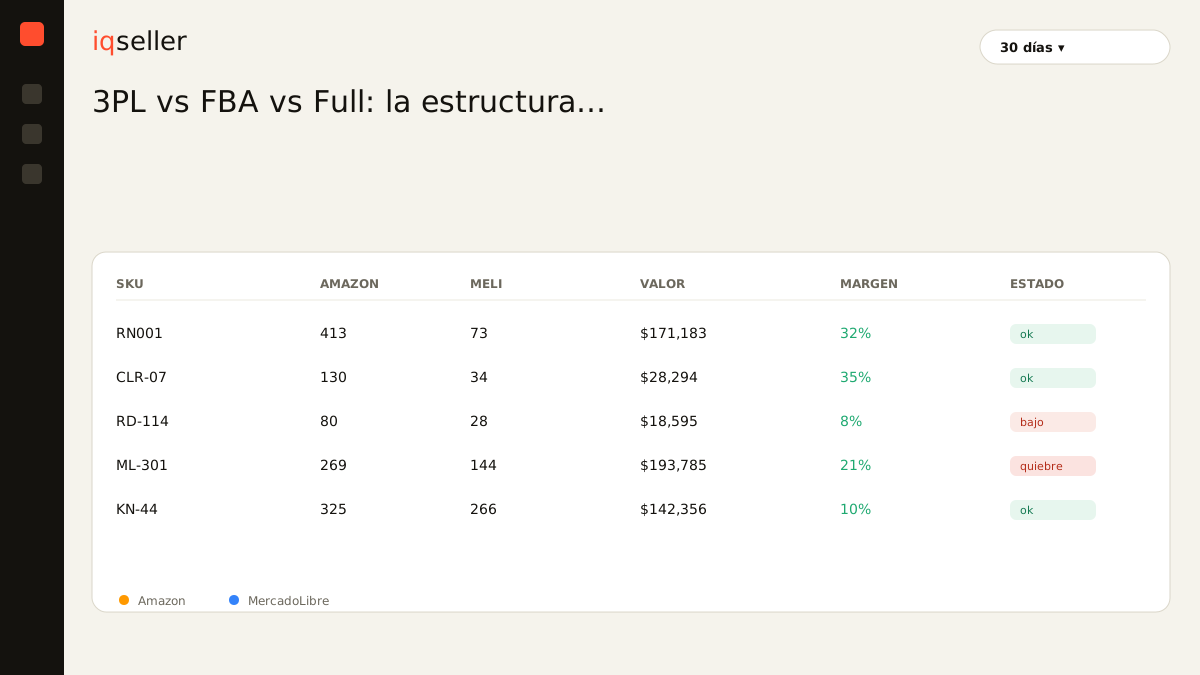
the three structures, side by side
Before arguing about which one wins, it is worth looking at what each one actually bills, because the shape of the charge matters as much as the amount.
Amazon FBA charges, for every unit, a fulfillment fee calculated from weight and dimensions, plus monthly storage for the volume your inventory occupies, plus surcharges on inventory that has been sitting too long without selling. On top of that come the cost of shipping your goods into the fulfillment center (inbound) and removal or disposal fees if you decide to pull it out. The referral fee is charged separately and does not depend on the fulfillment model.
MercadoLibre Full follows a similar logic with different rules: a shipping cost per unit that depends on the listing price and on seller reputation, daily storage per stored unit, and an extra charge for aged stock once units have been in the center too long. MercadoLibre’s own help pages describe that aged-stock charge as something that starts accumulating after a threshold of months and grows with the age of the unit; the exact rates change by category and by season, so the only place worth reading them is your own seller account.
A 3PL bills separate, transparent line items: receiving (per pallet or per carton), storage (almost always per pallet or per position per month), pick & pack (per order, with an extra charge per additional item), packing materials, and the shipping label, which can be the operator’s negotiated rate or yours. On top there is usually a monthly minimum and, sometimes, an onboarding fee.
The structural difference is this: with FBA and Full, cost scales with units and with time, and the rate is handed to you. With a 3PL, a large share of the cost scales with orders and with space, and the rate is negotiated. That is why a catalog full of slow-moving SKUs behaves very differently in one model than in the other.
Glossary: 3PL, the logistics operator that stores and ships for you →what you buy besides the shipment
If you only compare rate cards, FBA and Full almost always look expensive. The reason sellers use them anyway is that they are not just buying shipping.
On Amazon, inventory in FBA is what makes your offer Prime-eligible and what weighs heavily in the fight for the Buy Box. On MercadoLibre, Full is what lights up the fast-delivery promise and the badge the buyer sees before deciding. That differential never shows up as a saving on the fulfillment invoice: it shows up as conversion, and as units sold that you probably would not have sold with FBM or with your own 3PL.
With a 3PL the opposite happens. Cost per unit can be lower, you negotiate your own rate, and one inventory pool serves Amazon, Meli and your own store. But the delivery promise is yours to keep: if the operator slips, you are the one collecting claims and bad metrics, and on marketplaces late-shipment metrics have real commercial consequences.
So the honest comparison is not “which one charges less” but how many net pesos are left per unit sold in each scenario, knowing that sales volume is not the same across the three.
the variables almost nobody puts in the spreadsheet
This is the part that breaks most of the models I have seen.
- Long-term storage. The silent killer. Both FBA and Full punish units that do not move: first with monthly or daily rent, then with surcharges that grow as the unit ages. A SKU that turns in three weeks barely feels it; one that turns in seven months can pay more in storage than in fulfillment. In a 3PL the penalty exists, but it tends to be flatter, because you pay for space rather than for age.
- Returns. In FBA and Full, a good part of the receiving and restocking process is included, but the unit that comes back damaged, the one reclassified as unsellable and the processing fee all hit you. In a 3PL, every return is an explicit receiving and inspection charge. Either way, a high return rate completely changes the outcome of the comparison.
- Peak season. Buen Fin, Hot Sale and December move all three structures at once: marketplaces raise storage in the heavy months and cap how much inventory you may send in; the 3PL bills more pick & pack because more orders go out, and sometimes adds volume surcharges. A model that wins in March can lose in November.
- Inbound and reshuffling. Getting goods to Amazon’s center, to Meli’s center, or split between your 3PL and both marketplaces costs money and costs days. And if you got the split wrong, moving it again costs twice.
- Inventory control. The hardest variable to price and the one that hurts most. With a 3PL you can relabel, repack, build kits, pull a carton tomorrow and ship it to a wholesale client. With FBA and Full, your inventory is inside: pulling it out has a cost, a lead time and sometimes a cap. A product stuck in someone else’s fulfillment center is frozen capital you cannot reassign.
- Tied-up capital. What is sitting in a warehouse is not “inventory”, it is cash. Three models with the same cost per unit can leave you with very different inventory levels, because each one pushes you to ship different lot sizes.
an arithmetic example to make it concrete
The numbers below are invented and exist only to show the method. Take a SKU you sell at $650 whose landed product cost in your warehouse is $260. You sell 120 units a month and it turns in about 45 days.
In a marketplace-style scenario, shipping per unit costs $95 and prorated storage per unit sold works out to $18. Fulfillment cost per unit: $113.
In a 3PL scenario, pick & pack runs $38, packing material $9, the carrier label $79 and prorated storage $11. Fulfillment cost per unit: $137.
At first glance the marketplace wins by $24 per unit. But half the equation is missing: if the fast-delivery promise lifts conversion and you sell 155 units instead of 120, the extra gross margin from those 35 units enters the comparison. And if that same SKU turned in 150 days instead of 45, the marketplace’s prorated storage would no longer be $18 and the result would flip.
That is the point: there is no catalog-wide winner, there is a winner per SKU and per season. And you can only see it if the real fulfillment cost is charged against each unit sold, not treated as a fuzzy monthly expense.
when each model wins
Without pretending there is a universal rule, some patterns repeat:
- FBA or Full win when the product is small and light, turns fast, competes in a category where delivery speed closes the sale, and your volume does not yet justify negotiating your own rates. They also win when your operation cannot sustain the service level the marketplace demands.
- The 3PL wins when the product is bulky or heavy, when rotation is slow or seasonal, when you sell across three or four channels and want a single inventory pool, when you need to handle the goods (kitting, relabeling, B2B), or when your volume already gives you leverage with carriers.
- The mixed model wins more often than people expect. Sending only the fast-moving SKUs into FBA and Full, and keeping the rest of the catalog at the 3PL, usually lowers total cost without giving up the badge where it actually matters. The price of that strategy is management: now you have stock in three places and you need to see it together.
how this reads in iqseller
In the panel, the comparison stops being a quarterly spreadsheet and becomes a view.
In Profitability, every SKU carries its net margin with Amazon settlement commissions and MercadoLibre order fees already applied, FBA and Full fees as separate line items, shipping, and the COGS you load yourself. That is where fulfillment cost stops being a monthly expense and turns into pesos deducted from the unit you actually sold. If you load your 3PL cost inside COGS, the comparison lands in the same currency and the same view.
In Inventory you see stock split across FBA, Full and your own warehouse or 3PL, with the inventory valuation that tells you how much capital is parked in each. That figure is what turns “I have a lot of inventory in Full” into a concrete amount of money.
Forecast supplies the other half of the calculation: sales velocity and coverage per channel, which determine whether a SKU is going to pay aging surcharges or clear out before them. And Alerts flags when coverage drifts out of range, which is exactly when a fulfillment decision can still be corrected without paying for a removal.
The Parent → Model → SKU tree helps you avoid the usual trap: the model as a whole often looks profitable while two sizes are quietly paying for the storage.
how to decide without guessing
A method that works, with no sophisticated tooling:
- Take your twenty highest-selling SKUs and your twenty largest inventory positions. They are almost never the same list, and that is the problem.
- For each one, calculate the fulfillment cost per unit sold in the current model, including prorated storage and returns.
- Ask a 3PL for a real quote using your order mix, not an average. It should include receiving, storage, pick & pack, materials and carrier rates.
- Adjust for rotation: prorate storage using each SKU’s real days of inventory, not a catalog average.
- Check what happens in peak season to both rates and inbound limits, and run the math again for November.
- Decide per SKU and revisit every quarter, because rates change and so does your rotation.
One warning about concrete rates, worth more than any table: Amazon and MercadoLibre adjust their fulfillment costs regularly, by season and by category, and the public 3PL cost benchmarks that circulate online come almost entirely from operators in the United States, quoted in dollars, with an order mix unlike the Mexican one. Use them to understand the structure, never to budget. The numbers that belong in your model are the ones in your own Seller Central account, your own Meli panel, and a signed quote from your operator.
Glossary: real net margin, with everything deducted →The right fulfillment model is not a decision you make once. It is a decision you revisit with the real cost per unit in front of you, SKU by SKU, and it changes when rotation, season or rates change. The one thing you cannot do is make it with a margin inflated by a fulfillment cost that was never loaded.