
Multi-warehouse and 3PL inventory in one view
May 11, 2026
You have the same product sitting in four places at once: a few hundred units in a Fulfillment by Amazon center, another batch reserved in MercadoLibre Full, your own warehouse where you ship flex orders, and a 3PL that holds the bulk of your inventory and feeds it out over time. To know how many units of that one SKU you actually have, you open four different screens, write down four numbers, and add them up. By the time you finish, two of those numbers have already changed.
That is the daily reality of a multichannel seller once inventory is spread out. The problem isn’t that you’re short on stock; it’s that the stock is fragmented across silos that don’t talk to each other. Every warehouse and every marketplace has its own dashboard, its own way of counting, and its own lag. You become the human glue: you log into Amazon Seller Central, then the MercadoLibre panel, then the 3PL portal, you download the Excel report they emailed you, and you assemble a consolidated picture by hand that was already stale the moment it was born.
The cost of that manual work isn’t just your time. It’s that you decide restocks, transfers, and listing pauses based on yesterday’s data and a sum nobody validated. This article is about why multi-warehouse inventory becomes unmanageable by hand, what information you should actually be seeing, and why a single real-time view changes how you move your goods.
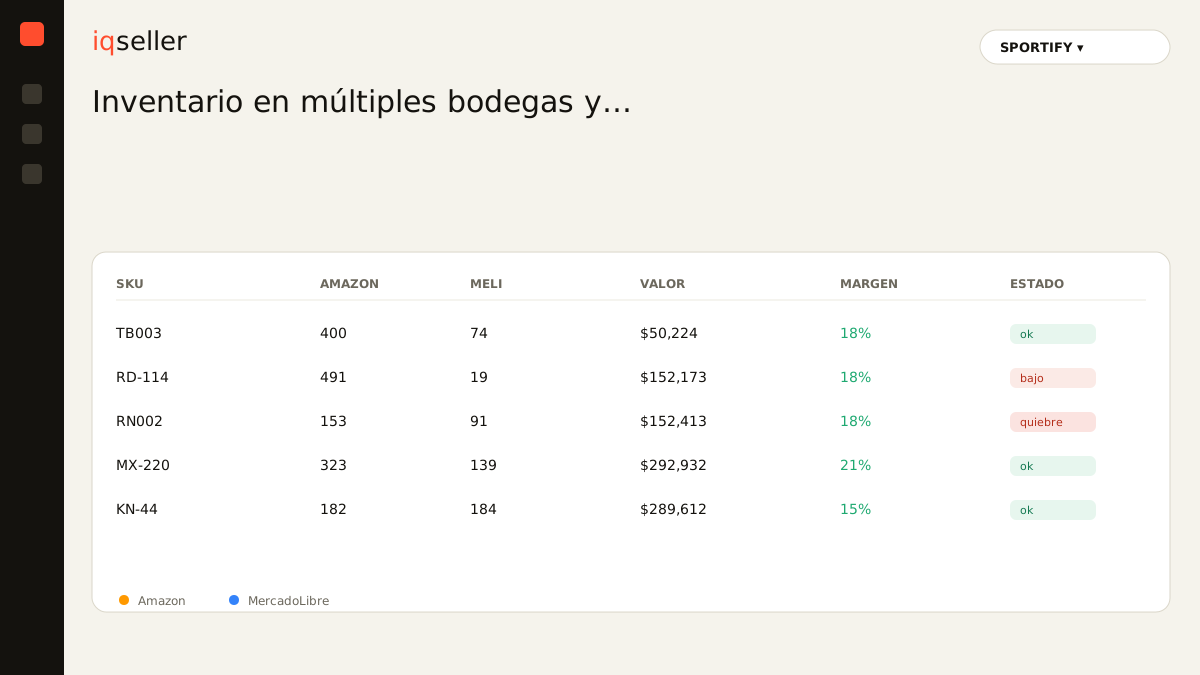
why inventory fragments as you grow
Nobody plans to keep their inventory in four places. You start with a single warehouse and a single channel, and it all fits in your head. But multichannel growth pushes you toward fragmentation almost without your deciding it.
You send a portion to FBA because the product sells better with the Prime badge and because Amazon punishes your ranking if you run out. You send another portion to MercadoLibre Full because fast delivery lifts your reputation and gives you exposure. You keep inventory in your own warehouse for flex orders and to stay independent on slow-moving products. And you hire a 3PL for the bulk, because storing everything inside the marketplaces’ centers gets brutally expensive in long-term storage fees.
Each of those decisions makes sense on its own. The problem is the cumulative effect: you end up with the same SKU spread across places that count differently, refresh differently, and share no single number. What started as a logistics decision becomes a visibility problem.
the real pain isn’t the stock, it’s the sum
It’s worth being precise about the pain, because it’s easy to misname. The problem is rarely that you don’t have inventory. The problem is that you don’t know, at any given moment, how much you have and where, without running a manual operation that takes minutes and goes wrong often.
There are three ways that manual sum betrays you. First, the data is born stale: by the time you’ve gathered all four sources, the real inventory has already moved because you sold while you were adding. Second, every source defines things differently — Amazon’s “available” isn’t MELI’s “available” or the 3PL’s — so adding up columns that don’t mean the same thing produces a meaningless total. Third, human error compounds: a mispasted cell, a SKU duplicated across channels, a filter you left on, and you restock against a phantom number.
Dictionary: real available stock is what you can sell right now, after subtracting reserves, holds, quarantine, and units in transit; with multi-warehouse inventory you have to calculate it per location and then consolidate.That’s why the more warehouses and channels you add, the worse the problem gets instead of better. Each new location multiplies the combinations you have to reconcile by hand.
what you should see on a single screen
Useful consolidation isn’t just “a total per SKU.” A total kills the nuance: it tells you that you have 600 units, but it doesn’t tell you that 400 of them sit in a 3PL five days away from any marketplace and that in FBA, where you actually sell, you have 40 left.
What you really need to see, on one screen and for each SKU, is the full distribution. How many units sit in each location: FBA, Full, your own warehouse, the 3PL. How many of each location are real available stock and how many are committed, held, in quarantine, or in transit. And on top of that, the sell-through rate per channel, so inventory isn’t a static snapshot but a number you read against the pace at which it’s running out.
With that view, a question that used to take ten minutes — “do I have a stock problem on Amazon this week?” — gets answered at a glance. It’s not that you’re short on inventory overall; it’s that the spare inventory is in the wrong place. Seeing the distribution, and not just the total, is what separates an informed decision from a gut call.
stranded inventory: having a lot and selling little
The classic case of poorly viewed multi-warehouse inventory is stranded inventory: stock that exists, that you count as yours, that inflates your total, but that sits in a location it can’t sell from.
Imagine SPORTIFY has 800 units of its flagship headphone. The “total stock” snapshot looks healthy. But 600 are at the 3PL, 150 are in the owned warehouse where almost no orders come in, and only 50 are in FBA, where 80% of demand happens. At that pace, SPORTIFY runs out on Amazon in four days while 750 units sleep elsewhere. The total was lying; the distribution was telling the truth.
Dictionary: inventory valuation is how much your stock is worth in money; when it’s spread across several warehouses, part of it can be dead capital in the wrong location without the total ever warning you.This is exactly the kind of situation a good inventory forecast should anticipate, but the forecast only works if it starts from the right distribution. Forecasting against a consolidated total, without knowing where each unit sits, makes you believe you’ll last weeks when in the channel that matters you’ll last days. And the underlying problem is the same one that separates real available from total stock: looking at the big number hides the number that actually decides whether you sell or not.
redistributing in time: the decision the view unlocks
When you see the real distribution on a single screen, a lever appears that you didn’t have before: redistributing before you run out in the wrong channel.
If you know you have four days of inventory left in FBA and 600 units at the 3PL, the decision is obvious and early: trigger a replenishment from the 3PL to FBA today, not next week when you’re already at zero and have lost ranking. If you see one channel holding inventory that isn’t moving while another runs dry, you transfer instead of buying more. Well-timed redistribution saves you from buying new inventory you don’t need, because you already had it — just in the wrong place.
This only works if the view is real-time. A redistribution decided on yesterday’s data arrives late by definition: you made the right call on the wrong snapshot. The value isn’t in seeing consolidated inventory once a day in an Excel; it’s in seeing it live, read against sell-through, so you can move goods while there’s still time to move.
Dictionary: a stockout is running out of real available stock to sell; with multi-warehouse inventory you can be out in one channel while you have a surplus in another, and you only notice it if you see the distribution.from four screens to one source of truth
The real shift isn’t a prettier Excel that pastes the four sources together better. It’s changing the model: instead of four snapshots from yesterday that you reconcile by hand, a single source of truth that reads Amazon, MercadoLibre, your warehouse, and your 3PL live, normalizes each one’s definitions, and gives you one view per SKU, per location, and per channel.
That’s exactly what the inventory module in iqseller solves. It doesn’t hand you yet another dashboard to add to your routine; it takes the others away. The “let me log into four screens and add up” step stops existing, and in its place you get a number that comes pre-reconciled, with its distribution broken out and the sell-through rate sitting right next to it.
When multi-warehouse inventory lives in a single real-time view, decisions that used to be reactive become anticipatory. You restock in the right channel before the stockout, you redistribute what’s stranded instead of overbuying, and you stop discovering problems only after they’ve already cost you sales. The physical fragmentation of inventory is unavoidable as you grow; the fragmentation of the information doesn’t have to be.