
Real available vs total stock: the gap that costs you sales
May 15, 2026
You open Amazon Seller Central and it says you have 240 units of your hero product. You open MercadoLibre and the same listing shows 180. Your 3PL emailed you a spreadsheet yesterday with 410 physical pieces sitting in the warehouse. How many can you actually sell right now, this minute, without breaking a promise? If your answer starts with “let me add it up,” you already lost the round. That question should have a single, instant answer, and it almost never does.
The problem isn’t that you’re out of inventory. The problem is that you’re confusing total stock —everything that exists somewhere— with real available, which is the only number you can honestly promise a buyer without sliding into a stockout or an oversell. Between those two numbers lives a gray zone where your missed sales hide, along with the cancellations you do pay for.
As a multichannel seller you live jumping between dashboards: Seller Central on one side, the MercadoLibre panel on another, the 3PL portal on a third, and at the end of the day it all gets pasted by hand into a spreadsheet that was already stale the moment you built it. You decide restocks, listing pauses and pricing on yesterday’s data. This article is about why that gap exists, what it actually costs you, and how a single real-time source of truth closes it.
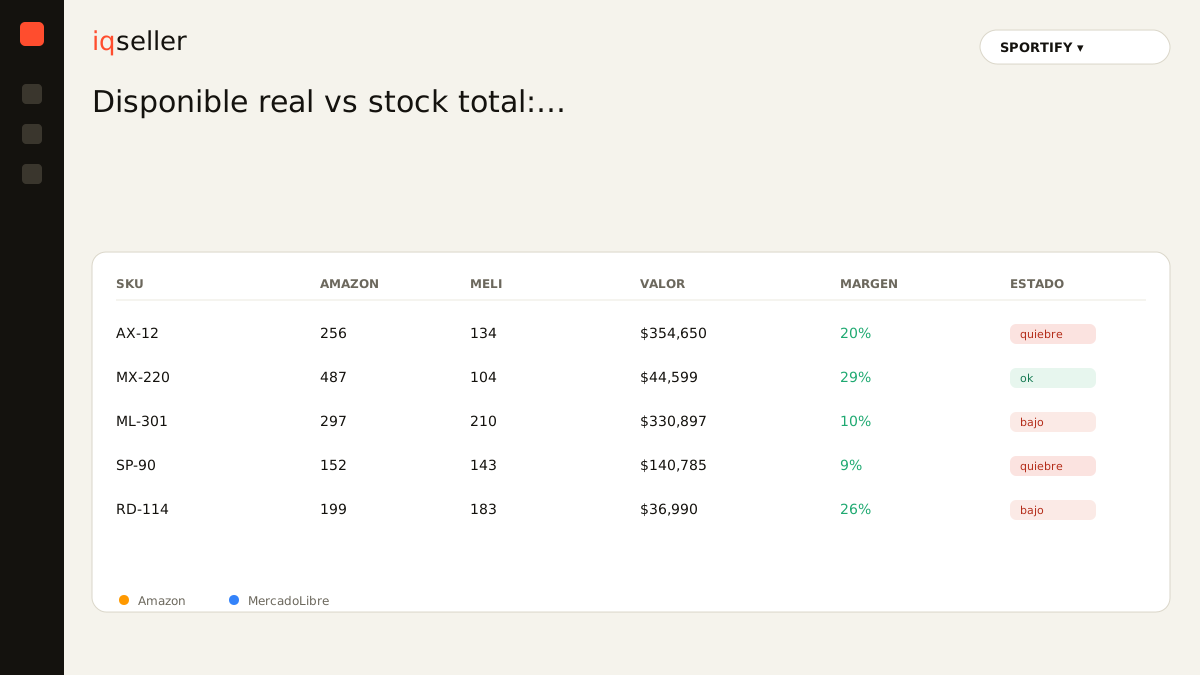
what real available actually means
Total stock is easy to grasp: it’s the count of pieces that physically exist, adding up warehouses, Fulfillment by Amazon centers, the 3PL’s storage and whatever sits in your own office. It’s an honest number, but a misleading one, because not everything that exists can be sold today.
Real available is a different thing. It’s total stock minus everything that’s already committed or blocked: units reserved by paid orders that haven’t shipped, pieces set aside for a MercadoLibre Full shipment, inventory in quarantine for quality review, returns not yet restocked, and the famous “in transit” stock that shows up in the report but is still on its way to the distribution center. Once you subtract all of that, you’re left with the number that actually matters: what you can sell without lying to anyone.
Dictionary: real available is the stock you can sell right now, after subtracting reservations, set-asides, quarantine and units in transit.The catch is that every marketplace computes “its” available differently and with its own sync delay. Amazon deducts pending orders at its own pace; MercadoLibre runs its Full and flex logic; the 3PL updates when it processes picking. Three different clocks, three different definitions, and you in the middle trying to make them line up.
why the gap widens without you noticing
The difference between total stock and real available isn’t constant: it moves throughout the day and grows exactly when you’re selling the most. On a normal Hot Sale morning, a single listing can take dozens of orders in an hour. Each one reserves units, but the reservation doesn’t show up at the same speed across all channels.
While Amazon has already deducted 30 pieces because it sold them in the last hour, your MercadoLibre panel still shows inventory from 40 minutes ago and keeps offering units that in practice are already gone. That lag is the breeding ground for oversells: you sell something you don’t have, you cancel, and you eat a reputation penalty on the marketplace.
The gap also widens from the opposite direction. You have 60 pieces reserved for a Full replenishment you haven’t processed yet, and because your spreadsheet only sees “total stock,” you think you have plenty and stop reordering. Two weeks later you’re in a stockout on Amazon while those 60 pieces are still set aside, not moving. The same misread number pushes you to oversell on one side and run short on the other.
the real cost: lost sales, oversells and dead capital
It’s worth putting numbers on this, because “difference between two columns” sounds harmless until you see the bill.
- Lost sales from a false stockout. You pause a listing or lower its priority because your spreadsheet says you’re low, when you actually had enough real available. Every hour paused is ranking you hand to a competitor.
- Oversells and cancellations. You promise what you can’t deliver. On Amazon that hits your Order Defect Rate; on MercadoLibre, your reputation and your access to MercadoLíder. The fees and the cost of a bad review are real.
- Dead capital. Inventory you count as “available” but that’s in quarantine or set aside is money standing still. And if your inventory valuation leans on undeduplicated total stock, your margin and your cash flow look better on paper than they really are.
Each of these costs comes from the same root error: treating two different numbers as if they were the same. And none of them gets fixed by forcing yourself to add faster in Excel.
why piecing it together by hand never scales
The manual approach has a very low ceiling and you’ve already hit it. With a handful of SKUs and a single channel, a daily sheet works. With hundreds of listings spread across Amazon FBA, MercadoLibre Full, flex seller and a 3PL, hand consolidation stops being viable.
There are three deep reasons. First, the data is born stale: by the time you finish pasting the three reports, real inventory has already changed. Second, every source defines “available” differently, so adding columns that don’t mean the same thing produces a meaningless total. Third, human error stacks up: one mis-pasted cell, a filter you left on, a duplicated SKU, and you make restock decisions on a number nobody validated.
That’s why the fix isn’t a prettier spreadsheet or a cleverer macro. It’s changing the model: instead of yesterday’s snapshots that you paste, a single source of truth that reads Amazon, MercadoLibre and your 3PL live, normalizes the definitions, and hands you one real available per SKU and per channel. That’s exactly what the inventory module in iqseller solves: “let me add it up” stops existing.
what a well-computed real available looks like
A reliable real available isn’t a single magic number; it’s a transparent subtraction you can audit. For each SKU you should be able to see total stock, and below it, clearly, what was deducted and why: reserved by orders, set aside for Full, in quarantine, in transit. When you see the full subtraction, you stop guessing.
Everything else is built on top of that well-computed real available. The inventory forecast only works if it starts from the right number: forecasting demand on inflated total stock makes you believe you’ll last longer than you will. And days of inventory, your countdown to a stockout are computed by dividing real available by your sales velocity: if the numerator is wrong, the countdown lies.
When SPORTIFY, to use a multichannel store as an example, looks at its board and sees that of 410 physical pieces only 286 are real available, it stops promising the 410. It restocks in time what’s actually selling and frees the capital trapped in what was over-reserved.
real available as the basis for decisions, not as a report
The mindset shift is to stop treating real available as a figure you look up and start treating it as the base on which you decide everything. Restocking, pricing, listing pauses, Ads budget: each of those decisions degrades if it starts from total stock instead of real available.
When real available lives on a single screen, in real time and per channel, decisions stop being grounded in uncertainty. You know exactly how hard you can push on Ads without risking an oversell, when to deprioritize a channel because its available ran out, and when a stockout is genuinely close.
Dictionary: a stockout is running out of real available to sell; watching total stock hides it from you until it’s already too late.The difference between real available and total stock isn’t an inventory technicality: it’s the difference between selling with confidence and selling blind. Close that gap and you stop paying for lost sales, cancellations and dead capital because of one misread number.