
Days of inventory: your countdown to a stockout
May 12, 2026
Most sellers look at inventory as a snapshot: how many units do I have today. And that snapshot lies, because it never tells you the one thing that actually matters: how many days you have left before you hit zero. Holding 200 units feels comfortable until you remember you sell 25 a day and your replenishment takes three weeks to arrive. Those 200 units aren’t a cushion; they’re an eight-day countdown that already started ticking.
The metric that turns the snapshot into a countdown is days of inventory: the number of days you can keep selling at the current pace before you run out of stock. It’s simple to define and brutally revealing, because it puts time —not units— at the center of the decision. The problem is that almost no one calculates it correctly, and even fewer do when selling across several channels at once.
If you’re a multichannel seller, you know the ritual: you open Amazon Seller Central in one tab, MercadoLibre in another, log into your 3PL portal, download three reports, paste them into Excel, and try to eyeball how much you have left. By the time you finish, the numbers have already changed: you sold while you were building the sheet. You decide on yesterday’s data and pray the stockout doesn’t catch you. This article is about why that ritual fails and what the alternative looks like.
what days of inventory really are
The formula is honest in its simplicity:
Days of inventory = real available ÷ daily sell-through rate
If you have 180 available units and sell 12 a day, you have 15 days left. Nothing more. But each term in that division hides a trap for the multichannel seller.
The real available is not what the general report says. It’s what you can actually sell right now: it discounts units reserved by in-process orders, damaged goods, items held in customs, and stock that sits physically in a warehouse but isn’t yet listed in the channel where it sells. The sell-through rate isn’t a fixed number either: it shifts with the season, with promotions, with whether you won or lost the Buy Box this week. Using a flat 90-day average in the middle of a Hot Sale ramp is the recipe for underestimating your pace and running short exactly when you sell the most.
Dictionary: real available is the stock you can sell today, already net of reservations, damaged units, and held goods, not the gross total from the report.why the manual calculation betrays you
The manual calculation doesn’t fail for lack of effort, it fails because of physics. When you sell the same SKU on Amazon FBA, on MercadoLibre Full, and from your own warehouse via a 3PL, that product has three “stocks” in three systems that don’t talk to each other. Adding them by hand means picking one frozen moment, and that moment goes stale in minutes.
Worse still: each channel defines things differently. What Amazon calls available includes reserved units you won’t be able to sell. What MercadoLibre reports as Full may include pieces in transit to the distribution center that still can’t be offered. If you add them as-is, you inflate your available and your days of inventory lie upward. You think you have 20 days and you have 11.
The result is that most stockouts don’t happen out of bad luck, but out of an optimistic spreadsheet. We dig into this in real-time inventory: as long as the numbers live in sheets you update by hand, you’ll always be one step behind your own sales.
lead time is the other side of the count
Knowing you have 15 days left is useless if you don’t know how long your replenishment takes. This is where lead time comes in: the days between firing off a purchase order and having the product sellable in the channel. It’s not just the supplier’s transit; it includes production, customs, warehouse receiving, shipping to the marketplace’s fulfillment, and the time it takes for the listing to go live.
The mental rule is direct: if your days of inventory drop below your lead time, the stockout is already guaranteed, no matter what you do today. If you have 15 days left and replenishment takes 30, you will be out of stock for 15 days no matter what; you should have ordered more than two weeks ago. That’s why the right alert threshold is never “tell me when it hits zero,” but “tell me when days of inventory drop to lead time plus a safety cushion.”
That cushion absorbs what always moves: a demand spike, a customs delay, a supplier who runs late. Without a cushion, any jolt pushes you into a stockout.
the real cost of hitting zero
Running out of stock costs more than the lost sale of the day. On Amazon and MercadoLibre, going to zero lowers your organic ranking: the algorithm stops showing a product it can’t fulfill, and recovering the position takes weeks of consistent sales once you replenish. It’s a penalty you pay later, when you’re already back in stock but the traffic isn’t.
There are more hidden leaks. If you have active Ads campaigns, they keep spending budget sending traffic to a paused listing: you pay for clicks that can’t convert. And there’s the brand cost: a customer who didn’t find you available buys from the competitor and may never come back.
Dictionary: a stockout is running out of sellable units of a SKU; on marketplaces you don’t just lose the sale, you also lose organic ranking that takes weeks to rebuild.overstocking is not the solution
The typical reaction to the fear of a stockout is to buy too much “just in case.” But excess inventory has its own price, only it’s a silent one. Every idle unit is frozen capital you can’t put toward another SKU that does turn over. On Amazon FBA you add the storage fee, which punishes aging inventory with rising charges. And the product that doesn’t sell risks obsolescence, damage, or having to be liquidated at a loss.
That’s why days of inventory is a double-edged metric: it warns you of both the stockout and the overstock. Too few days, you’ll lose sales; too many days, your money is asleep. The healthy number lives in a band, not at a maximum. To see how much capital you have locked up in that excess, check real-time inventory valuation: how much capital is tied up: days of inventory tell you the time risk, valuation tells you the money risk.
Dictionary: inventory valuation is the capital invested in your available stock; crossing it with days of inventory reveals how much money sits idle from overstock.a single source of truth in real time
The way out isn’t a prettier Excel, it’s removing Excel from the critical calculation. When the three channels —Amazon, MercadoLibre, and your 3PL— pour their available into a single source that updates itself, days of inventory stop being a stale snapshot and become a live number that drops as you sell.
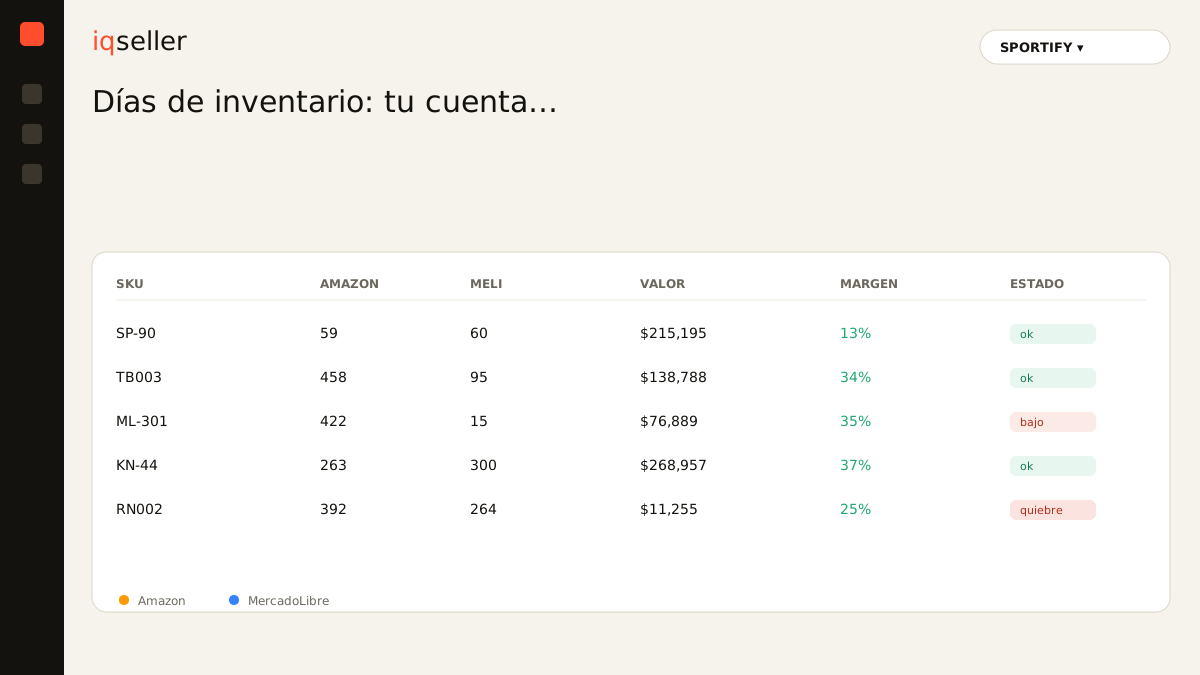
On that foundation, the calculation runs itself, per SKU: it takes the consolidated real available, divides it by the sell-through rate weighted by channel and season, and compares it against your lead time plus cushion. What used to cost you a morning of tabs and copy-paste becomes a column that’s already computed when you open the panel, sorted by urgency: at the top, the SKUs whose countdown is closing in on the point of no return.
That changes the daily question. You stop asking “how many units do I have?” —the snapshot that lies— and start asking “which SKU is running out of time first?”. That’s the question that prevents the stockout and, along the way, keeps you from over-buying what still has weeks of cushion.
in short
Days of inventory turn your stock into a countdown, and that countdown is only useful if it’s computed on real available, a realistic sell-through rate, and an honest lead time. The manual calculation across Amazon Seller Central, MercadoLibre, and the 3PL portal fails because it stitches together stale numbers and mismatched definitions. The alternative is a single source of truth in real time where the number computes itself, per SKU, and sorts your urgencies before it’s too late. iqseller keeps that countdown alive so you replenish on time and stop deciding on yesterday’s data.