
Phantom inventory across Amazon, MELI and 3PL
May 14, 2026
Phantom inventory is the stock that exists in your reports but not in reality, or that exists in the warehouse but no longer in your listings. It is the unit you sold on MercadoLibre forty minutes ago that Amazon still believes is available. It is the box your 3PL received yesterday that no marketplace has counted yet. If you sell across several channels at once, this ghost lives with you every single day, even when you cannot see it.
The problem rarely starts with a serious error. It starts with a small gap: Amazon Seller Central shows one number, MercadoLibre shows another, and your 3PL panel shows a third. Each platform has its own clock, its own reservation logic, and its own way of counting what is “committed.” As a seller, you end up opening three tabs, exporting three files, and building a spreadsheet by hand to try to guess how much you really have. And by the time you finish that spreadsheet, you have already sold three more units and the number is lying again.
The real damage is not the mess, it is the decision. You overbuy because you do not trust the data and would rather keep a cushion. Or you underbuy because an old report told you that you were well stocked. You pause a listing that actually had stock, or you keep another one alive that is already sold out and end up cancelling orders. Every one of those decisions is born from the same source: you are operating on yesterday’s data in a business that moves by the minute.
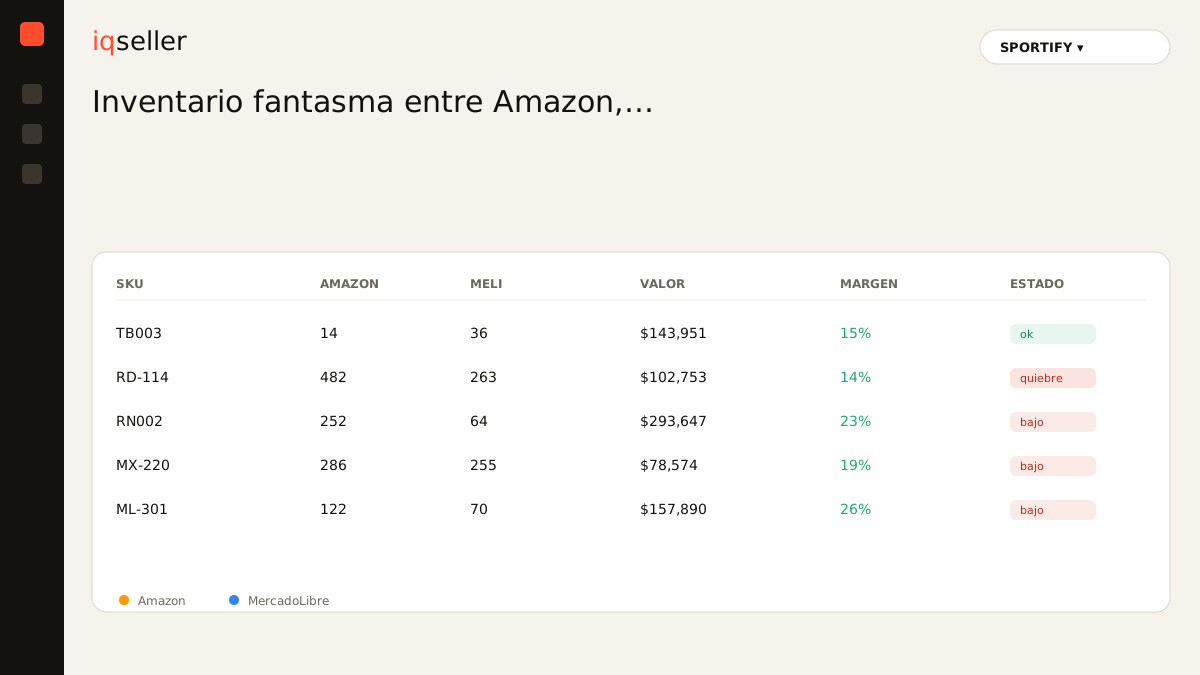
why phantom inventory appears
Phantom inventory is not a bug, it is a natural consequence of how marketplaces are designed. Each channel assumes it is the sole owner of your stock. Amazon decrements when it confirms an order; MercadoLibre reserves when someone adds to cart or pays, depending on the flow; your 3PL decrements when it physically picks the order. Three different moments for the same event.
When a single unit can sell on any of the three channels, those timings collide. You sold the last unit on Amazon, but MercadoLibre still offers it because its sync runs on an interval. The buyer pays, you cannot fulfill, and you walk straight into the territory of cancellations and damaged reputation. On MELI that hits your seller level directly; on Amazon, your account health. The ghost costs money and it costs metrics that take months to recover.
On top of this sits in-transit inventory: what you already went out to buy, what is in customs, what the 3PL received but has not yet shelved. That real stock does not show as sellable yet, so you see it as zero and you panic. The ghost works in both directions: it makes you believe you have what you no longer have, and it hides what you actually do have.
the cost of stitching it together by hand
The survival method for almost every multichannel seller is the same: download reports, paste them into a sheet, run a subtraction, and pray. It works until you stop having five SKUs and move to fifty, or five hundred. The spreadsheet stops being a tool and becomes a second job that does not pay.
Dictionary: true available stock is what you can genuinely sell today, after subtracting reservations, orders in process, and damages, not the figure each panel shows on its own.The problem with the spreadsheet is not just the time. It is that it is out of date the second you save it. When you built it at nine in the morning, it was a snapshot; by eleven it is already fiction. You make buying and pricing decisions on an old snapshot, and every decision inherits the error. If you also work with a team, everyone has their own version of the file and nobody knows which one is correct. The source of truth stops existing and gets replaced by whoever spoke loudest in the last meeting.
one single source of truth in real time
The way out is not checking all three dashboards more often. It is stopping having three and having a single one that reads them all. The idea behind Multi-warehouse and 3PL inventory in one view is exactly that: let Amazon, MELI, and your 3PL feed the same number, and let that number update on its own when something sells, is received, or is reserved.
When a single source of truth exists, phantom inventory becomes visible. It is no longer something you discover when a buyer complains; it is an alert that appears when the true available stock of a SKU drops below the threshold you defined. The difference between “I found out too late” and “I was warned in time” is exactly what separates an operation that reacts from one that gets ahead.
In iqseller that single view does not replace your channels: it reads them, reconciles them, and shows you the number that matters. If SPORTIFY sells a unit on MercadoLibre, the available stock drops for every channel in the same move, not in the next sync cycle.
reconciling is more than adding up
Having the three numbers side by side is not enough; you have to reconcile them. Reconciling means understanding why Amazon says 12, MELI says 14, and the 3PL says 13, and deciding which number is correct. Almost always the physical truth lives in the warehouse, but the truth about what is committed lives in the marketplaces. Reconciliation crosses both: physical stock minus what is already sold and reserved in each channel.
That cross also reveals leaks you would not otherwise see: shrinkage nobody logged, returns that came back to the warehouse but not to the listing, damaged units that still count as sellable. Each of those leaks is phantom inventory waiting to become a cancellation or an oversell.
Dictionary: inventory valuation tells you how much money you have locked up in stock; without a reconciled view, that number is also inflated by phantom units.Reconciling continuously, not once a month, is what keeps the ghost in check. A monthly reconciliation tells you what happened; a live reconciliation tells you what is happening and lets you act before the error reaches the buyer.
from data to pricing and purchasing
Reconciled inventory is not only good for avoiding oversells. It is good for deciding better at everything else. When you know your true available stock per channel, you can move prices with intent: raise the price of a SKU that is running low to stretch the stock until the next replenishment, or lower it in a channel where you have excess. That is exactly what connects to the Automatic price calendar: smart pricing needs reliable inventory underneath, because adjusting prices on phantom data only amplifies the error.
The same applies to purchasing. The question “how much do I order?” only has a good answer if you know your true available stock plus what is in transit, crossed with your combined sales velocity across the three channels. Ordering based on what a single dashboard shows is buying blind across two thirds of your business.
Dictionary: a stockout is running out of sellable product; phantom inventory pulls the stockout forward because it makes you believe you have room when you no longer do.what changes in your day to day
The practical change is simple to describe and deep to live. You stop starting the morning by opening three tabs and building a spreadsheet. You open a single view, you see the true available stock per SKU and per channel, and the alerts have already flagged what is urgent. The time you spent reconciling, you now spend deciding.
It also changes the conversation with your team and your 3PL. Everyone looks at the same number, so the arguments stop being about which file is correct and shift to what to do with the data. Uncertainty does not vanish entirely, no business removes it, but it stops coming from your own reports.
Phantom inventory will keep showing up every time one channel sells faster than another can register it. The difference is that now you watch it appear in real time, you reconcile it before it bites, and you make your pricing and purchasing decisions on a number you can actually trust. That is the promise of having a single source of truth for Amazon, MELI, and your 3PL at the same time.