
Price War: What It Is and How to Exit Without Burning Margin
July 27, 2026
A price war is a downward spiral in which two or more sellers offering the same product (or a very similar one) keep undercutting each other, round after round, to win the sale or the Buy Box. Each one reacts to the other’s latest cut, nobody wants to be the higher-priced option, and the price falls far faster than costs do. The outcome is predictable: everyone ends up selling roughly the same number of units as before, but each unit leaves far less profit behind. That is the heart of the problem.
Getting out of a price war without burning your margin almost never means “cutting faster than the other guy.” It comes down to three things: knowing your real floor —the price below which you actually lose money, not the one you assume—; understanding that competing on price isn’t your only lever; and having all your channel data in one place so you don’t react blind. Most sellers lose these wars not because their product is worse, but because they don’t know in real time what is happening or how much each cut actually costs them.
This article explains why price wars break out, exactly what damage they do to your net profit, and what you can do to compete without racing to zero. If you sell on Amazon Mexico and MercadoLibre at once —plus Shopify or a 3PL— the problem multiplies: a war that started in one channel bleeds into another, and without a panel that sees them together, you almost always find out too late.
why a price war breaks out
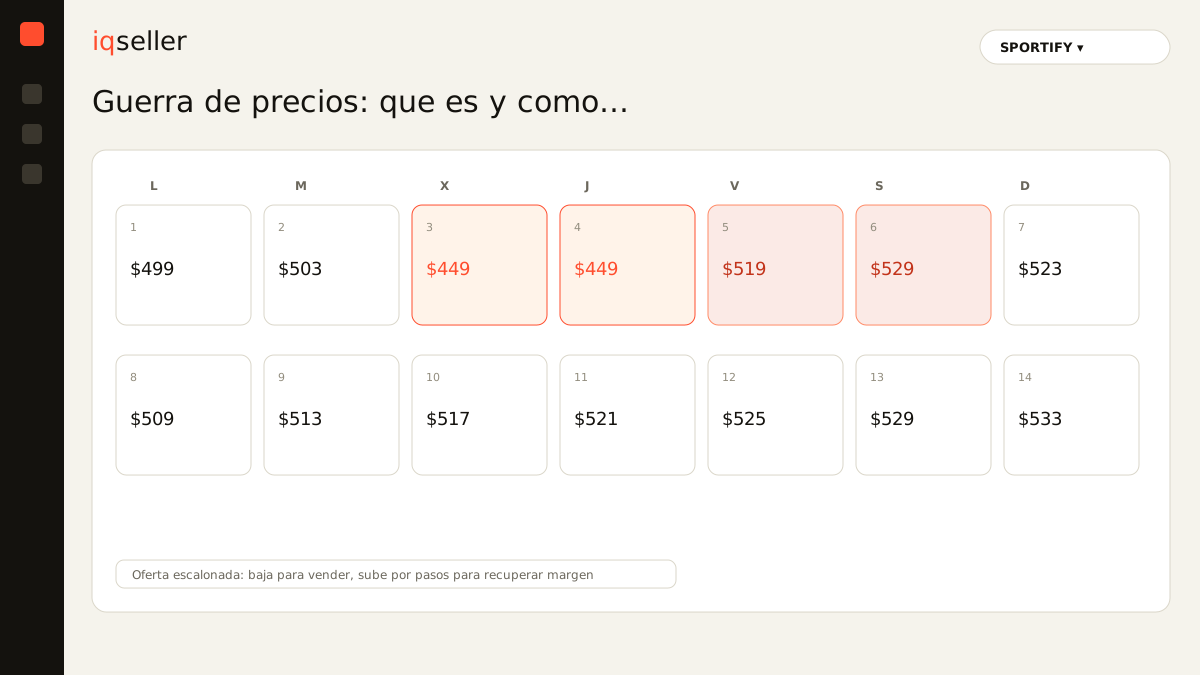
It almost always starts the same way: a competitor drops the price a few pesos to grab the Buy Box or climb the search ranking. You notice —or your repricer notices— and you drop to stay in the running. The other seller cuts again. Within hours, a product that sold for $499 is at $449, then $429, and neither of you sold a single extra unit: you just split the same sales at a lower price.
What lights the fuse is usually a mix of these factors:
- Identical or commodity product. When several sellers share the same listing or sell an undifferentiated product, price becomes almost the only buying criterion. There is nothing else to compete on.
- Poorly calibrated automatic repricers. Many wars are fought by bots, not people. If your repricer is set to “always be the cheapest” and the competitor’s is too, they undercut each other to the floor with nobody actually deciding anything.
- Inventory pressure. A seller sitting on excess stock —or with FBA storage fees ticking— is in a hurry to sell and dumps the price. Their urgency becomes your problem.
- New entrants. Someone who just landed on the marketplace buys share by cutting price, willing to lose margin for a while to earn reviews and ranking.
The trigger is rarely rational in the long run. It’s a short-term reaction that, multiplied across several players, turns into a race to the bottom.
the real damage: what happens to your margin
Here is the point many sellers measure badly. Cutting the price by 10% does not cost you 10% of profit: it costs you far more, because your costs don’t fall with you. The marketplace fee is a percentage, yes, but product cost, shipping, packaging and your time are fixed per unit. When you cut the price, that cut comes almost entirely out of your margin.
An example makes it concrete. Say you sell a product at $500 that costs you $300 all-in —product, shipping and fees. Your profit is $200. If you drop the price to $450 —just 10%— your profit falls to $150. That’s a 25% drop in your earnings from a 10% price cut. Drop another rung to $420 and your profit is $120: you’ve lost 40% of what you used to make, and you still carry the same operational work on every order. This asymmetry is the trap in every price war.
That’s why the number you need to know before you enter a price fight isn’t the competitor’s price: it’s your glossary: real net margin, with everything deducted →. Without that figure per channel, you’re fighting without knowing where your floor is. To calculate it properly, product by product, it’s worth reviewing how to calculate the real profitability of a marketplace product: it’s the foundation that tells you, in every war, how far you can go down without giving money away.
the multichannel pain: finding out late
The seller who works a single channel at least fights on one board. The multichannel seller fights on several at once, and that is the part that burns the most margin. You spot a price drop on Amazon by opening Seller Central, on MercadoLibre by logging into its panel, on Shopify by checking yet another screen. Since nobody has time to watch three or four dashboards all day, the data gets stitched together by hand —often in a spreadsheet at the end of the day— and by the time you see the competitor’s cut, you’ve already spent hours selling low or, worse, you’ve already lost the Buy Box.
That delay is expensive. In a price war, time is literally money: every hour you react late is a handful of units sold at the wrong price, or a handful of sales the other seller took. The uncertainty —“am I losing margin right now and don’t know it?”— is as costly as the drop itself, because it pushes you to overreact out of fear.
This is where real time changes the fight. A panel that sees your channels together and alerts you the moment a competitor moves the price —or the moment your own price falls below a floor you defined— turns a late, blind reaction into an informed decision. It’s not about watching more screens; it’s about not watching them at all: letting the system flag you only when something needs a decision.
how to exit without racing to zero
Getting out of a price war isn’t surrender, nor “outlasting the other guy.” It’s changing the terrain. These are the levers that work better than cutting further:
-
Set your floor and don’t cross it. First, fix the minimum price per channel where you still earn an acceptable margin. That floor is your hard limit. If the competitor goes below your floor, let them: they’re selling at a loss, and that wound is self-inflicted. Chasing them only means you lose too.
-
Differentiate to escape pure comparison. Price rules only when the product is identical. A bundle, an extended warranty, faster shipping, better listing content or better reviews break the one-to-one comparison and earn you permission to charge more. Stop competing on the same peso and start competing on the better offer.
-
Use price as a sequence, not a reaction. Instead of answering every cut instantly, design a strategy with an automatic price calendar: drop to capture demand when it makes sense and step back up to recover margin, rather than leaving the price sunk “because the other guy is still low.” A glossary: laddered offer, step by step → lets you move units without getting stuck at the war price.
-
Let the system watch, not you. Set up cross-channel price-drop alerts and a glossary: what a price calendar is and why to automate it → so the price rises again on its own when pressure eases. That way you don’t rely on your memory or discipline to recover margin once the war cools off.
the repricer’s role: ally or fuel
An automatic repricer can be your best tool or the thing that drags you into the war. The difference is in how you configure it. A repricer that only chases “be the cheapest” is fuel: it guarantees you join every race to the bottom. One that respects your real net margin floor and only drops that far is an ally: it competes when it’s worth it and holds firm when crossing the floor would mean selling at a loss.
The key is that the repricer knows your real cost per channel, not a flat number. Because Amazon and MercadoLibre fees differ, and FBA or Full costs differ too, the same selling price leaves very different margins on each platform. A single floor for all channels is an expensive mistake: on one you have cushion to spare, on another you’re already selling at a loss without noticing. That’s why the floor —and therefore the repricer— has to be calculated channel by channel, with unified, up-to-date data.
what to watch when the war ends
Every price war ends: someone runs out of inventory, someone decides it’s no longer worth it, or the market stabilizes. The moment to recover is exactly when the pressure eases, and it’s also the one most sellers waste, because nobody remembers to raise prices back up. A forgotten war price keeps eroding your profit weeks after the battle is over.
That’s where having your channels in one panel pays for itself. You see when the competitor stopped cutting, you step the price back up so you don’t kill sales momentum, and you confirm —with real net margin in view— that each rung recovers profit without scaring off the buyer. You move from reacting to designing, which is the only way to compete on price without price eating you alive. The goal was never to win the war: it was to walk out of it with your margin intact.