
Stranded and unfulfillable inventory: two buckets and their exit routes
November 22, 2026
Almost every seller with a year in FBA has a number they would rather not look at: the total units sitting physically in Amazon’s warehouse that cannot be sold. And one piece of confusion makes that number grow larger than it needs to be, because it is really two different buckets, with different causes and different exits, and they almost always get treated as the same thing.
The first bucket is stranded inventory: units in perfect condition whose offer broke. The product is fine, the listing is not. Fix the listing and the unit sells again. It is a catalog problem.
The second is unfulfillable inventory: units Amazon has already classified as not fit to be sold as new. Product damaged in the warehouse, returned by a customer and received in bad condition, expired, packaging destroyed. There is no listing to fix here. The product is never going back on sale as new, and the only valid question is how you get it out and how much you recover.
The distinction matters because the correct reaction is the opposite in each case. With stranded stock, you fix and reactivate. With unfulfillable stock, you pick an exit and execute it fast, because every month you leave it there it pays storage with zero chance of generating a sale. And in the last quarter it pays that at the peak-season rate.
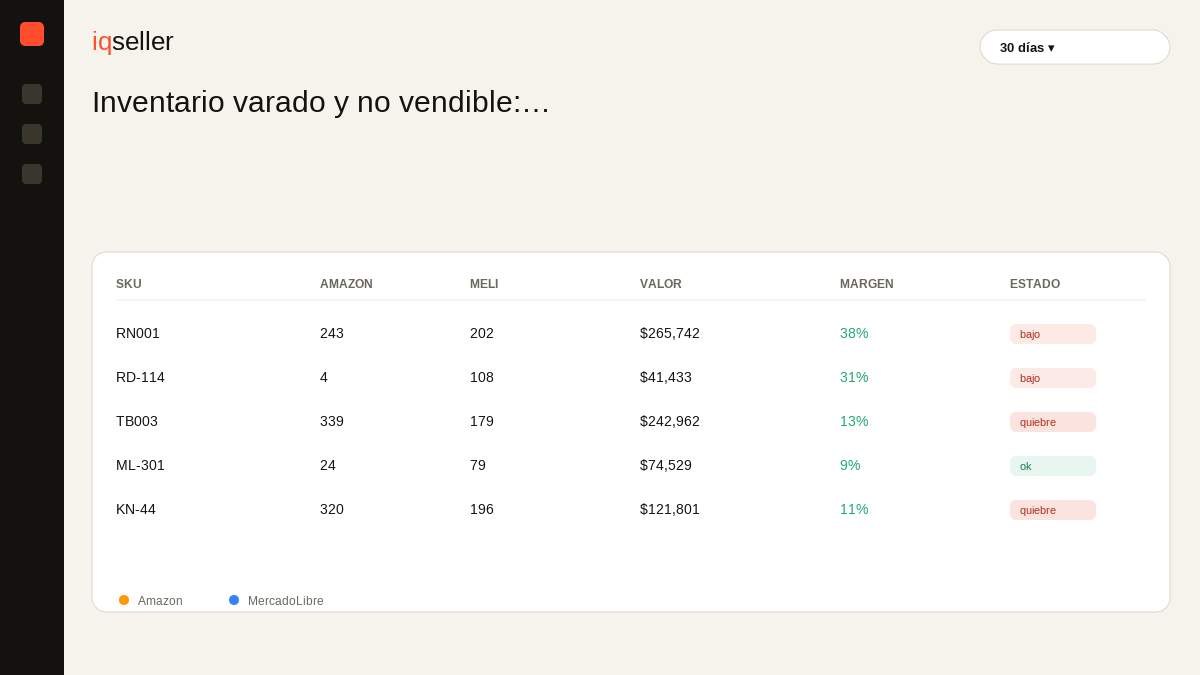
bucket one: stranded, or good product with a broken listing
Stranded inventory is stock physically in a fulfillment center with no active offer selling it. The most frequent causes documented by industry guides are all catalog-side: a listing suppressed over an image, price or content issue; an offer closed by accident; a variation Amazon split; a new category compliance requirement; a product-code change or a switch from merchant-fulfilled to FBA that disconnected the units from their page.
We covered this bucket in depth in two other articles — what stranded inventory is and how to recover it and the common causes and how to prevent them — so here I will stick to what matters when you have to decide fast.
Every stranded SKU comes with a reason code and a recommended action in the corresponding Seller Central report. It is not a mystery to be investigated: Amazon tells you what broke. Most cases resolve by correcting whatever the reason code points at and reactivating the offer; a portion fixes itself because Amazon automatically relists certain error types.
What you want burned in is the clock. Those units keep accruing storage while they are stranded, and they keep marching toward the aged inventory surcharge thresholds — which the guides place from 181 days onward, with tiers around 271 and 365. There is no pause button. A unit stranded in October that you fix in February paid four months of rent, three of them at the peak-season rate, for nothing.
Glossary: real available stock, what you can truly sell right now →bucket two: unfulfillable, the one almost nobody cleans
This is the part that gets discussed least and where more capital gets trapped than people realize.
Unfulfillable inventory — or unsellable, depending on what the report calls it — is units Amazon received or reclassified and can no longer offer as new. The usual sources are four: product returned by a customer and received opened or damaged, product damaged inside the warehouse or in transit, product expired or near expiry in dated categories, and product whose packaging arrived in a condition that does not meet the sale standard.
The way it accumulates almost always follows the same pattern. It does not arrive all at once, it arrives two or three units a month. Nobody opens a report to look at two units. And since it does not appear in the sellable inventory list, it does not get in the way of the daily view either. Twelve months later it is eighty units occupying volume and paying rent, and by the time somebody finally sees them they have passed every aging tier.
The real cost has three layers and they are worth seeing together:
- The storage those units paid every month with no chance of a sale.
- The capital immobilized: that inventory has an acquisition cost that already left your bank account.
- The volume they consume from your capacity limit, which is the most expensive cost in peak season because it is space your bestseller does not have.
And there is a fourth cost that is not monetary: part of that unfulfillable inventory comes from returns, and if you never review it, you never learn that a SKU is coming back more than it should. The unfulfillable report is, without anyone saying so, a quality and packaging problem detector. If a product shows up there month after month, the problem is not in Amazon’s warehouse.
how to catch it before it piles up
Detection is not hard; it is a habit almost nobody has because nothing forces it to exist. Three levels, from least to most:
Level one, the weekly manual check. Seller Central has a stranded inventory report and views for unfulfillable inventory. Industry sources give slightly different paths depending on the panel version, so the useful instruction is to look for “fix stranded inventory” inside FBA inventory management and the unfulfillable inventory report in the same section. Ten minutes a week, always the same day.
Level two, automated rules. Seller Central lets you configure automatic actions for unfulfillable inventory: units classified as unsellable get removed or liquidated on their own according to the rule you define, without anyone having to decide case by case. It is the only realistic way to stop the two-units-a-month drip from becoming eighty. The available options and their conditions change by marketplace, so check what is enabled on your Mexican account before assuming you have all of them.
Level three, the alert that comes looking for you. The difference between a seller who checks and a seller who finds out is which way the arrow points. As long as you have to remember to open a report, the report wins: in the week of the peak nobody opens anything. What works is the number showing up where you are already looking, with the capital it represents next to it.
The golden rule, if you keep only one thing: the time to clean both buckets is before the peak-season window opens, not in January when you have already paid three months of rent at the highest price of the year.
the exit routes for unfulfillable stock
Once a unit is unfulfillable, you have four paths. None of them returns the selling price; the point is to pick the one that recovers most or loses least.
Removal to your address. Amazon returns the product to an address you provide. You pay a removal fee per unit plus shipping. It makes sense when the product can be refurbished, resold through another channel, repackaged or used for parts. It is the route that recovers the most value if you have the operational capacity to process it, and the worst one if the boxes are going to end up in a corner of your warehouse.
Liquidation. Amazon sells the inventory to wholesale liquidators and credits you a fraction. Industry guides are blunt about it: what you recover is a low proportion of the selling price. It makes sense when the product works but is no longer sellable as new and you have no way to move it yourself.
Disposal. You pay for Amazon to destroy it. It sounds like the worst option and is sometimes mathematically the best: on small, low-priced, damaged product, paying the removal fee plus freight can cost more than the value of what you recover.
Grading and resale programs. Amazon runs schemes where it evaluates returned product, grades it by condition and relists it as used. Industry sources note that access can be invitation-based and limited to returned inventory in enabled fulfillment centers, so do not assume it is available for your account: verify it in Seller Central.
Two warnings about the figures. First: removal, liquidation and disposal costs are published by Amazon in its fee table and they are not the same in Mexico as in the United States; the estimates circulating in guides are almost always for the US marketplace and in dollars. Second: these policies have changed several times, including changes in how unfulfillable inventory is handled in different regions, so the term that applies is whatever is in your Seller Central help the day you decide.
the decision with illustrative numbers
Let us run the math with an invented example to see the reasoning, not for you to use these figures.
You have 40 unfulfillable units of a product with a COGS of $180 and a selling price of $590. They occupy 0.3 m³, and let us assume a hypothetical peak-season rate of $750 per cubic meter per month: $225 a month in rent for product that cannot generate a single sale. Across the three peak months that is $675.
Removal route: assume $25 per unit between the fee and prorated freight, so $1,000 for all 40. If repackaging lets you resell 28 of them through your own channel at $420, you recover $11,760 against $1,000 of exit cost plus the repackaging labor. Clearly the best route if you are genuinely going to do the repackaging.
Liquidation route: if you recover a low fraction of the price, say $70 per unit, that is $2,800 with no work on your side. Worse result, zero effort, immediate.
Disposal route: zero recovery, but you cut the $225 a month immediately.
The worst route, the one not on the list, is the one most sellers pick: not deciding. Leaving those 40 units there for twelve months means paying rent all year, accumulating the aging tiers, occupying volume in the season when volume is worth most, and in the end probably liquidating or disposing of exactly what you could have liquidated or disposed of a year earlier. Indecision is the most expensive option of all and never appears as a line in any report.
how it looks in iqseller
iqseller does not reactivate listings or create removal orders: those actions are executed in Seller Central. What it does is make sure neither bucket can hide, which is 90% of the problem.
Inventory shows a single stock position split by location — FBA, Full, 3PL, your own warehouse — with its valuation. That last figure is what changes the conversation: it stops being “I have 80 unfulfillable units” and becomes “I have this much capital immobilized in product that cannot sell”, and a number in money moves decisions that a number in pieces does not.
Alerts is the piece that flips the arrow: instead of you remembering to open a report in the week of the peak, the warning shows up where you are already looking. And Catalog, with its Parent → Model → SKU tree, is the structural prevention for stranding: when a product exists once and every channel’s listing hangs off the same master SKU, it is much harder for an orphaned variation to leave units with no active offer for months.
Profitability closes the loop by charging the cost where it belongs: net margin per SKU is built from the COGS you load plus what the platform actually deducted — Amazon settlement commissions, FBA fees, shipping, advertising, VAT and withholdings — so the storage on what you did not sell does not dissolve into a general expense.
What it does not do, said plainly: it does not read Amazon’s unfulfillable inventory report as its own category, and it does not run your automated removal rules. Those rules are configured in Seller Central and that is where they belong. iqseller gives you the capital and turnover read so you know when to use them.
the practical conclusion
Separate the two buckets and the problem becomes manageable. Stranded stock is a catalog problem, fixed by reactivating and prevented with a well-structured catalog and a weekly check. Unfulfillable stock is a decision problem: it does not get fixed, it gets removed, and the only variable you control is how fast.
Both share the same clock and the same enemy. The clock is the storage and aged-inventory tiers, which run identically for the unit waiting on you to fix its listing and for the one that will never sell again. The enemy is invisibility: neither appears in the sales report, both accumulate a little at a time, and both get discovered after the charge has already landed.
One habit, one fixed day of the week, ten minutes. And before October, a deep clean of both buckets, because in the last quarter every cubic foot of product that cannot sell is a cubic foot you are taking from the product that can. The removal, liquidation and disposal fees for your marketplace, like the aging thresholds, have to be confirmed in Seller Central: Amazon adjusts these numbers and does not apply them the same way in Mexico as in the United States.
Glossary: inventory valuation, how much capital is tied up →