
Stranded inventory on Amazon: catching it in time
May 4, 2026
There is a kind of inventory problem almost nobody sees coming, because on paper everything looks fine: you have units, they sit in an Amazon warehouse, they show up on your report. And yet they sell exactly zero, because the listing that exposed them went down. That is stranded inventory: physical stock that exists in FBA but is not attached to any active offer. It is sitting there, taking up space, generating storage fees, and producing nothing.
The dangerous thing about stranded inventory is not that it is large — it rarely is at first — but that it is silent. No alert tells you “you are losing sales.” One day you simply notice that a SKU that used to sell stopped showing up in your revenue, and when you dig in you discover the units have been trapped for three weeks. By then you have paid storage for nothing, lost ranking, and if a long-term storage window kicked in, it ate margin without you selling a single unit.
For the multichannel seller, the risk multiplies. When you run Amazon Seller Central, MercadoLibre, and a 3PL at the same time, nobody is staring at Amazon’s “Fix Stranded Inventory” tab. You are putting out fires on another channel, adjusting pricing, answering buyer questions. Stranded inventory thrives precisely in that divided attention.
what stranded inventory actually is
Amazon uses the term stranded inventory to describe units that are physically in an FBA fulfillment center but have no active offer making them sellable. In practice, you have product in Amazon’s warehouse and, at the same time, zero buyer-facing availability. Stock and sale got disconnected.
This is not the same as a stockout. In a stockout you simply ran out of units. Here the opposite is true: you have units to spare, but you cannot sell them. That is why many sellers struggle to detect it — their instinct is to ask “do I have stock?”, and the answer is yes. The right question is “is this stock sellable right now?”, and that one almost never gets asked in time.
Dictionary: what a stockout is, and why stranded inventory looks like one but is not →why a listing goes down without you touching it
The frustrating part is that inventory strands itself, with no action from you. These are the most common causes we see in Mexican accounts:
- Listing suppression for compliance. Amazon asks for a document, an invoice, a certificate, or flags a category issue, and suppresses the offer. The stock stays in the warehouse, intact, but invisible.
- Broken ASIN–SKU relationship. A catalog edit, an ASIN merge, or a variation change breaks the link between your SKU and the offer. The physical product no longer “knows” which listing it belongs to.
- Authenticity or review holds. Amazon deactivates the offer while it reviews, and that can take a while.
- Price out of range. If a price lands above the ceiling Amazon considers reasonable, the offer can be deactivated, leaving the stock without a channel.
- Image or content problems. A single image that violates policy can take down the whole listing, inventory and all.
The common thread: none of these causes flags you with a big banner. They show up in a report you have to go looking for. And if your routine is to check Seller Central twice a week, you have already lost days of sales and ranking before you find out.
the real cost, beyond storage
It is tempting to measure stranded inventory only by what you pay in storage. But the warehouse cost is usually the smallest part of the damage. What really hurts is:
- The opportunity cost of the lost sale. Every day the listing is down is a day your competitor absorbs your demand. And that demand does not come back on its own.
- Loss of organic ranking. An ASIN with no sales for weeks collapses in relevance. When you reactivate the offer, you do not return to where you were: you have to rebuild the position, often by paying for ads.
- Frozen capital. You bought that inventory with money. While it is stranded, it is capital that does not turn over, that you cannot reinvest, and that in peak season you might need for another SKU that actually sells.
- Long-term storage risk. If the stranded stock overlaps with the aged-inventory window, you end up paying elevated fees on units that were not even available for sale.
Added up, stranded inventory can be one of the most expensive and least visible margin holes in a multichannel account.
why multichannel sellers find out late
The root of the problem is not seller laziness — it is the architecture of their information. When your operation lives split across Amazon Seller Central, MercadoLibre, and your 3PL’s dashboard, there is no single place where you can see, at a glance, which stock is sellable and which is not.
What ends up happening is the usual: you download reports from each platform, paste them into Excel, and try to reconcile them by hand. But Amazon’s “normal” inventory report shows you units — it does not shout that those units are stranded. You have to go specifically to the stranded inventory report, cross it against your sales, and spot the anomaly: “this SKU has 40 units and zero sales in 18 days.” Almost nobody does that cross-check every single day. And since deciding with yesterday’s data is the norm, stranded inventory lives comfortably in that lag.
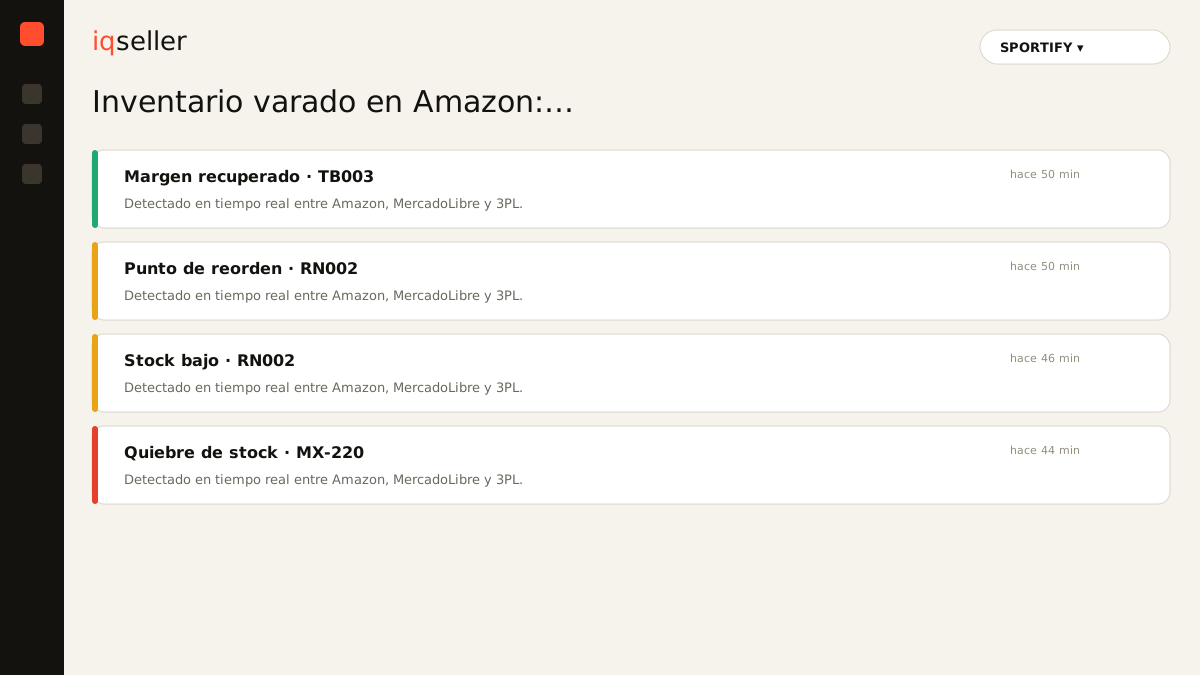
This is where the approach of a single source of truth in real time changes the game. If your inventory, sales, and listings from all three channels consolidate in one panel — as they do in iqseller — the system can continuously compare “physical stock” against “sellable stock” and flag the gap the instant it appears — not whenever you happen to open the right report. Detection stops depending on your discipline and becomes automatic.
how to catch it in time: the signals that matter
Catching stranded inventory in time comes down to watching three signals and crossing them:
- Physical stock above zero + buyer-facing availability at zero. This is the classic stranded signature. You have units in FBA but the offer is not active. Any system that consolidates both sides can detect it the same day.
- Sell-through that drops suddenly to zero while stock remains. A SKU that was selling steadily and abruptly hits zero sales, without having run out of inventory, is a red flag. It is not seasonality: it is a downed listing. This ties directly into out-of-pattern behavior detection and demand planning — the same way the price calendar anticipates when to raise or lower, watching for sharp sales drops anticipates when a listing went down.
- Days of inventory that stop falling. If a SKU’s days of inventory are not moving — not turning over — even though the product should be selling, something is blocking it.
The key is that, on their own, each of these signals is ambiguous. But together, in one place and in real time, they draw a clear diagnosis. That is why a panel that crosses them for you is worth more than three reports you have to cross by hand.
Dictionary: what days of inventory are, and how they warn you something stopped turning over →what to do when you catch it (and how to keep it from coming back)
Catching it is half the job. The other half is fixing it fast and making sure it does not recur. A reasonable flow:
- Find the root cause, not just the symptom. “Reactivate the offer” is not enough. If it was compliance, upload the document; if it was a broken ASIN–SKU link, restore it; if it was price, fix the range. Reactivating without understanding the cause guarantees it strands again.
- Prioritize by money, not by quantity. A stranded SKU with 5 high-margin units can hurt more than one with 200 low-value units. Order your “what do I fix first” queue by frozen capital and daily lost sales, not by unit count.
- Redirect demand while you fix it. If the same product also lives on MercadoLibre or your own store, temporarily push the sale there so you do not lose the demand while Amazon comes back. You can only do this well if you see real stock across all channels together — otherwise you risk causing a stockout somewhere else.
- Turn detection into a standing alert. The ultimate goal is not to fix this stranded case, but to have the next one reach you as a day-zero notification. A rule like “tell me when a SKU with physical stock has zero sales and zero availability” eliminates the problem at the root.
The difference between a seller who loses thousands to stranded inventory each year and one who barely feels it is rarely the size of the business. It is whether detection depends on someone remembering to check, or on a system like iqseller that syncs all three channels in real time and raises its hand on its own.
Dictionary: why real-time synchronization across channels is what makes detection automatic →the deeper shift: from hunting the problem to the problem finding you
Stranded inventory is a good example of why gathering data by hand does not scale. With 20 SKUs, you might manage to review the stranded inventory report once a week and catch it. With 300 SKUs split across three channels, it is mathematically impossible for your eye to catch it in time. The problem is not effort: it is structure.
That is why the approach that matters is not “check more often,” but “stop checking.” When Amazon, MercadoLibre, and your 3PL feed one source of truth, the contrast between physical stock and sellable stock is computed on its own, all the time, and the anomaly comes looking for you instead of you looking for it. You go from discovering stranded inventory three weeks late to getting a notice the same day — and recovering margin that would otherwise leak away in silence.