
Seasonal temporary help: what to delegate, what not to, and how to document it
November 18, 2026
There is a pattern that repeats every November. The seller knows the peak is coming, knows they will not cover it alone, and decides to hire help “when it gets heavy.” It gets heavy on day two of Buen Fin. That day nobody gets hired: that day you pack until midnight, answer questions at red lights, and postpone everything that is not on fire.
Seasonal hiring does not fail for lack of budget. It fails on timing and on missing documentation. Someone who starts on the most chaotic day of the year, with no written process, no defined access and no idea what they are allowed to decide alone, is not help: they are a second person to supervise at the exact moment you have nothing left to give.
And there is a cost higher than the wage: a mistake from an unprepared temp does not stay a mistake. A mistyped price, a reply promising what you cannot deliver, a stock adjustment made in the wrong place — all of that reaches your account indicators, and account indicators take months to recover.
This article takes the question in the right order: when hiring genuinely makes sense, what gets delegated without risk, what never does, and how to write the process in one afternoon so it works without you.
the signal that says you already need it
“When I can’t keep up” is not a signal: it is the description of a problem that already happened. Useful signals are measurable and arrive earlier.
The queue that never empties. If you end the day with questions pending from the day before, your capacity is already below demand. It does not matter if it is five: the queue compounds, and in a week it is fifty.
The work that stopped happening. When you have gone three days without reviewing prices, without looking at restock and without reconciling anything, you are not simply busy: your operation has shrunk to the tasks that shout. The work that does not shout is exactly the work that protects your margin.
The hours that count themselves. Do the arithmetic a week before the peak: how many orders you expect per day, how many minutes it takes to pack one, how many questions you expect at three minutes each. If the total exceeds the hours you physically have, you know the answer without waiting for anything to burn.
An example to show how it is calculated. Suppose you expect 120 orders a day at the peak, at four minutes of packing and labeling each: 480 minutes, eight hours of packing alone. Add 90 questions at three minutes: another 270 minutes, four and a half hours. That is twelve and a half hours of hands-on work daily, before restock, incidents or sleep. With one support person at six hours a day, the number drops to something operable. The figures are an example built to show the method; what matters is that the arithmetic is done with your numbers and done beforehand.
The date that rules. The calendar decides too. For 2026, Buen Fin was scheduled from Friday 13 to Tuesday 17 November — five days, with Monday 16 as a holiday for the Mexican Revolution commemoration — according to Mexican press coverage when the edition was announced; it is worth confirming on the program’s official site. If your reinforcement has to be trained for that first week, the hiring and the documentation happen in October, not in November.
what gets delegated without risk
The rule that organizes everything: you delegate the execution of a decision already made; you do not delegate the decision. With that in hand, the list writes itself.
- Packing, labeling and dispatch. The most obvious delegation and the highest return. A physical process with clear steps, verifiable at a glance, where the error gets caught before the parcel leaves.
- Pre-sale replies with an objective data point. Dimensions, what’s in the box, compatibility, available colors. Everything answerable by reading the listing or checking a single stock source. If an answer bank exists and there is one place to look up the figure, this gets delegated on day one.
- Shipment tracking and follow-up. Checking which parcels have not moved, opening the report with the carrier, telling the buyer the real status. Repetitive work, high value to the buyer, low risk.
- Logging incidents. Recording what happened, on which order, what the buyer said and what evidence exists. Logging is not resolving, and logging well is half of resolving well.
- Physical inventory counts. Count and report. The system adjustment is made by whoever has the authority.
- Material prep. Assembling kits, labeling boxes, preparing inserts and gift packaging. Block tasks that free your hours with zero exposure.
Two things make this list work. The first is that every task has a verifiable outcome: the parcel went out or it did not, the question got answered or it did not. The second is that none of them requires judgment about money, policy or reputation.
Glossary: reorder point, when to order again →what never gets delegated
This is the short list and the important one. It is not about trusting the person: it is that these decisions carry consequences an apology does not reverse.
Changing prices. Not up, not down, and not authorizing a volume discount. A mistyped price at the peak can sell fifty units below your cost before anyone notices. If you need someone to enter prices, they enter a list you signed off on, with no room for interpretation.
Resolving complaints and authorizing refunds or reshipments. This needs precision, because it is where people get it wrong in both directions. Do not delegate the decision on how a complaint is resolved; you can delegate the execution of a protocol you wrote, with defined amounts and conditions. “If the parcel arrived damaged and there is a photo, reship without asking, up to [AMOUNT]” is healthy delegation. “Use your judgment” is not, and “stall them until I can look at it” is worse: a legitimate complaint left to stagnate ends in mediation, and claims are precisely what damages your reputation on both platforms.
Replying to reviews and ratings. It is brand communication, it is public, and it sits on ground with strict platform rules. It stays with you.
Adjusting inventory in the system. The count gets delegated; the adjustment does not. A bad adjustment in peak season produces overselling, and overselling produces cancellations.
Creating, editing or closing listings. No temp touches the catalog. One badly edited attribute can tank the placement of a listing that took you a year to build.
Anything tax-related. Invoicing, regime, withholdings. That stays between you and your accountant.
Administrator access. A temp gets the minimum permission their task requires and nothing more, and they get it with an expiry date.
how to document it in one afternoon
Documentation that works in peak season is not a manual. It is a handful of pages someone can read standing up, and it gets written in four blocks.
Block one: the order flow, step by step. From order arrival to parcel handoff at the carrier. With the exact clicks and a photo of how the packing should look. If a step has an exception, the exception is written right there, not stored in someone’s head.
Block two: the answer bank. The ten questions that repeat, with the structured reply and visible gaps for the specific data. And above all of it, in bold, the rule: if you do not know the answer, do not invent it; write that you are confirming and pass it on.
Block three: the decision matrix. The most valuable page of the four. Two columns: “you decide this” and “you ask about this.” And for the first column, the exact limit: up to what amount gets refunded without asking, which cases get reshipped automatically, the maximum time allowed before a buyer gets an answer. A clear matrix is what lets someone be fast and prudent at the same time.
Block four: access and its limits. Which tool, which user, which permissions, until which date. Writing it down avoids the awkward January conversation and prevents a temporary access from staying alive for six months.
Two details make the difference. First: have the temp write their own version of the document after using it. Whatever they did not understand becomes visible, and the next person onboards faster. Second: rehearse two days before the peak with real orders, rather than explaining the process in theory. A half-day rehearsal exposes every hole in the document, and the time to find them is beforehand.
And the question that organizes the training: what happens when this person does not know what to do? If the answer is “they call me,” your season still depends on you. If the answer is “they check the matrix, and if it is not there they log it and move to the next thing,” you have built something that works without you.
Glossary: real net margin, with everything deducted →where iqseller fits and where it does not
Plainly: iqseller does not manage messaging and does not answer buyer questions, so your temporary team’s support block gets operated in each platform’s own panel, with whatever answer bank you keep wherever you keep it. The panel does not handle payroll, shifts or contracts either.
What the panel contributes is the other side of the problem: the control that lets you delegate without losing visibility.
- Roles and permissions are the base of everything above. The panel is multi-user, so a temporary helper can look up what they need — real stock, what is in transit, which SKU maps to which listing — without access to what is not theirs.
- Inventory is the single source that makes availability replies and counts safe. The view consolidating warehouse, FBA, Full and 3PL against what is published per channel, plus inventory valuation, is what keeps two people from working off two different truths.
- Alerts is what replaces your constant supervision. The inventory gap and cross-channel price discrepancies announce themselves, so you do not need to be watching dashboards to learn that something slipped while someone else was operating.
- Catalog, through the Parent → Model → SKU tree, is the map a temp needs to know which physical product maps to which listing — the number one confusion for anyone new to a catalog with variants.
- Profitability and Pricing stay with you. Net margin per SKU — the COGS you load, commissions from the Amazon settlement and from MercadoLibre orders, FBA and Full fees, shipping, advertising, VAT and withholdings — is what lets you set each product’s floor before the peak, so the decision matrix you hand over carries numbers instead of intuitions.
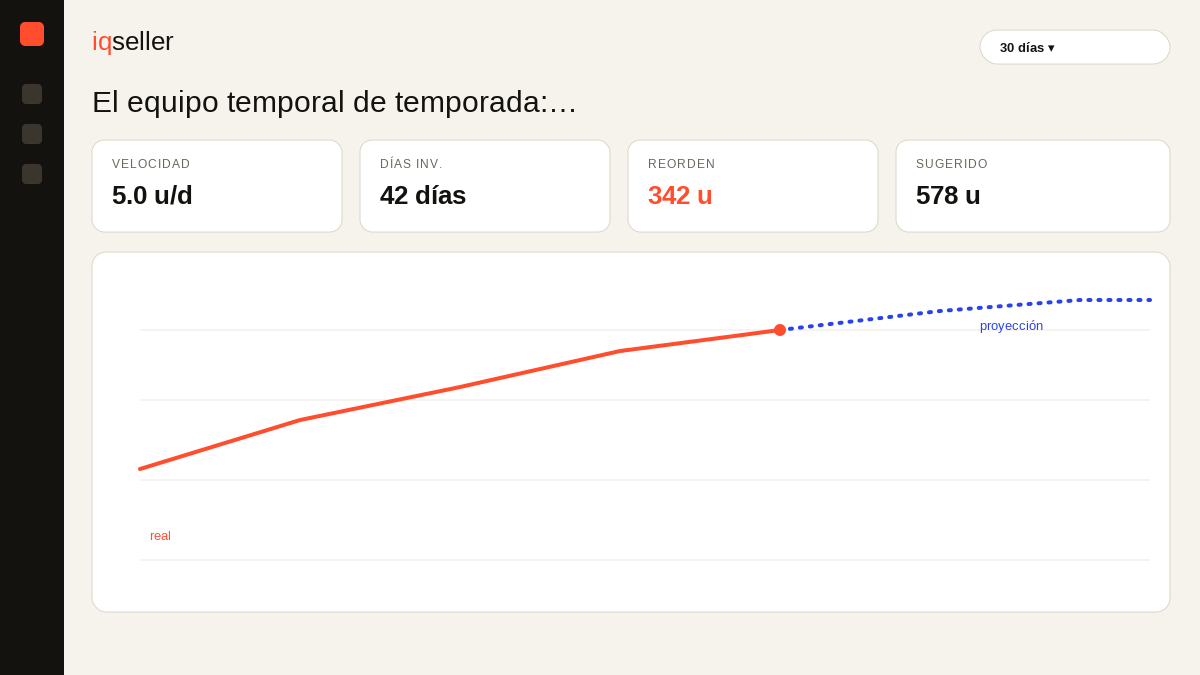
- Forecast helps you size the reinforcement with time to spare: if the weekly unit projection is visible in October, hiring stops being a reaction.
The honest sentence: the panel will not find you people and will not train them. It gives you the information to write a decision matrix that actually works, and the visibility to avoid looking over anyone’s shoulder.
what is worth remembering
Hiring for the season is an October decision, not a November reaction. The signal is not “I can’t keep up”: it is the hour count you run a week before and the queue that never empties.
You delegate execution, not decisions. Packing, replies with an objective data point, shipment follow-up, incident logging and physical counts go out without risk. Prices, complaint resolution, inventory adjustments, catalog, reviews and tax matters stay with you.
And the deliverable worth more than any training session: four pages — order flow, answer bank, decision matrix and access with an expiry date — rehearsed two days ahead with real orders. With that, a legitimate complaint gets resolved quickly and properly even while you are packing, which is exactly what you want to happen.