
VAT on Marketplaces: Withholding, Credit and Your Real Margin
August 11, 2026
Seller VAT on marketplaces works in three moments: you collect VAT inside your selling price, Amazon or MercadoLibre withhold part of that VAT (and income tax) when they pay you out, and you credit the VAT you paid on your own purchases and expenses. The net effect on your margin is not the full 16%: it is the difference between the VAT you charged, the VAT that was withheld from you, and the VAT you can credit. If you measure profitability while ignoring that mechanic, your real margin is lower than you think.
The most expensive confusion is treating VAT as if it were yours. It is not: it is a tax you collect on behalf of the tax authority (the SAT) and later remit. The practical headache for the multichannel seller is that each platform withholds differently, deposits on different dates, and reports it in its own dashboard. Pulling that information together by hand — one spreadsheet for Amazon’s withholding, another for MercadoLibre, supplier invoices somewhere else — is exactly where clarity gets lost and where margin turns into guesswork.
This article separates the three pieces — withholding, credit and margin — so you understand what the platform takes, what you recover, and how much actually stays in your pocket on each sale.
what seller vat is and why it is not your money
When you sell a product for $580 with VAT included in Mexico, that price contains $80 of VAT (16% on a base of $500). That output VAT is not your income: you collect it on behalf of the tax authority. Your real sale — the taxable base — is $500, not $580. The first mistake many sellers make is calculating margin on the $580, when the number that matters for profitability is the base without VAT.
At the same time, when you buy inventory, pay platform commissions, contract fulfillment or a 3PL, all of those expenses also carry VAT. That is input VAT: the VAT you paid that you can subtract from the VAT you charged. Your actual obligation to the SAT is the difference between what you passed on and what you credited. If you charged $80 and credited $50 on purchases and commissions, you remit $30, not $80.
Understanding this changes how you read your operation: VAT should not show up in your margin as a cost, but it does show up as cash flow. And that is where withholding comes in, altering the moment that money moves.
how platform withholding works
Marketplaces operating in Mexico withhold taxes when they pay you, because the SAT designated them as collection agents. In practice, when Amazon or MercadoLibre settle a sale, they do not hand you the full amount: they deduct a VAT withholding and an income-tax withholding before the deposit. Those withholdings are not a new tax or an extra cost: they are a prepayment of the tax you were going to owe anyway. What matters is that they reduce your cash today and become a credit you apply in your tax return.
The detail that complicates the multichannel seller is that each platform withholds with its own logic and reports it in its own format. Amazon breaks it out in its settlement report; MercadoLibre shows it in its sales detail and in the withholding invoices (CFDI). If you are registered and provide your tax ID (RFC), the withholding rates are lower than if you operate without a registered RFC, where the platform withholds at higher rates. A seller whose tax information is not in order may be overpaying on every deposit without realizing it.
To see it clearly, separate two things that get confused: the platform commission (which is a real cost of your operation, and carries its own creditable VAT) and the withholding (which is not a cost, but a tax prepayment). Mixing them in the same row of your spreadsheet is one of the reasons a hand-calculated margin almost never matches what you see in the bank.
the credit: what you actually recover
Input credit is the piece most people forget and the one that recovers the most margin. Every peso of VAT you paid on a deductible purchase — inventory, marketplace commissions, advertising, fulfillment services, software, packaging — is creditable VAT as long as you hold the invoice (CFDI) that backs it. At the end of the period, that creditable VAT is subtracted from the VAT you charged, and the withholdings the platforms made are applied against the balance.
The result can go two ways. If you charged more VAT than you credited, you have VAT payable, but the withholdings already advanced part — or all — of that payment. If you credited a lot (say, a month when you bought heavy inventory for the Buen Fin sales event), you can end up with a VAT credit balance in your favor, which you can offset or request as a refund. That balance is real money many sellers leave parked because they do not keep fine control of their invoices.
The non-negotiable condition is documentation. Without a valid CFDI, the VAT you paid is not creditable: it becomes a pure cost that ate your margin. That is why asking for an invoice on every operating expense — including the platform’s commissions and fulfillment — is not bureaucracy, it is protecting your profitability.
the net effect on your real margin
This is where it all comes together. Your real net margin does not come from subtracting the commission and product cost from the VAT-inclusive price. It comes from working on the base without VAT, subtracting the real costs (product, commission net of its creditable VAT, fulfillment, advertising), and treating VAT separately as a flow that comes in, gets withheld, and gets credited.
An example grounds the idea. You sell for $580 (base $500, VAT $80). The marketplace commission is $116 VAT-included ($100 commission + $16 creditable VAT). Your product cost $232 VAT-included ($200 + $32 creditable). On the base, your gross profit is $500 − $100 − $200 = $200. The VAT you charged is $80; the VAT you credit is $16 + $32 = $48; your VAT payable on this sale is $32, part of which the withholdings already advanced. The margin that matters is calculated on that $200, not on VAT movements that cancel out on a net basis. Getting this calculation right is exactly the kind of detail where hand-checking goes wrong, as we cover in margin calculation mistakes that cost sellers money.
Glossary: real net margin, with everything deducted →When you sell across two or three channels, this calculation multiplies: each platform has different commissions, withholds differently, and deposits on different dates. A flat price across channels leaves uneven margins, which is why price is best designed per channel and in sequence with the automatic price calendar, always starting from real net margin rather than a nice round number.
Glossary: what a price calendar is and why automate it →why real time changes the game
The multichannel seller’s underlying pain is not understanding VAT once: it is keeping it current across dozens of SKUs, two or three platforms, and hundreds of operations a month. Amazon’s withholding lives in one report, MercadoLibre’s in another, your suppliers’ invoices in your inbox, and the real balance only appears when your accountant closes the month — weeks after you made pricing decisions blind.
Seeing VAT in real time, alongside commission and cost, per SKU and per channel, turns that uncertainty into a number you can read today. You know how much was withheld this pay period, how much creditable VAT you have accumulated, and what your real net margin is after everything. You stop estimating profitability by eye with a spreadsheet that is always behind, and start making pricing decisions with the tax effect already built in.
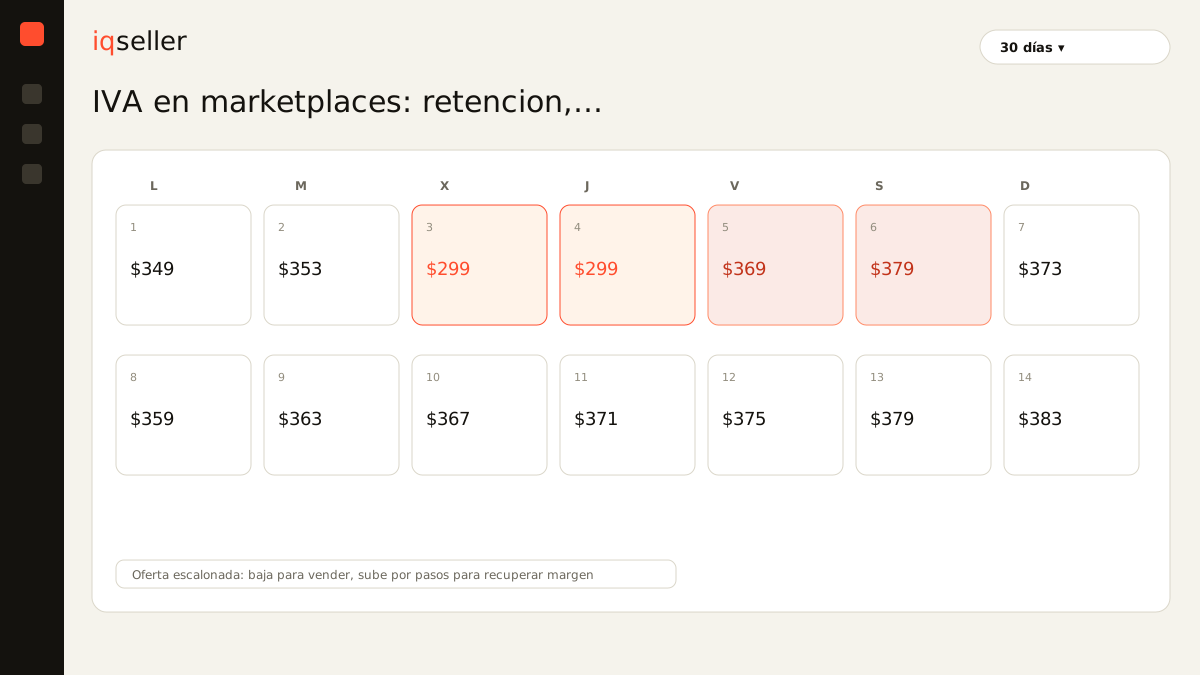
That is the shift: VAT stops being an end-of-month surprise and becomes one more variable the panel already has counted. When you design a laddered offer for the Buen Fin, you see it with its withholding and its credit included, not as a discount whose real effect you discover when the deposit lands.
Glossary: laddered offer, step by step →what to take away
Seller VAT does not cut your margin by 16%: it reduces your cash flow temporarily through withholding and neutralizes on a net basis through credit, as long as you keep your invoices in order. What can cost you margin is measuring it wrong: calculating on the VAT-inclusive price, confusing withholding with a cost, forgetting to credit commissions and fulfillment, or leaving a credit balance unclaimed.
For a seller selling on Amazon, MercadoLibre, and their own store, the key is not memorizing rates but having tax information sit next to operational data, per channel and in real time. When output VAT, withheld VAT, and creditable VAT live in the same view as your commission and your cost, your real margin stops being an estimate and becomes a figure you can price on.