
What Is Available Market Stock and Why Not All Your Inventory Is for Sale
July 19, 2026
Available market stock is the portion of your inventory that you can actually sell today on a specific channel, once you subtract the units that are reserved, in transit, blocked, or committed to another marketplace. Put differently: the big number you see in your warehouse is not what is for sale. What is for sale is a subset of that total, and that subset shifts throughout the day as orders come in, returns get processed, and you move units between Amazon, MercadoLibre, and your 3PL. Available market stock is that subset, measured honestly.
If you are a multichannel seller, the gap between “total stock” and “available market stock” is the source of most of your scares. You think you have 400 units to sell, but 120 are reserved for orders in process, 60 are in transit from your supplier, 40 are in inspection after a return, and another 90 can only serve MercadoLibre because they sit in Full. The real number you can offer today on Amazon may be a fraction of what you imagined. And when that number runs out without warning, the stockout hits.
This article breaks down what makes up available market stock, why it never matches your total inventory, and why trying to compute it by hand from screenshots of three dashboards and a spreadsheet is a losing battle. The only sustainable way to know it is to read it in real time, channel by channel, from a single source that subtracts everything that is not truly for sale.
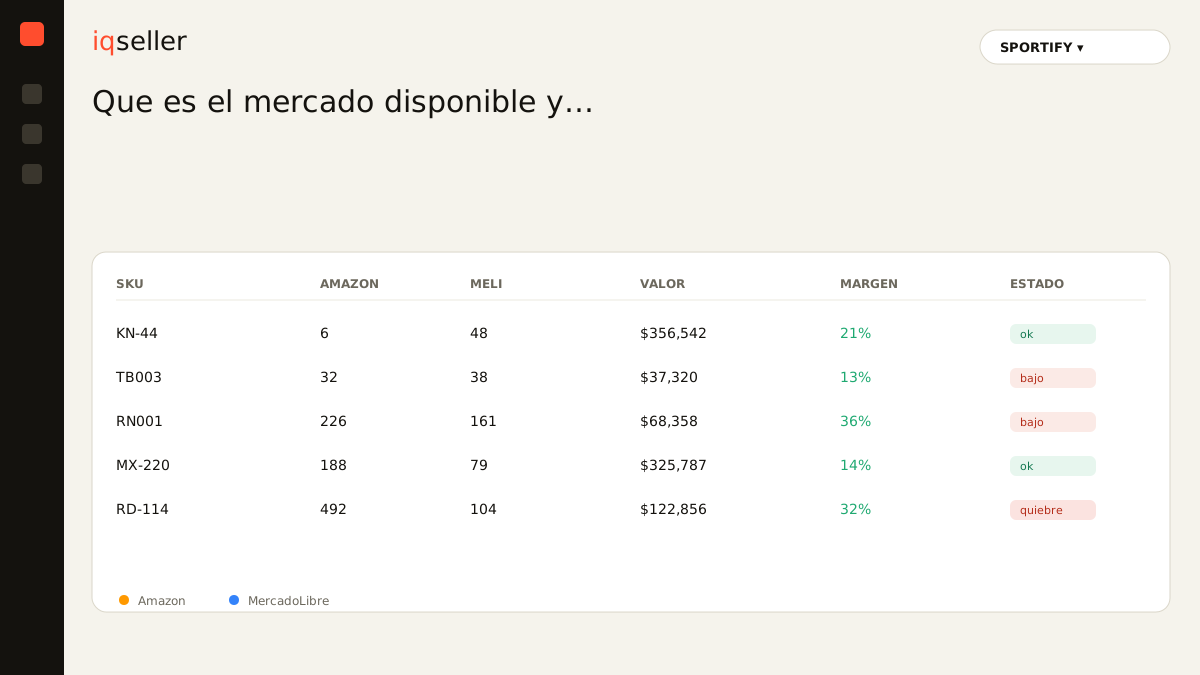
what available market stock actually is
Available market stock starts from a simple idea: not every unit that physically exists is ready to be sold at this instant on this channel. Your total stock is an accounting inventory; available market stock is an operational inventory. The first answers “how many units do I have in the world”; the second answers “how many can I promise to a buyer who lands on this listing right now”.
The distinction matters because marketplaces do not sell against your total stock, they sell against what you declare as available. Publish more than you can actually fulfill and you slip into oversell, risking cancellations, penalties, and reputation damage. Publish less out of caution and you leave sales on the table and hand the Buy Box to a competitor. Available market stock is the number that lets you publish exactly what you can honor: no more, no less.
That number is not static. Every incoming order lowers it, every return that comes back raises it, every unit you ship from your 3PL to FBA moves it from one channel to another. That is why available market stock only makes sense when measured in real time. A figure from the morning is already stale by the afternoon.
why your total stock is not what you can sell
Picture opening your inventory report and seeing 500 units of a SKU. That number is reassuring, but it is mixing together things that should never be counted together. Inside those 500 there are at least five distinct populations with incompatible behaviors.
First, reserved units: orders that already came in but have not yet left the warehouse. They are committed; you cannot sell them again. Second, in-transit inventory: units you bought from a supplier or moved between fulfillment centers that have not arrived yet; they exist in your accounting but you cannot fulfill them today. Third, returns in process: product that came back and is in inspection; it may become sellable again or it may go to waste, but in the meantime it does not count. Fourth, blocked inventory: units held back by a listing issue, by damage, or aged inventory the platform has flagged. And fifth, stock committed to another channel: what sits in MercadoLibre Full does not serve Amazon demand, and vice versa.
Only what remains after subtracting all of that is your available market stock. In practice, the gap between total stock and real available stock tends to run 20 to 40 percent, and for high-turnover or high-return SKUs it can be larger. Confusing the two numbers is the number-one cause of stockouts you “didn’t see coming”: you saw them, but you were looking at the wrong figure.
Glossary: real available stock is the stock you can sell right now on a channel, once reservations, transits, returns in process, and blocked inventory are subtracted; it is the honest basis of available market stock.available market stock differs on every channel
Here is the nuance that breaks any back-of-the-envelope calculation: there is no single available market stock for your business, there is one per channel. The units you hold in FBA can only sell Amazon demand. The ones in MercadoLibre Full only serve MercadoLibre. Your 3PL units can feed Flex shipments or your own sales, but they cannot solve an FBA stockout without a replenishment that takes days.
This means you can have 300 units “in total” and still run out of available market stock on the channel where your sales concentrate. If 70 percent of your demand is on Amazon but only 40 percent of your sellable inventory sits there, you will fall short on Amazon while product piles up on MercadoLibre. The global number hid the imbalance.
That is why available market stock has to be viewed per channel first and consolidated afterward. Seeing both levels at once is what lets you tell the difference between “I need to buy more” and “I need to move what I already have from one channel to another”. This is the same logic that governs your real-time inventory: without a fresh, per-marketplace reading, any purchasing or reallocation decision carries yesterday’s error.
the manual work this number is costing you
Without a tool to compute it, available market stock lives where it should not: in your head and in a spreadsheet you update when you remember. The pattern is always the same. You open Amazon Seller Central to check FBA availability, then MercadoLibre to review Full and Flex, then the 3PL sheet someone emailed you, and you start subtracting by hand the reservations, transits, and returns you can recall. By the time you finish, forty minutes have passed, the order data is already old, and you make the decision with that uncertainty on top.
The problem is not just the time. It is that the manual calculation breaks by day two. One dashboard shows you a number, another shows you a different one, none of them tells you which part is sellable today, and you end up averaging hunches. Multiply that by dozens or hundreds of SKUs spread across three or four channels and the exercise stops being sustainable. The information ages faster than you can gather it.
That uncertainty carries a measurable cost. When you do not trust your available market stock, you do one of two things: publish too little for fear of overselling and lose sales, or publish too much and end up canceling orders the marketplace punishes. Neither is an accident; both are the direct result of not having the right number at hand.
Glossary: a stockout happens when a channel runs out of sellable units; on Amazon it drags down your organic ranking and can cost you the Buy Box, and recovering the position takes weeks.from available market stock to the buying decision
Knowing your available market stock is not a vanity metric: it is the direct input to every replenishment decision. Once you know how many truly sellable units you have on each channel, you can cross that number with your sales velocity and turn it into time. That translation from “units” to “days” is what tells you whether to buy today, pause a listing before it penalizes you, or move stock from one channel to another.
That is where available market stock connects with days of inventory: dividing real available stock per channel by your current sales velocity gives you the days left before you run out. If you run that calculation on total stock instead of available stock, your days of inventory come out inflated and you believe you have runway when you do not. Available market stock is the honest numerator of that formula.
Glossary: days of inventory measure how long your stock will last at the current sales pace; they are only reliable when computed on available market stock rather than on total stock.a single source in real time
The reason a consolidated module changes the game is not that it looks nice, but that it removes the step of gathering and subtracting the information by hand. Instead of three tabs, a 3PL email, and a spreadsheet, you get a single screen that reads the units on each channel, subtracts reservations, transits, returns in process, and blocked inventory, and hands you the real available market stock, per channel and consolidated, without you touching a single figure.
When a SKU is about to run out of available market stock on Amazon while it has surplus on MercadoLibre, you see it immediately, not the following Monday. When a return comes back sellable, your number goes up on its own. And when you publish, you publish against what you can actually honor, not against an accounting total that includes things not for sale. That is the difference between operating with certainty and operating on the hope that the spreadsheet still balances.
Available market stock, at its core, is a question of trust: does the number you declare to each marketplace reflect what you can genuinely fulfill? Answering it well, in real time and per channel, is what separates a seller who reacts to stockouts from one who avoids them. And for that you need to stop subtracting by hand and start reading a single number that is always up to date.