
What Is Net Margin and Why It Matters for Online Sellers
July 4, 2026
Net margin is the percentage of a sale that actually stays in your pocket after you subtract every cost tied to that sale: the product cost, marketplace commissions, fulfillment, advertising, returns, payment fees and the taxes you have to absorb. In one line: it is net profit divided by revenue, expressed as a percentage. If you sell $100,000 in a month and $12,000 is what truly remains, your net margin is 12%.
The reason this number matters so much for online sellers is simple but uncomfortable: it is the only one that answers the question “does this business actually make money?”. The sale price looks great, the gross margin looks healthy, but between the sale and your bank account sits a line of deductions that eats the difference. Net margin is what is left once nobody else has taken their cut.
For a multichannel seller the challenge is not understanding the definition, it is actually calculating it. When you sell on Amazon, MercadoLibre, your own Shopify and maybe out of a 3PL, every channel charges differently, reports differently and hides its fees in different corners. Stitching all of that together by hand in a spreadsheet, week after week, is exactly where most sellers give up and end up flying blind.
what net margin is in plain words
Say you sell a speaker for $499. Your instinct is to subtract the product cost ($180) and celebrate $319 of “profit”. That number is an illusion. Net margin forces you to keep subtracting all the way down: the marketplace commission, the fulfillment fee, storage, the cost of shipping your inventory into the fulfillment center, a returns provision, ad spend and the portion of tax you cannot recover.
Once all of that is deducted, those $319 can shrink to a real $55. That is a net margin of roughly 11%, not the 64% the naive subtraction suggested. The real net margin is precisely that figure after every deduction, the only one that tells you whether a product deserves to stay in your catalog.
The base formula is short:
Net margin (%) = (Revenue − All costs and expenses) / Revenue × 100
The math is not the hard part. The hard part is that the “all costs” column has ten rows, each one changes every week and they live across separate dashboards.
gross margin vs net margin: do not mix them up
This is where many sellers stumble. Gross margin only subtracts the product cost: price minus what the merchandise cost you to make or buy. It is useful for sanity-checking your pricing up front, but it is dangerously optimistic, because it ignores everything that happens between the sale and your bank.
Net margin subtracts absolutely everything. That is why a product can carry an enviable 55% gross margin and a starving 6% net margin once you add commissions, FBA, Ads and returns. That gap between the two numbers is where your business is decided, and if you never look at it, you believe you are winning when you are actually subsidizing sales.
If you want to see the difference calmly and with numbers, read gross margin vs net margin: what actually sets them apart. Understanding that distinction is the first filter that stops you from making decisions with the wrong figure.
which costs go into net margin
For a seller in Mexico selling on Amazon and MercadoLibre, the list of deductions you have to subtract usually looks like this:
- Product cost (COGS): what you paid for the merchandise landed in your warehouse.
- Marketplace commission: the percentage Amazon or MercadoLibre charges on each sale, variable by category.
- Fulfillment and logistics: FBA or MercadoLibre Full fees, or your 3PL cost if you ship yourself.
- Storage: monthly, plus penalties for inventory that sits too long.
- Inbound shipping: sending your inventory into the fulfillment center. The line almost everyone forgets.
- Payment fees: what the gateway or the marketplace itself takes for processing the charge.
- Returns and refunds: not an exception, a recurring cost you have to provision for.
- Advertising: Amazon Ads or Product Ads spend comes straight out of your margin. A neglected ACoS turns profit into loss.
- VAT and taxes: the 16% you must handle correctly and the portion you cannot recover.
Every row you forget inflates a fictional net margin. And because each channel reports these costs with different names and formats, assembling the full list per product is exactly what makes the manual spreadsheet unworkable.
why net margin decides your prices
Net margin is not just a report to glance at month-end; it is the compass for your pricing. When you know the real net margin of each SKU, you know how far you can drop a price in a promotion without going into the red, and you know which products can survive a price war and which cannot.
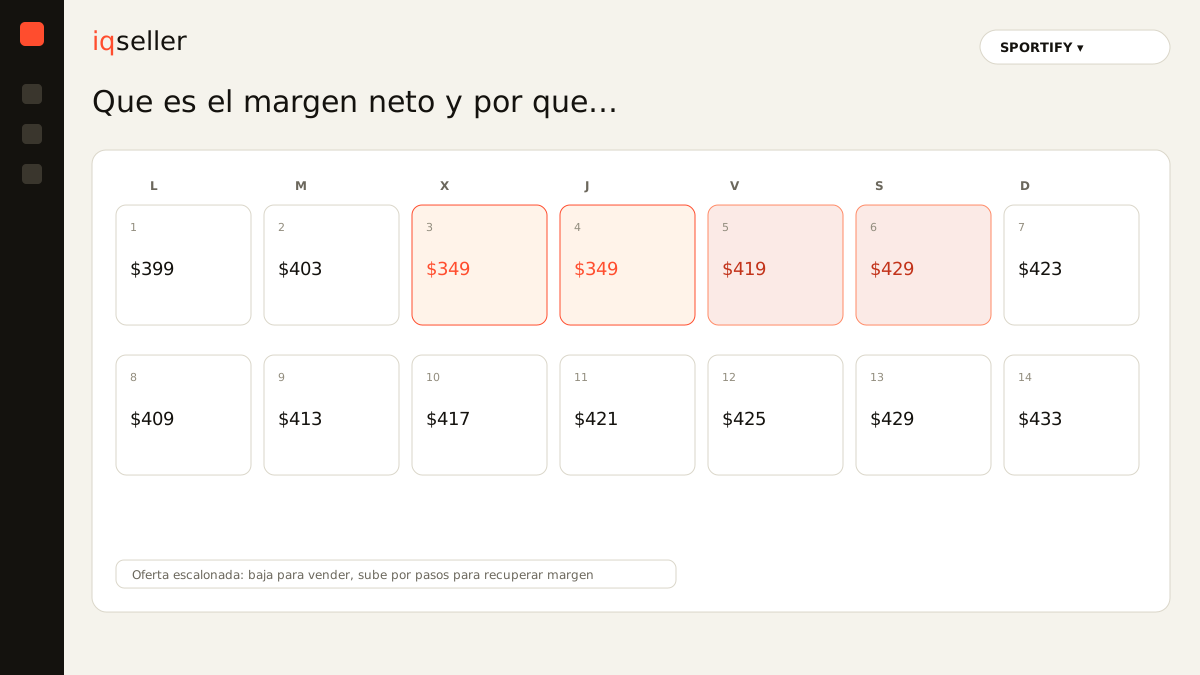
Without that figure, promotions become a gamble. You cut $80 to win the Buy Box, the unit moves, you celebrate the volume, and you never notice that each sale now costs you money because that discount ate a margin that was already thin. With net margin per product you can design a tiered offer that protects your profit: discounts that bite only into the cushion you actually have.
This is where pricing stops being intuition and becomes an informed decision. Scheduling price changes with an automatic price calendar only makes sense when every scheduled price is already validated against net margin: you move up and down inside a range that never puts you at a loss. That price calendar is useful precisely because every move respects your net margin.
the multichannel pain: many dashboards, zero certainty
If you sold on a single channel, a dedicated spreadsheet might do the job, tedious as it is. The problem is that almost no serious seller lives on a single channel. You have the Amazon Seller Central tab, the MercadoLibre one, the Shopify panel and maybe your 3PL report. Each one gives you a slice of the picture, none of them gives you consolidated net margin.
So the ritual begins: export reports, paste into Excel, cross-reference SKUs that are named differently on each channel, calculate fees by hand, and by the time you finish, the data is already a week old. You make pricing, inventory and advertising decisions off a blurry, lagging snapshot. The uncertainty is not a flaw in your discipline; it is a consequence of information living fragmented.
The profitability that actually helps is the one you see today, per product, per channel, with everything already deducted. Not the one you rebuild by hand next Monday. When net margin is calculated in real time and consolidated, you stop guessing and start operating on data that reflects your business as it is right now.
calculating net margin without losing your mind
The good news is that net margin is a mechanical calculation: if you have all the data, the formula always returns the same result. The bottleneck was never the math, it was gathering clean data from each channel and keeping it current.
That is where a platform that unifies your channels changes the game. Instead of chasing reports, you see the net margin of each SKU and each channel updating on its own, with every fee already baked in: commission, fulfillment, storage, inbound, returns, Ads and VAT. The figure that used to take half a day to assemble simply appears, and correct.
iqseller calculates that real net margin per product and per channel automatically, so the question “does this business make money?” has a clear answer every day, not an estimate at month-end. When you stop calculating by hand, you stop deciding blind.
in short
Net margin is the percentage of your sale that survives after you subtract absolutely everything: cost, commissions, logistics, storage, inbound, returns, advertising and taxes. It is the only number that tells you whether you truly make money, which is why it is the compass for your pricing and your catalog. Gross margin cheers you on; net margin tells you the truth. For a multichannel seller, the real challenge is not the formula but gathering the data from each channel and keeping it fresh, and that is exactly the part real time solves.