
What Net Margin Is Healthy for an Amazon and MercadoLibre Seller
August 3, 2026
A healthy net margin for a seller on Amazon Mexico and MercadoLibre usually lands between 10% and 20% after you subtract everything: product cost, marketplace commissions, FBA or Full fees, shipping, returns, advertising, and tax. Below 8% the business is fragile, and any single hit —a fee increase, a price war, a wave of returns— pushes you into the red. Above 25% you’re typically in a niche category, with a strong private label or little competition, and that rarely lasts before someone shows up to undercut you.
But the honest answer is that there is no single number. A “healthy” margin depends on your category, your turnover, and whether you sell through FBA or FBM. A product that turns 12 times a year at 9% net margin makes you more money per year than one that turns twice at 22%. So the right question isn’t just “is my percentage high?” but “does my margin, at the volume I move, give me the profit I need?”.
The practical problem is that most multichannel sellers don’t know their real net margin, per product and per channel, today. They estimate it in a spreadsheet once a quarter, with stale fees, without prorating returns or ad spend, and across two dashboards that never reconcile. This article pins down what range is healthy, why it varies so much, and how to stop guessing.
what actually counts as net margin
Before you judge whether your margin is healthy, you have to agree on what you’re measuring. Many people confuse gross margin (price minus product cost) with net margin, and that’s where the self-deception starts. A product with 45% gross margin can end up at 6% net once Amazon or MercadoLibre take their cut.
Real net margin subtracts, on top of the product cost:
- Marketplace commission (referral fee on Amazon, category commission on MercadoLibre), variable by category.
- Fulfillment fee: FBA on Amazon, Full on MercadoLibre, or your own shipping cost if you do FBM.
- Storage prorated per unit, plus the inbound cost of shipping inventory to the fulfillment center.
- Returns and refunds, as a provision, not an exception.
- Advertising: your ACoS comes straight out of the margin.
- Tax: the 16% VAT you have to handle correctly so it doesn’t eat you.
Only when you subtract all of that do you have the number that matters. That’s the figure you measure a product against to decide whether it’s healthy or only looks healthy.
Glossary: real net margin, with everything deducted →the healthy range, category by category
A 12% margin doesn’t mean the same thing in electronics as it does in supplements. Here are rough ranges we see among Mexican sellers:
- Electronics and accessories: high commissions, fierce competition, and prices compared down to the cent. A healthy net margin sits around 8%–14%; you win on volume, not on percentage.
- Home, kitchen, and hardware: mid-range commissions, bulkier products (watch out for FBA weight fees). Healthy: 12%–20%.
- Beauty, health, and supplements: commissions and returns that bite, but good ticket and repeat purchase. Healthy: 15%–25% if you have a brand.
- Apparel and fashion: sky-high returns that must be provisioned seriously. A 20% gross can end at 7% net. Healthy net: 10%–18%.
- Private label with little competition: here you can sustain 25%+, but it’s the exception, not the rule, and it attracts competitors.
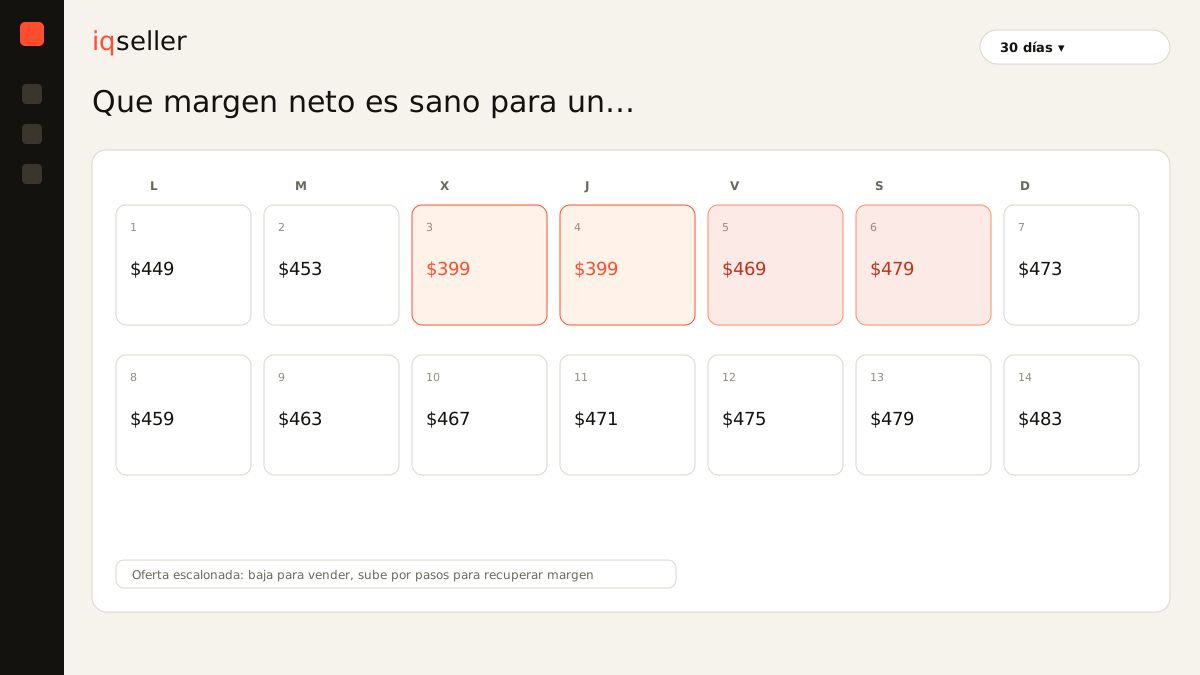
The lesson: don’t compare your margin against an abstract “seller.” Compare it against your category and against your own history. And because Amazon and MercadoLibre charge differently, the same product can be healthy on one channel and thin on the other. A laddered offer lets you push volume without giving away the whole margin.
Glossary: laddered offer, step by step →why a low margin can still be profitable
Here’s the most expensive mistake a seller makes: killing a 9% product because “the margin is low.” Margin is a snapshot; the profitability of the business is a movie that includes turnover.
Think about two products, each with $200 of capital invested per unit:
| Product | Net margin | Turns/year | Annual profit per unit of capital |
|---|---|---|---|
| A | 9% | 12 | ~$216 |
| B | 22% | 2 | ~$88 |
The “thin” 9% product generates more than double the annual profit of the 22% one, because your capital turns 12 times instead of 2. A low margin with high turnover is an excellent business. A high margin that stalls in the warehouse is frozen capital.
That’s why the number that truly matters isn’t just the percentage, but margin multiplied by velocity. A good automatic price calendar plays with exactly this: it lowers the price to speed up turnover when stock is plentiful, then steps it back up to recover margin without breaking the sales momentum.
Glossary: what a price calendar is and why to automate it →the margin that slips away: commissions and fees
The number one reason a seller thinks they have 18% and actually has 9% is the commissions they never counted. On MercadoLibre, the commission varies by category and by whether the listing is “Classic” or “Premium,” and on top of that there’s a fixed cost per sale on low prices and the free-shipping charge above a certain threshold. It’s easy to underestimate by 5 or 6 full points.
It’s worth reviewing exactly how much each channel takes before you set prices: we break it down in MercadoLibre fees by category: where your money goes. If you set the same “flat” price on both marketplaces without adjusting for commission, you’re guaranteeing that on one of the two channels your margin is thinner than you think.
how to know your real margin today, not last quarter’s
The core pain of the multichannel seller is this: to know whether your margin is healthy you’d have to open the Amazon report, open the MercadoLibre report, cross-reference them by hand in a spreadsheet, plug in the current fees, prorate returns and ad spend, and do it for every SKU. By the time you finish, the numbers have already changed. Nobody decides well that way; they decide on the feeling that “we’re roughly doing fine.”
Useful profitability is the one you can see today, per product, per channel, with everything already deducted. When real net margin is calculated in real time, you stop wondering whether a product is healthy: you see it. Sort your catalog from lowest to highest margin and it immediately jumps out which to raise in price, which to push on volume, and which to discontinue because they’re only tying up your capital.
That’s where a single view changes the game against two separate dashboards. It’s not that iqseller “works magic”: it simply gathers what you assemble by hand today —sales, fees, returns, advertising, tax— and returns your real net margin per SKU and per channel, up to date, so the question “is it healthy?” has an answer with a number, not a hunch.
in short
A healthy net margin for an Amazon and MercadoLibre seller lives between 10% and 20%, adjusted for your category, but the percentage alone doesn’t tell the whole story. A 9% that turns fast can be a better business than a 22% that sleeps in the warehouse. The danger isn’t having a low margin: it’s not knowing your real margin, per product and per channel, today. When you see it in real time, you stop guessing and start deciding what to raise, what to push, and what to let go.