
Your own channel without leaving the marketplace: what you gain and what it really costs
October 21, 2026
There is a scene that repeats itself. A seller has been doing well on Amazon and MercadoLibre for two or three years, adds up everything paid in commissions last year, feels the knot in their stomach and reaches the obvious conclusion: “if I sell direct, that whole percentage stays with me.” A month later they have a store running and expect the sales to migrate on their own.
They do not migrate. Two things happen instead: the store sells a tiny fraction of what the marketplace sells, and the seller discovers that the commission that hurt so much was paying for something that never made it onto the list. It was not paying for a payment gateway or a cart. It was paying for traffic.
That is the original confusion, and it deserves to be said plainly: an owned channel does not replace the marketplace. They are two businesses with different cost structures, different rhythms and different jobs inside the same operation. Anyone who treats them as mutually exclusive alternatives almost always ends up with two mediocre channels instead of one good one.
This article separates the three things you genuinely gain with an owned store, the three that genuinely cost, and the arithmetic that tells you whether your own channel holds up or is just moving pesos from one pocket to another.
what you are actually buying when you pay a commission
When you list on a marketplace and accept a double-digit commission, you are buying a bundle. It is worth taking apart, because each piece has a market price when you buy it separately.
You are buying demand that already exists: people who opened the app intending to buy your category, not to discover your brand. You are buying transactional trust: the buyer hands their card to a platform they already know, not to a domain they are seeing for the first time. You are buying payment and dispute infrastructure, with its fraud screening and its claims mechanism. And you are buying a search engine loaded with purchase intent, which is the most expensive form of traffic in all of digital advertising.
When you open your store, the last three pieces are solved relatively easily: mature commerce platforms give you a cart, a gateway and a trustworthy checkout for a monthly fee and a percentage. The first piece is not solved by software. Demand does not come bundled, and that is the cost that shows up afterwards.
what you do gain, and it is not only margin
The margin argument is the easiest one to see, so let us start there and move to the two that matter more over time.
One: margin without a channel commission. In your store you do not pay a percentage for the referral of the sale. You still pay the gateway, shipping and the platform, but the marketplace commission leaves the equation. In a high-commission category that is a structural difference, not a cosmetic one.
Two: the customer data. On a marketplace, the buyer belongs to the marketplace. You have the order, not the relationship: you can rarely segment, retain or contact on your own. In your store you have email, purchase history, browsing behavior and consent to communicate. That is the only foundation repeat purchase gets built on, and repeat purchase is what makes acquisition cost sustainable.
Three: brand control. On a marketplace your listing competes in a grid where everything looks alike and the next result is one scroll away. In your store you decide the narrative, the packaging, the cross-sell, the tone of the post-purchase email and the unboxing experience. If your product defends itself on something other than price, that control is where it shows.
There is a fourth, less glamorous and quite real: platform independence. A suspension, a policy change or an algorithm adjustment can switch off your main channel without notice. Having an owned channel running — even a small one — is the difference between a scare and a crisis.
what actually costs: traffic
Here is the part almost nobody calculates before opening. On a marketplace, acquisition cost is embedded in the commission: if you sell, you paid; if you do not sell, you did not. It is a variable, proportional cost. On an owned channel, acquisition cost comes first, is uncertain, and gets paid whether or not you sell.
And it is not only advertising. The real cost structure of an owned store includes at least: the platform’s monthly plan, the payment gateway’s commission — with VAT on that commission, which many people forget — an additional per-transaction charge if you use an external gateway instead of the platform’s native one, shipping, the apps you end up needing, and the human work of content, support and reverse logistics.
That set of figures changes by plan and by country, so check it on the official pricing page of whatever platform you use before building your model. What you can take as given is structural: a store has fixed monthly costs that run even when you sell zero, and a marketplace does not.
But the dominant cost is still traffic. The good news is that there is a clean way to turn it into a number you can compare.
the arithmetic that decides: your implicit acquisition budget
Take one of your products and run the math on both channels. Illustrative example, not a rate card.
On the marketplace. Selling price $1,590, COGS $640, a 15% category commission ($238.50) and $110 of shipping. You keep $601.50 before taxes.
In your store. Same $1,590 price and same $640 COGS. A 3.5% gateway fee ($55.65) plus the VAT on that fee ($8.90) is $64.55. Shipping $110. Platform and apps prorated: $12 per order. You keep $763.45 before spending a single peso attracting the buyer.
The difference between those two numbers is $161.95. That is your maximum acquisition budget per order for the owned channel to break even against the marketplace. If attracting a buyer costs you less than that, your store wins; if it costs more, you are selling with more work and less profit, even though the report says “0% commission.”
That number is the tool. Compare it against your real acquisition cost — what you spent attracting buyers divided by the orders it produced — and you have the answer without debate. And when you measure, account for the second purchase: if a share of those customers comes back through email or a direct message with no media cost, acquisition cost gets spread across several orders and the math shifts in the owned channel’s favor. That is exactly why the customer data is worth what it is worth.
Glossary: real net margin, with everything deducted →the cannibalization that rarely happens, and the one that does
The most common fear is that the owned store will steal sales from the marketplace. In practice that fear is almost always misdirected: these are audiences with different intent. Someone searching inside the marketplace app wants to complete a purchase there; someone landing on your site usually arrives from a brand search, from social, from an email or from a recommendation.
The cannibalization that does happen is different, and it is self-inflicted: price. If you set your store noticeably cheaper to “reward” the direct buyer, you train the market to compare you against yourself, you pressure your own Buy Box and you hand shoppers a reason to wait. And if you set it higher, the informed buyer goes to the marketplace and you pay the commission anyway.
The practical rule is to treat per-channel price as a margin decision, not a loyalty one. Each channel has its own cost structure, and the right price in each is the one that respects its own profitability floor. Differentiating by package — presentations, bundles, free shipping above a threshold, extended warranty, content — works far better than differentiating by raw price, because it does not invite a direct comparison.
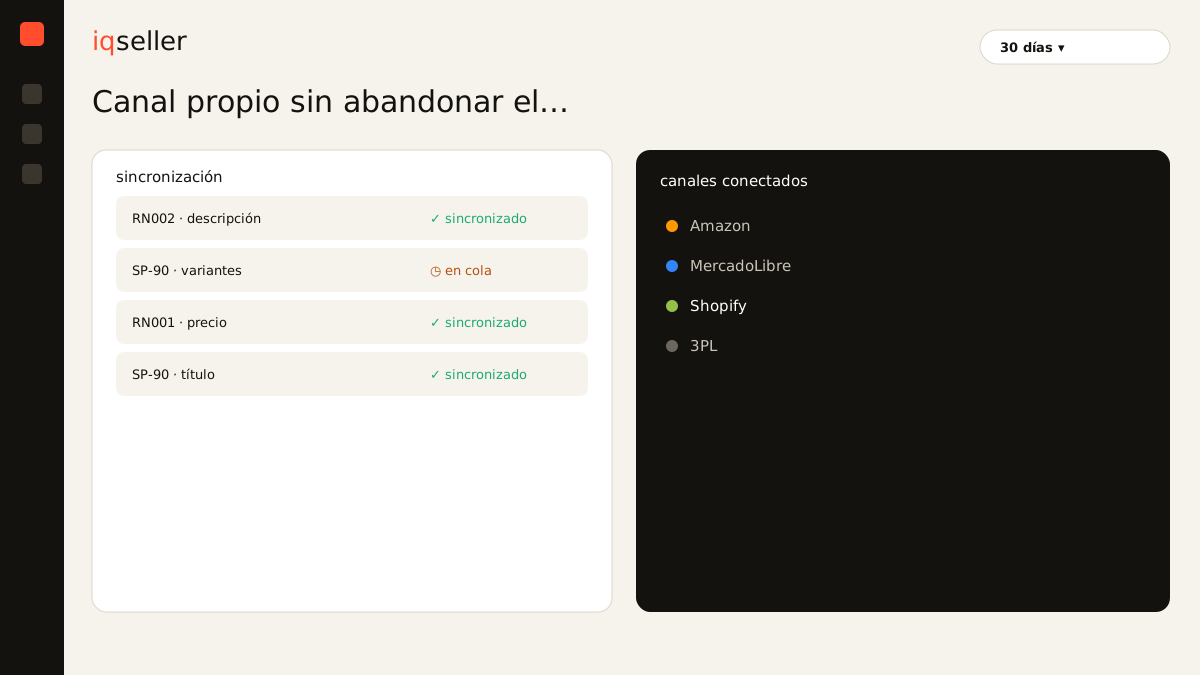
Then there is the operational problem that can genuinely hurt: shared inventory. The same unit listed in three places is a promise made three times. If synchronization lags, you sell what you no longer have, you cancel, and you pay for that mistake in reputation, which marketplaces charge dearly for.
Glossary: real-time synchronization across channels →how marketplace and owned store coexist in iqseller
Adding an owned channel does not add a dashboard: it adds a different logic. The marketplace hands you orders with commission already deducted and payout reports with withholdings; the store hands you gross orders where the costs sit scattered across gateway, platform and media. Comparing them from memory is impossible; comparing them in a spreadsheet is work that gets redone every week.
In iqseller the product lives once in the Catalog, with its Parent → Model → SKU tree, and every listing — from every marketplace and from your store — hangs off the same master SKU. One real product, many listings. That is what lets the question “how much does this product make?” have a single answer with a breakdown, instead of three answers that cannot be added together.
Inventory shows one stock split by location — FBA, Full, 3PL, your own warehouse — with its valuation, so none of the channels promises units already committed elsewhere. It is the direct defense against the overselling that shows up exactly when you open the owned channel. Alerts flags critical stock before it becomes a stockout, and Forecast uses each channel’s real sales velocity to say how much to reorder.
Pricing lets you see each listing’s current price side by side, which is where the inconsistency between your store and your listings gets caught before the buyer catches it. And Profitability is where the argument closes: net margin per SKU is built from the COGS you load plus what was actually deducted — Amazon settlement commissions, MercadoLibre order commissions, FBA and Full fees, shipping, advertising, and the VAT and withholding breakdown — so the owned channel’s margin and the marketplace’s margin end up in the same unit and can finally be compared.
the right sequence for opening it
Order matters more than the decision itself. This sequence avoids most of the stumbles.
- First, margin under control on the channel you already run. If you still cannot recite your net margin per SKU on the marketplace, opening a store only adds variables to a calculation that does not add up yet.
- Second, the unified catalog. One real product, one master SKU, and every listing hanging off it. Without that, shared inventory becomes guesswork in week one.
- Third, stock synchronization before design. Not overselling matters more than a pretty page. Marketplace reputation is lost faster than it is rebuilt.
- Fourth, calculate your acquisition budget with the math from the section above, and let it decide how much you can spend per order before you turn on the first campaign.
- Fifth, start with few SKUs: your own-brand items, the highest-margin ones, the ones that benefit from content and the ones that bundle well. Do not upload the whole catalog for the sake of completeness.
- Sixth, measure repeat purchase from day one. If nobody has come back after six months, your owned channel is an expensive marketplace with no traffic included, and the fix is the offer, not more ad spend.
the honest conclusion
An owned channel is not the exit from the marketplace: it is the piece the marketplace is missing. The marketplace gives you volume, discovery and speed in exchange for a commission and for not knowing your customer. Your own store gives you margin, data and control in exchange for sourcing the traffic yourself. Neither one does the other’s job.
The businesses that sustain both do not do it out of abstract diversification, but because each channel feeds the other: the marketplace generates product validation, reviews and brand recognition; the store captures the buyer who already knows you and turns them into repeat purchase at a far lower cost than the first one.
That only works if you can see both in the same unit of measure. As long as the marketplace margin lives in a settlement report and your store’s margin lives on another screen, the comparison will be an opinion. With the same product, the same COGS and every deduction loaded in one place, it becomes a decision.