
From marketplace to D2C: why your own store matters
April 9, 2026
Selling your first batch on Amazon feels unbeatable: you upload a listing, demand shows up, and the marketplace brings the traffic. That early ease is real, but it hides an invoice that takes a while to land. Every sale you close on Amazon Mexico or MercadoLibre leaves you with one fewer commission, no buyer email, and a page where three competitors offer almost the same thing a few pesos apart. The channel gave you scale, but it took away the relationship with your own customer.
The move to D2C —selling directly to the consumer from your own online store— is not about abandoning the marketplace; it is about no longer depending solely on it. The catch is that, for a seller already running two or three channels, that move usually means opening even more tabs. Amazon Seller Central on one side, the MercadoLibre panel on another, the 3PL portal to check what shipped, and now a Shopify admin on top of it all, with its own inventory, its own prices, and its own orders. The promise of “owning your brand” turns into the reality of copy-pasting numbers across four systems at eleven at night.
That is the real hidden cost of a badly assembled D2C play: it is not the platform, it is the fragmentation. And it gets solved before you open the store, not after, by deciding how you will keep a single source of truth when the same SKU lives in four places at once.
what your own channel actually gives you
The first thing that changes when you sell on your own domain is the economics of each order. On the marketplace, the sale price is eaten by referral fees, fulfillment fees, and sometimes advertising spend just to avoid the second page of results. In your store those fees disappear or shrink to the payment processor’s cut. The same product, at the same list price, leaves you with a different margin depending on which channel it went out through.
But the economics are not the whole story. In your store you own the relationship: you have the buyer’s email, their history, their consent to be contacted again. You can run remarketing, drive a second purchase, ask for a direct review. On Amazon, the customer belongs to Amazon. That difference, multiplied across thousands of orders a year, decides whether you build a brand or just restock someone else’s shelf.
Your own channel also gives you something the marketplace never will: control over presentation. Your MercadoLibre listing looks just like your competitor’s —same template, same layout. In your store you decide the narrative, the photos, the bundle, the extended warranty. It is the difference between being one more row in a catalog and being SPORTIFY, a brand the customer remembers and searches for by name.
the real pain: four panels, one truth
Here is the knot every multichannel seller knows. You have 200 units of a SKU in the 3PL warehouse. You sell eight through Amazon this morning, five through MercadoLibre at noon, and, if you opened your store, another three through Shopify in the afternoon. How many are left to promise on each channel? If every panel keeps its own count, the honest answer is: you do not know for sure until someone reconciles it by hand.
That uncertainty is expensive. You oversell on one channel because another already consumed the physical stock, and you end up canceling an order —with the hit to your reputation that carries on Amazon or MercadoLibre. Or the opposite: you get conservative, leave a stock buffer on every channel “just in case,” and end up with product sitting idle that you could have sold. Both failures come from the same place: not having an available number that all channels respect at the same time.
Dictionary: the unified catalog ties each SKU to its listings across every channel, so a product is a single entity instead of four loose copies.The fix is not to work faster in Excel; it is to eliminate the Excel. When all four channels read and write against the same inventory record, the count stops being an act of faith. You sold three through Shopify and the amount available for Amazon drops that instant, with no one touching a spreadsheet. On how that number is calculated and how to anticipate restock before you run short, it is worth reviewing inventory forecast in depth, because adding a D2C channel changes the speed at which your stock moves.
prices and descriptions that do not contradict each other
The second front of fragmentation is pricing and content. You launch a promotion in your store for the holiday season, but you forget the same product is still cheaper on MercadoLibre, and a sharp customer calls you out. Or you update the spec sheet on Amazon —fix a measurement, add a certification— and that correction never reaches your Shopify, where the old data lingers. Each channel tells a different version of your own product.
Keeping things consistent by hand becomes unsustainable the moment you pass a dozen SKUs. The healthy logic is to define the price and description once, in one place, and let each channel receive its version adapted to its rules —because yes, pricing can and should vary with each channel’s fees, but that variation has to be a deliberate decision, not an oversight. This is exactly the problem we tackle in syncing prices and descriptions with Shopify: how to propagate a change from the source to every point of sale without rewriting it four times.
Dictionary: real-time synchronization propagates every change in stock, price, or listing instantly across channels, instead of running nightly batches.deciding with today’s data, not yesterday’s
A seller who reports numbers on Mondays with last week’s close is always deciding through the rearview mirror. Is it worth advertising this SKU in your store or pushing it on the marketplace? Which channel leaves you the better real margin once fees are subtracted? Those questions are not answered with yesterday’s data; they are answered by watching how each channel moves today, side by side, on the same screen.
When inventory, sales, and margins from Amazon, MercadoLibre, and Shopify consolidate into a single dashboard, you stop assembling the report and start reading it. The time you used to spend gathering information now goes to acting on it. That is the real reason a single source of truth matters: it is not technical elegance, it is reclaiming the hours that copy-paste steals from you every week and, above all, deciding with certainty instead of hunches.
Dictionary: the real available is the stock you can truly promise right now, after subtracting what is already committed across all channels and what is in transit.how to make the leap without multiplying the chaos
The most common mistake is opening the D2C store as if it were a separate business, with its own inventory and its own operation. It works for two weeks, until the first big sales weekend, when the counts drift apart. The solid way into D2C is the reverse: first you unify the operation —catalog, inventory, orders— and then the Shopify channel plugs in as one more point of sale on top of that common base.
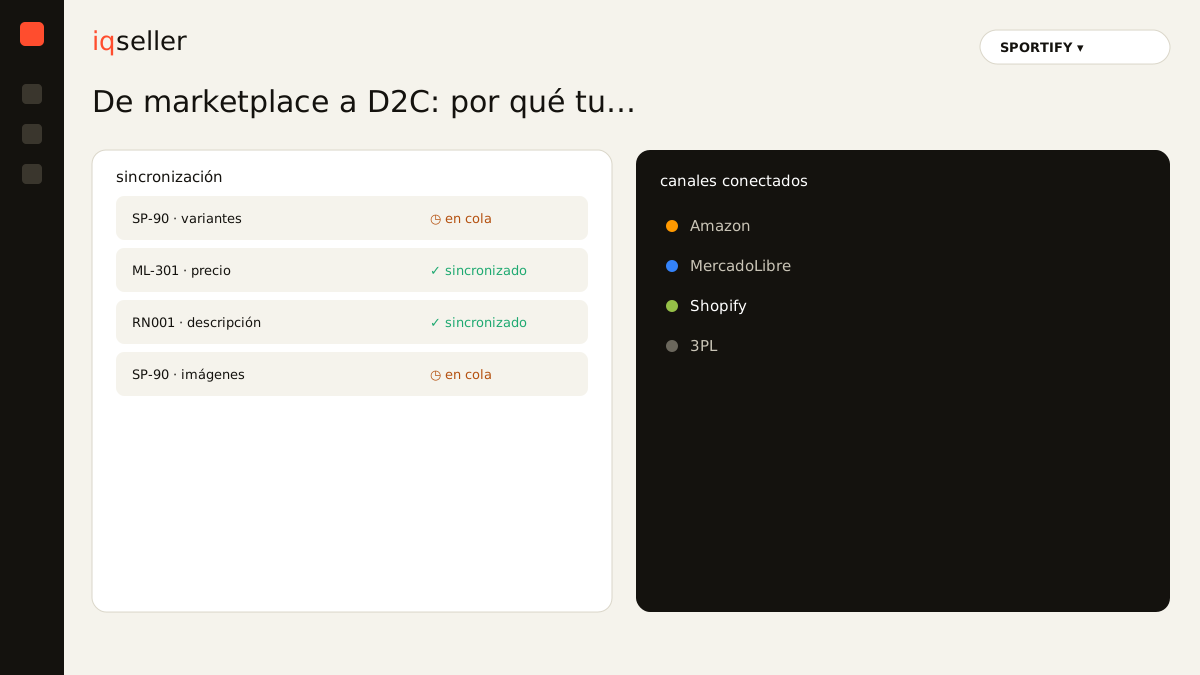
Under that logic, adding your store does not add a fifth panel to watch; it adds one more column to the dashboard you already consolidate. The order that comes in through Shopify draws down the inventory shared by Amazon and MercadoLibre, flows to the 3PL through the same pipeline, and shows up in the same sales report. Your own store stops being an operational burden and becomes what it should have been from the start: a higher-margin channel with a direct relationship to your customer, mounted on the same machinery you already have running.
what to measure from day one
When you open D2C it pays to define upfront the numbers you will watch, because they differ from the marketplace ones. Margin per channel, net of fees and shipping cost, tells you whether the store really pays better than Amazon for each SKU. The repurchase rate tells you whether the direct relationship is bearing fruit or whether you just switched shelves. And the share of orders fulfilled on time tells you whether your 3PL can absorb the extra channel without blowing your delivery windows.
The underlying point is that D2C does not compete against your marketplace; it complements it. iqseller exists so that this coexistence costs you less manual work, not more: a single source of truth where inventory, prices, and orders from all your channels live together, in real time, so the seller already juggling several panels can finally see them as one. Starting with your own online store is not a branding luxury; it is reclaiming the margin and the customer relationship that the marketplace, by its very nature, will never hand you.