
Syncing prices and descriptions with Shopify
April 13, 2026
When you opened your Shopify store, the idea was to finally have a place of your own: no marketplace fees biting into every sale, no rules that change overnight, your brand front and center. But within a few weeks you discover the quiet trap of going multichannel. The same product you sell on Amazon, on MercadoLibre, and on your Shopify now lives in three different places, and each place has its own price, its own description, and its own version of the truth. You raised the price on Amazon because the fees changed, but on Shopify it still shows the number from two months ago. You improved a listing’s description on MercadoLibre, and your store kept the old text with the typo you’d already fixed.
The problem isn’t a lack of effort. It’s that keeping everything aligned by hand is a job that never ends. Each channel has its own dashboard, its own format, its own way of asking for the data. You end up exporting a CSV from here, pasting into an Excel sheet over there, comparing columns at eleven at night to figure out where the price drifted apart. And meanwhile, a customer who landed on your Shopify from an ad sees a price that no longer exists, or reads a description promising something the current product no longer includes.
Syncing prices and descriptions with Shopify isn’t a luxury reserved for big sellers. It’s what keeps your own direct channel, the one with the best margin, from being the one that shows the worst information. This article explains why sync breaks when it’s done by hand, what decisions you need to make before automating it, and how a single-source-of-truth approach changes the way you manage your catalog.
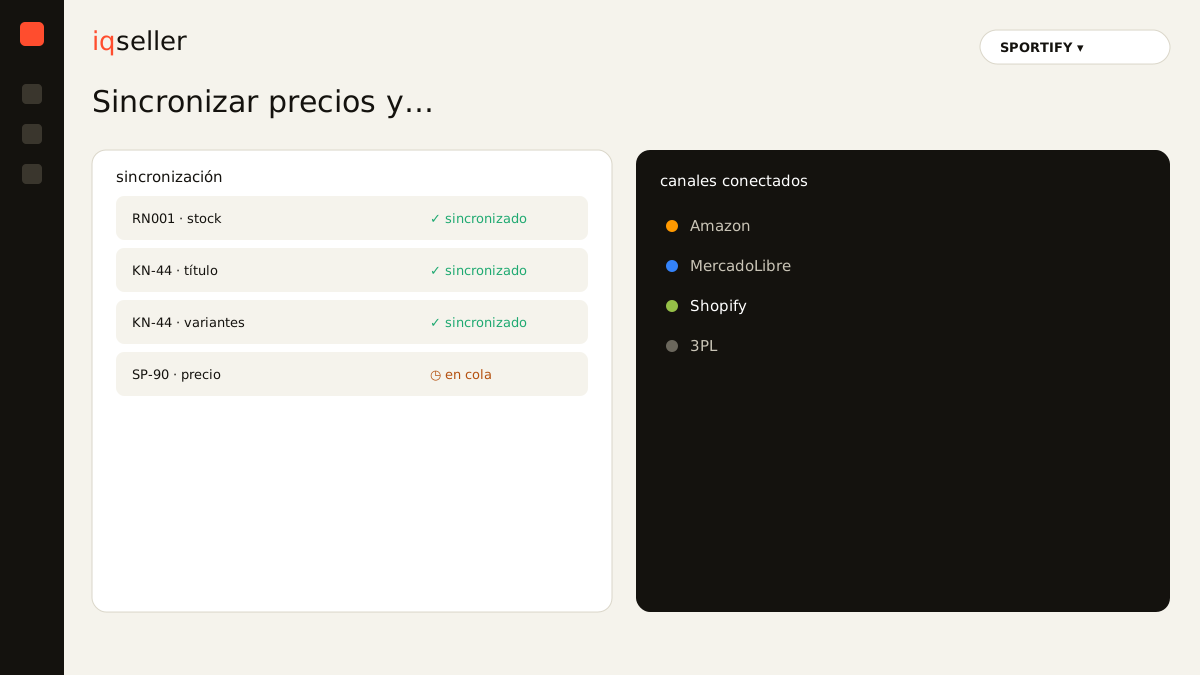
why prices drift apart without you noticing
Price seems like the simplest data point in the world: a single number. But in multichannel that number moves for different reasons in each place. On Amazon you adjust to defend the Buy Box or because the category fee changed. On MercadoLibre you raise it to absorb the cost of free shipping when you join a promotion. On Shopify, by contrast, you set the price you want, free of marketplace commissions, and often leave it lower precisely to reward whoever buys from you directly.
The result is that there is no “the price.” There are three pricing logics living side by side, and when you change one without touching the others, the inconsistency piles up. A customer who Googles you finds your product more expensive on Amazon than on your store, or the other way around, and grows suspicious. Worse: sometimes you lose track of which is the “real” price for a SKU, because each dashboard shows you its own.
Syncing doesn’t mean putting the same number everywhere. It means deciding, explicitly, what relationship you want between channels, and having that relationship hold on its own when one of the prices changes. If your Shopify is always going to be 5% below your MercadoLibre price, that’s a rule that can be automated. What can’t continue is having the rule live in your head and applying it by hand whenever you remember.
Dictionary: a unified catalog gathers all your products from Amazon, MercadoLibre, and Shopify into a single record per SKU, so you don’t edit the same thing three times.descriptions: the problem nobody measures but everybody suffers
With price, at least you eventually catch the error because a customer complains or you spot odd numbers. With descriptions the damage is invisible. You improved a product’s text on Amazon after reading your buyers’ frequent questions, added exact measurements, clarified compatibility, removed a promise that was driving returns. That learning stayed on Amazon. On your Shopify the generic first-day description still runs, the one you copied from the supplier.
Descriptions accumulate knowledge. Every adjustment you make is a lesson a customer taught you. When that knowledge lives isolated in one channel, the other channels repeat the same mistakes: the same doubts, the same returns, the same “it wasn’t what I expected” reviews. Your direct store, which should be your best showcase, ends up the worst-informed because it’s the one you touch least day to day.
Syncing descriptions has a nuance price doesn’t: format. Amazon rewards bullet points loaded with keywords, MercadoLibre has its own editor with character limits, and Shopify lets you write free HTML in your brand’s style. You don’t want to paste your Amazon copy straight into Shopify; you want the underlying information (measurements, materials, warranty, warnings) to be the same, but presented as each channel demands. Smart syncing separates content from format: the data is one thing, the presentation adapts.
one source of truth instead of three copies
The root of the problem is that you have the same product stored three times, and each copy is edited separately. As long as that holds, drift is only a matter of time: one change you forget to replicate is enough. The alternative is to flip the structure. Instead of three copies you fight to keep identical, a single master record per SKU that all three channels feed from.
In that model, when you raise a price or fix a description, you do it in one place. The platform takes care of pushing the change to Amazon, MercadoLibre, and Shopify according to the rules you set for each. Shopify’s price can follow its own formula relative to the marketplaces; the description is reformatted for each destination; but the source data is one. You stop asking “which price is the right one?” because there’s only one that matters, and everything else is derived from it.
This is exactly the difference between operating on yesterday’s data and operating on right-now data. When you assemble the information by hand in an Excel sheet, what you see is a snapshot that went stale the moment you exported it. A single source in real time shows you the current state of each SKU on each channel, and when something doesn’t match, it flags it before a customer discovers it for you. If you’re curious how this connects to scheduled pricing logic, we develop it in the automatic price calendar, which is the natural sibling of this topic.
Dictionary: real-time sync propagates a price or description change to every channel the moment you save it, not on the next manual cycle.what to decide before automating
Automating sync isn’t pressing a button and forgetting about it. First you have to make decisions the tool can’t make for you, because they depend on your business. The first is the direction of flow: is Shopify the source of truth or the destination? Many sellers keep the master catalog outside the marketplace and push toward it; others use Amazon as the base because that’s where the business began. There’s no right answer, but there has to be a single one, and it has to be explicit.
The second decision is the per-channel price rule. Does Shopify match the MercadoLibre price, go cheaper to encourage direct purchase, or go higher because you offer something extra there? If you define the rule as a formula (for example, “Shopify = list price minus 7%”), sync respects it on its own every time the base price changes. If you don’t define it, every change forces you to recalculate by hand.
The third is which fields you sync and which you don’t. Price and stock almost always yes. The long description, usually yes, but adapted to the format. The title sometimes no, because on Amazon you need keywords that look forced on Shopify. Images may or may not be shared. It’s wise to start by syncing the critical fields (price, stock, availability) and add more as you trust the flow. Brands like SPORTIFY that manage dozens of SKUs migrated from Amazon to their own store tend to start exactly this way: price and stock first, content later.
the hidden cost of not syncing stock alongside price
A detail that gets overlooked: there’s no point syncing price if stock goes its own way. Imagine your Shopify shows the correct price and a flawless description, but the product sold out an hour ago in the warehouse because it moved on Amazon. The customer buys on your store, you charge them, and then you write to apologize because you don’t have the piece. That’s the worst of all worlds: the sales information was perfect, but availability was a lie.
That’s why syncing prices and descriptions has to go hand in hand with inventory. The sales promise you make on each channel is only honest if it reflects what you can truly ship today, counting what’s in your 3PL, what’s reserved, and what’s already committed on another marketplace. Selling the same item in three places without a shared inventory is promising three times what you have only once.
Dictionary: true available stock is what you can genuinely sell right now, after deducting what’s reserved and what’s already committed on other channels.from store-as-burden to store-as-asset
When sync works, Shopify stops being the channel you neglect and becomes the one you care for most, because keeping it current no longer costs you effort. That’s the foundation for taking your direct channel seriously: only when your store shows coherent prices, up-to-date descriptions, and true availability can you drive traffic to it without fearing the customer will hit stale information. The deeper argument, about why your own store deserves that investment, we cover in from marketplace to D2C: why your own store matters.
The mental shift is to stop seeing sync as a maintenance chore and start seeing it as the condition that unlocks your highest-margin channel. Every hour you don’t spend comparing columns in Excel is an hour you can put toward growth. And every time a customer sees the same fair price and the same trustworthy description no matter where they found you, your brand gets a little more solid. That coherence, sustained without manual effort, is what separates a seller who survives in multichannel from one who actually controls it.