
Shopify and marketplaces: one inventory
April 10, 2026
The day you launch your Shopify store, it finally feels like you own something: your domain, your brand, your rules. But that freedom arrives with a quiet bill attached. You were already selling the same product on Amazon and MercadoLibre, and you were already juggling to keep the numbers straight. Now you have added a fourth front —your own store— and the oldest question gets harder to answer: how many units do I actually have available, right now, across every channel?
The honest answer for most sellers is “let me check.” And “let me check” means opening Shopify, then Amazon Seller Central, then the MercadoLibre panel, then the 3PL portal, jotting figures into a notebook or a spreadsheet, subtracting what is already committed, and praying that nobody bought anything between the moment you opened the first tab and closed the last one. By the time you finish, your snapshot was born stale. You sell on yesterday’s data while the customer buys today.
The root problem is not Shopify. Shopify is excellent at what it does. The problem is that every channel believes it owns the stock exclusively, when in reality they all share the same boxes in the same warehouse. Without a layer that reconciles them, you end up running parallel inventories that contradict each other.
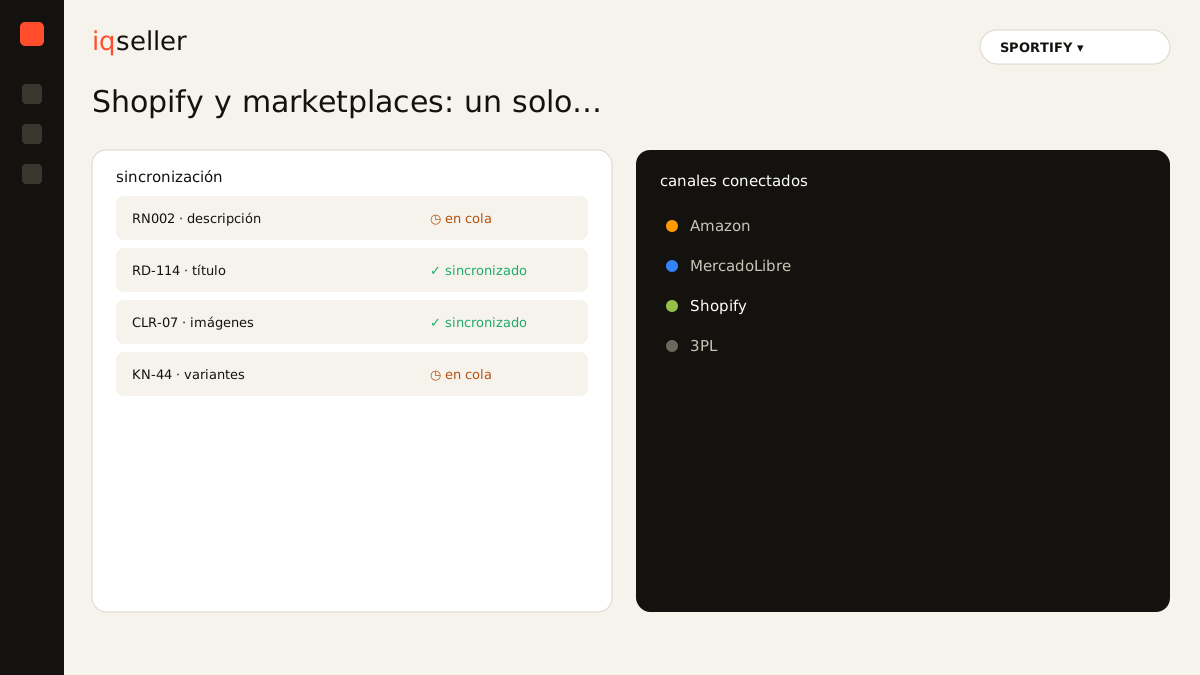
one physical product, four different truths
Picture SPORTIFY selling an adjustable dumbbell. There are 40 units in the 3PL warehouse. But on Amazon the listing says “12 available” because of a buffer that was set that way, on MercadoLibre it says “20” because someone adjusted it by hand two weeks ago, and on Shopify it says “40” because nothing was ever deducted for the orders already reserved for pending shipments. Four panels, four figures, one single pile of boxes.
Each of those figures looks reasonable on its own. Together they are a time bomb. If orders land at the same time on two channels, you sell something that no longer exists. And overselling on marketplaces is not a cosmetic error: on Amazon it hits your account metrics, on MercadoLibre it damages your reputation and your position in the listing. Canceling an order costs far more than the sale you lost.
Dictionary: the unified catalog ties the same physical product to all of its listings, regardless of channel →the unified catalog is the starting point
Before you can talk about “one inventory,” you have to be able to say, unambiguously, that the Shopify listing, the Amazon ASIN, and the MercadoLibre publication are the same product. That sounds obvious, but operationally it almost never is: each channel has its own identifier, its own title, its own variant. The SPORTIFY dumbbell can be a SKU on Shopify, an ASIN on Amazon, and an MLM on MercadoLibre, and nothing in those systems knows it is the same box.
A unified catalog solves that by tying all those identifiers —ideally via EAN/GTIN— to a single master record. From there, adding up stops being dangerous, because the system knows which listings share units and which do not. Without that layer, any consolidation is guesswork. As we covered in integrating Shopify: your brand, not just a listing, your own store deserves to be treated as a first-class channel inside the same catalog, not as a separate island you sync by hand when you remember.
real available, not total stock
Here is the nuance that costs almost everyone sales. The question is not “how many units do I have?” but “how many can I promise today without overselling?”. Those two figures rarely match. From the physical total you have to deduct what is reserved for in-process orders, what is in transit between warehouses, what the 3PL flagged as unsellable, and the per-channel buffers you set to protect yourself.
That result —the consolidated real available— is the only number you should expose to your channels. If instead you sync total stock, you inflate every listing and overselling is only a matter of time. If you sync the availability of a single channel, the rest are left blind. The goal is to compute one real available figure and distribute it with clear rules: how much to reserve for Shopify, how much for Amazon, how much for MercadoLibre, based on where you sell fastest.
Dictionary: real available vs total stock, and why confusing them makes you cancel orders →the sync has to happen in real time
A perfect calculation is useless if it updates once a day. Multichannel inventory moves by the second: a sale on Shopify has to immediately deduct what is available on Amazon and MercadoLibre, and a sale on any marketplace has to reflect instantly in your own store. When the sync runs in batches every few hours, you open a window in which two channels can sell the same last unit.
Real-time sync closes that window. Every movement —sale, return, goods receipt, adjustment— recomputes the real available and pushes it to all listings almost instantly. This is exactly the principle we developed in real-time inventory: stop operating on “yesterday’s stock” and start promising only what truly exists right now. With Shopify in the mix, that principle stops being nice to have and becomes essential, because your own store is usually where canceling hurts most: there, the customer is yours, not the marketplace’s.
Dictionary: what real-time sync is and how it prevents double selling →the 3PL cannot be left out of the picture
Many sellers consolidate Amazon, MercadoLibre, and Shopify, but leave the 3PL as an annex they check over email. That is an expensive mistake, because a large share of your physical stock lives there. If your source of truth does not include what the logistics operator holds, has reserved, and is in the process of receiving, your real available is incomplete and you will make restocking decisions on figures that do not add up.
A self-managed warehouse, a 3PL, and each marketplace’s fulfillment centers should appear in a single view, each with its respective real available. Only then can you answer honestly where every order ships from and how much you have left in total. That consolidated view also lets you move inventory with judgment —sending it to the right channel before a stockout— instead of reacting after a listing has already gone dark.
one source of truth, several better decisions
When the catalog is unified, the real available is computed correctly, and the sync runs in real time, “let me check” disappears. There is one single figure, alive, identical on Shopify, on Amazon, on MercadoLibre, and in your internal report. That single source of truth does more than prevent overselling: it changes how you decide.
You see instantly which SKUs concentrate your idle capital, which are about to run out, and on which channel it pays to push them. You stop arguing with the team about how many units there are with three different screens open. And when you grow from one hundred to one thousand products, control no longer depends on how many tabs you can review in the morning, but on a panel that is always up to date. That, in the end, is the real promise of bringing Shopify and the marketplaces under one inventory: not more dashboards, but less uncertainty.