
A single source of truth for your operation
February 17, 2026
It is Monday morning and you want to know something that should be trivial: how much you sold over the weekend and how much stock you are starting the week with. To answer it you open Amazon Seller Central in one tab, MercadoLibre in another, your 3PL panel in a third, and finally a spreadsheet where you keep “the consolidated view.” Each place gives you a different number, none of them fully agree, and you end up guessing which one to believe. That simple question just cost you half an hour and, worse, left you with an answer you do not trust.
This is the everyday pain of the multichannel seller: it is not that you lack data, it is that you have too many versions of the data. Every channel has its own truth, captured with its own delay, with its own way of counting a sale or a refund. Amazon counts a sale when it confirms the order; MercadoLibre when the payment clears; your 3PL when it ships. When you stitch it all together by hand in a sheet, you are gluing photos taken at different moments and pretending they are the same scene. The result is deciding with yesterday’s data, without even knowing how old “yesterday” really is.
A single source of truth does not mean having “yet another dashboard.” It means the opposite: that there is one place where the whole operation is reconciled and current, and that this is the place you check instead of sweeping across four screens. It does not replace the marketplaces; it reads them, normalizes them, and hands you a number you can actually base a decision on. The shift is not cosmetic: it is no longer being the human integrator who copies and pastes between systems.
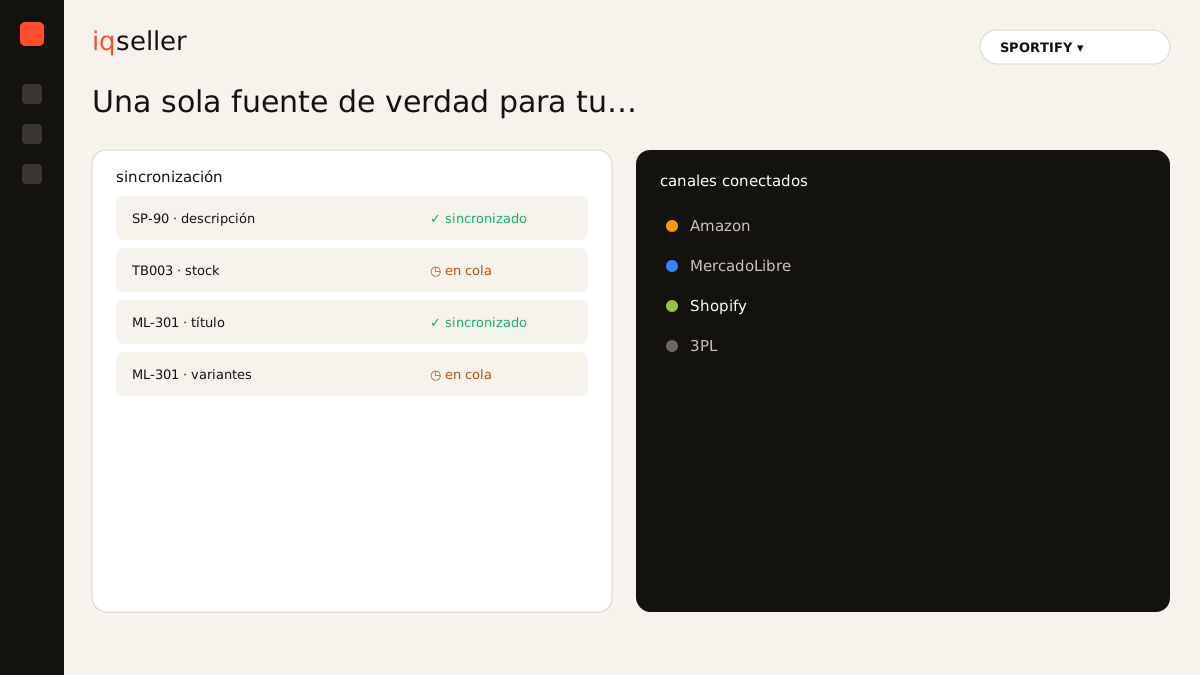
what “source of truth” means when you sell across channels
The term comes from data systems, but for a seller the idea is very concrete. A source of truth is the record everyone agrees to obey when there is doubt. If Amazon says you have 12 units left and your spreadsheet says 18, which one do you believe? Without a source of truth, you believe whichever one is closest at hand or whichever confirms what you already wanted to do. With a source of truth, there is one number that is responsible, and the rest are checked against it, not against each other.
What matters is that this source is not just one more copy, but the reconciled copy: the one that has already integrated sales from every channel, subtracted what is committed, added what arrived at the warehouse, and resolved the date clashes. It is not where you store data; it is where the data agrees with itself. That distinction is what separates a “master” spreadsheet —which is really just your own opinion frozen last Tuesday— from a living source that updates on its own.
Dictionary: the unified catalog is the foundation of a source of truth: one physical product at the center and each marketplace listing as one of its representations, not as an independent piece of data.why the consolidated spreadsheet always arrives late
The spreadsheet is not wrong for being a spreadsheet; it is wrong for this job because it is a photo and you are living a movie. For your consolidated sheet to reflect reality, you would have to update it the instant every sale comes in, every refund lands, every unit moves in the 3PL, and every price changes. Since that is physically impossible by hand, what you have is a document that was true at some point and that you trust with a faith it never earned.
The cost is not just the time spent maintaining it. It is that every error spreads silently. You mistyped a figure on Thursday, decided Friday’s restock based on it, and by the time you notice the gap you have already over-ordered one product and under-ordered another. The sheet never warns you when it is wrong, because it does not know what is happening in the channels: it only knows what you managed to type in.
A source of truth reverses the direction of the work. Instead of you carrying the data into the sheet, the channels report their events to the center and you read something already reconciled. This connects directly to real-time inventory: a beautiful consolidated view is worthless if the stock number it shows expired three hours ago.
the heart of it: synchronization
For a single place to be truthful, it has to learn what is happening outside almost instantly. That is where synchronization comes in: the flow that brings every sale, every cancellation, every price change, and every inventory movement from Amazon, MercadoLibre, and the 3PL into the center, and pushes back the changes you make. Without that flow, the “source of truth” would just be another photo, only with better design.
Synchronization is neither magic nor instant to the millisecond, and it helps to understand its timing so you can trust it with your eyes open. Some events arrive through an immediate notification from the channel; others are polled at intervals. If you want the detail of how that back-and-forth is orchestrated, we take it apart in how real-time sync works. What matters here is that a good source of truth tells you not just the number, but how fresh that number is.
Dictionary: real-time synchronization is the process that keeps the center current with what happens in each channel, so the number you read is the one from now and not from hours ago.reconciling is not adding: the traps of merging channels
The hard part of a source of truth is not bringing the data in, it is reconciling it. Every channel counts differently and, if you add them up raw, you get figures that look true and are not. A MercadoLibre sale with a pending payment is not a cleared sale. An Amazon refund hits one day’s revenue but the unit returns to stock on another. A unit “in transit” to the 3PL is neither sold nor available: it is in a limbo your sheet has no way to represent.
Reconciling is resolving all those cases with a consistent rule, applied the same way every time. The real available stock, for example, is not the sum of what each listing shows; it is what you can actually promise right now, once you subtract what is committed across all channels and what is set aside for shipments. That number only exists if someone applies the same logic to every channel at once, and that someone cannot be you, by hand, every morning.
Dictionary: real available stock is the inventory you can sell right now, after subtracting what is committed across all channels; it is one of the numbers a source of truth computes for you.who sees what: truth is also a security matter
Having a single place with the entire operation brings a quiet advantage: you can finally control who sees and who touches each thing. When information lives scattered across four tabs and a spreadsheet in someone’s email, “security” is an illusion: anyone with the password sees everything, and changes leave no trace. If your assistant adjusts a price in MercadoLibre, there is no way to find out later who moved it or when.
A centralized source of truth lets you define roles —who can see costs, who can change prices, who can only view— and keeps a record of who did what. That matters when you grow and stop being a one-person shop: the team works on the same data, but not everyone with the same power. A single truth is not just more convenient; it is more defensible when something goes wrong and you need to reconstruct what happened.
what it feels like to operate with one truth
The practical change is not that you see more numbers, but that you stop auditing numbers. The Monday question —how much did I sell, how much do I start with— gets answered at a glance, with no tabs and no copy-paste, and without that nagging doubt of “but is this number the right one?”. When you see a drop in sales, you do not waste the first half hour figuring out whether it is real or a data-entry error: you already know the data is reconciled and can go straight to understanding why.
Operating this way does not remove the marketplaces or save you from learning their rules; SPORTIFY will keep selling on Amazon and MercadoLibre with all the quirks of each. What it removes is the glue work: those weekly hours that used to vanish into stitching together by hand what the system can reconcile on its own. You decide with today’s situation, you stop discovering problems only after they cost you a sale, and you regain trust in your own numbers. A single source of truth is not a luxury for big companies: it is what lets you grow without your uncertainty growing alongside you.