
How real-time sync works
February 20, 2026
If you sell on more than one marketplace, you know the scene by heart: Amazon Seller Central open in one tab, MercadoLibre in another, your 3PL panel in a third, and to close out the day you copy numbers into a spreadsheet that was already stale the moment you built it. Each platform shows its own version of the truth, on its own clock, and the most thankless job of all falls to you: reconciling by hand what each one says about the same product. By the time the picture is finally assembled, the last hour of sales has made it obsolete.
That lag isn’t cosmetic. It’s the difference between selling a unit you no longer have and eating a penalized cancellation, or between raising a price in time and giving away margin because your listing still carried last week’s promo. The multichannel seller doesn’t suffer from a lack of data; they suffer from data that lives in silos, arrives late, and never quite agrees with itself.
Real-time sync exists to solve exactly that. The idea is easy to state and hard to execute: keep stock, orders, prices, and the status of every listing reflecting what is happening right now, in one place, without forcing you to refresh three dashboards or guess which one is correct. This article explains how it works under the hood and why the approach changes the way you decide.
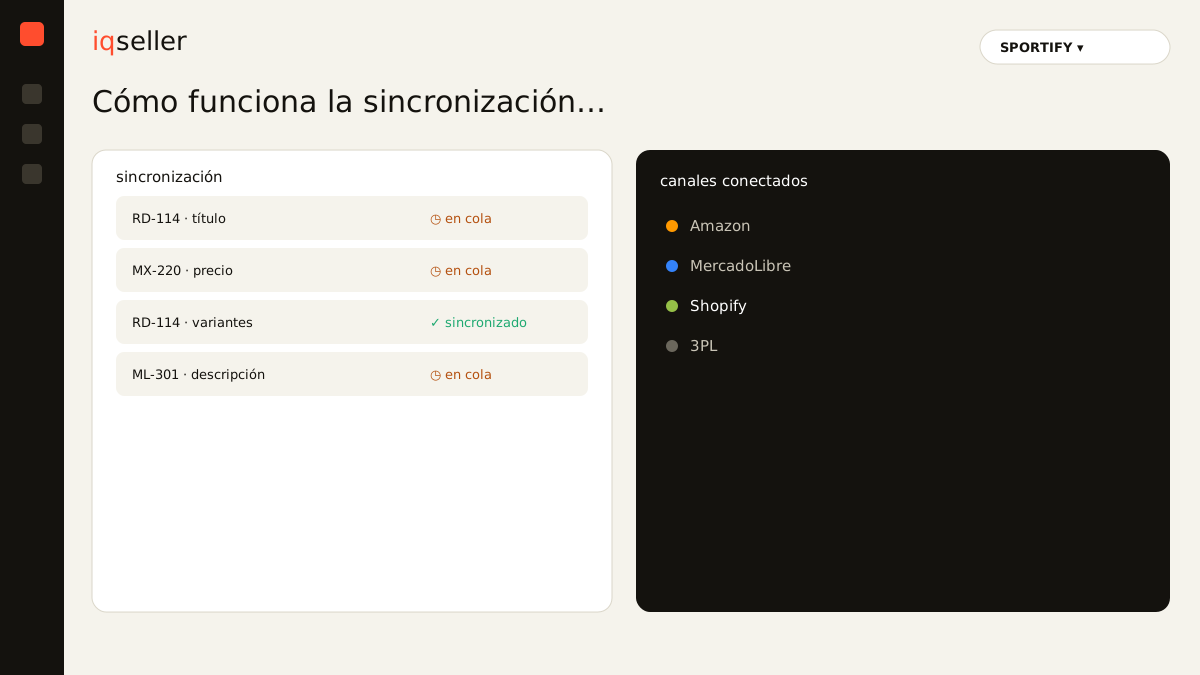
what “real-time” means when three marketplaces are involved
It’s worth grounding the term before going further. “Real-time” does not mean every movement lands on your screen in the same millisecond it happens; not even the Amazon or MercadoLibre APIs promise that. It means the system reacts to changes as soon as the source publishes them, without waiting for a nightly batch or for you to hit refresh. In practice we’re talking seconds to a couple of minutes, depending on how fast each platform notifies.
The difference from the old model is one of kind, not just speed. The traditional scheme is scheduled pull: every so often the system asks each marketplace, “anything new?” Between one query and the next, you fly blind. The real-time scheme is push plus smart polling: the platform announces when something changes, and the system only asks more when it needs to confirm.
Dictionary: real-time sync means keeping one up-to-date version of your data across every channel, reacting to changes as they happen instead of in scheduled batches.where each change comes from: webhooks, notifications, and polling
The heart of the system is capture. Each channel exposes changes differently, and serious sync combines several techniques because no single one is enough.
The first is the webhook or push notification. Amazon offers notifications for events like a new order or an offer change; MercadoLibre has its own topic-based notification system (orders, items, questions). When one of those alerts arrives, the system knows it must go fetch the detail for that specific resource, not the whole catalog. It’s the fastest path and the cheapest in terms of API consumption.
The second is polling, which remains necessary. Notifications sometimes get lost, arrive out of order, or simply don’t exist for a given data point. So a backup poll is kept running, more frequent for the critical stuff (stock, orders) and more relaxed for what rarely changes (listing attributes). The trick is polling just enough: too much and you hit API rate limits; too little and the lag comes right back.
The third source is the 3PL and your own actions. If your logistics operator receives or ships goods, that inventory change must enter the same flow as the marketplaces. The same goes for when you adjust a price or pause a listing from the panel itself. Every change, wherever it comes from, passes through the same door.
the problem of merging truths that don’t match
Capturing changes is the easy half. The hard part is reconciling them, because the platforms don’t speak the same language. The SKU your internal system calls SPORTIFY-BTL-750 shows up on Amazon as an ASIN, on MercadoLibre as an MLM, and in your 3PL under yet another identifier. If you don’t resolve that mapping, “syncing” turns into mixing apples and oranges.
That’s why the foundation of everything is a unified catalog: a master table where each real physical product has a single entry, with its per-channel representations hanging off it. When an Amazon sale comes in, the system doesn’t deduct from “Amazon stock”; it deducts from the master product, and recalculates from there how much it can offer on each listing. Without that spine, every channel stays an island.
Dictionary: a unified catalog is the master table that links one physical product to its identifiers on each marketplace (ASIN, MLM, 3PL SKU), so a single change propagates everywhere.On top of that base comes the trickiest question in sync: when two sources contradict each other, which do you believe? If Amazon says 4 units remain and your 3PL says 6, the system needs a priority rule and a timestamp. This is where it connects to the discipline of a single source of truth for your operation: it isn’t only about having the data together, but about defining which one wins in each case.
reservations, double sales, and computing the real available
The most expensive pain in multichannel selling is overselling. You have 5 pieces and you list all of them on both Amazon and MercadoLibre because you don’t want to cap sales on either. Three orders come in on Amazon and three on MercadoLibre almost at once, and suddenly you owe six against five in the warehouse. Whoever arrives late gets a cancellation, and the cancellation costs you reputation, metrics, and sometimes money.
Real-time sync attacks this with the concept of the real available: not raw stock, but what you can truly promise once you subtract confirmed orders, in-flight reservations, and a safety buffer if you configure one. When a unit is committed on one channel, the available drops for all the others almost instantly, before the next buyer can duplicate the sale.
Dictionary: the real available is the stock you can actually sell right now, minus confirmed orders, reservations, and a safety buffer, not the raw warehouse figure.Doing this well requires resolving millisecond races. Two simultaneous purchases can’t both read “1 available” and both sell. The system needs atomic writes and short locks so the deduction from one sale lands before the next is authorized. That invisible detail is exactly what separates sync that looks pretty in a demo from sync that survives Black Friday.
from capture to decision: why real-time is the base of the forecast
Syncing is not an end in itself; it’s the foundation for everything else. If your data arrives late or stripped down, any analysis you build on top inherits the error. An inventory forecast fed with yesterday’s sales projects yesterday’s demand, and sends you to reorder too late or too much.
With a real-time flow, by contrast, the sales velocity the forecast sees is today’s. If a product accelerated this morning, the estimate of when it runs out moves with it, and the replenishment alert reaches you while there’s still room to react. Pricing works the same way: adjusting against the competition only makes sense if you read the market now, not as it stood last week.
That’s the real value of pulling everything into one live place. You stop spending the first two hours of the day rebuilding the state of your business and start the day knowing where you stand. The decisions —how much to reorder, which price to move, which listing to pause— get made against what is, not against an old snapshot.
what happens when an API fails (and why it matters)
No integration is perfect, and any honest system assumes it. The marketplace APIs have outages, rate limits, and moments when they respond slowly or with incomplete data. Serious sync doesn’t pretend this away: it manages it.
When a channel stops responding, the system retries with growing backoff instead of hammering the API and making the block worse. If a change couldn’t be applied, it sits in a queue to be processed when the service returns, in order and without getting lost. And above all, the system tells you the truth about its own state: when the last successful sync for each channel was, so you know whether the number you’re looking at is thirty seconds old or two hours old because MercadoLibre is down.
That operational honesty is part of the value. A dashboard that always looks “green” even while it’s disconnected underneath is more dangerous than having nothing, because it gives you false confidence. Sync done right would rather show you a lag indicator than lie to you with a figure that’s no longer true.
what changes in your day to day
In the end, all of this boils down to a different experience. Instead of jumping between Seller Central, MercadoLibre, and the 3PL panel, you look at a single board where stock is already reconciled, orders from every channel live in one list, and the available you see is the one you can truly sell. The manual spreadsheet stops being the mandatory close of the day.
It’s not magic and it’s not a promise of zero errors: it’s an architecture that captures changes as they happen, reconciles them against a unified catalog, computes the real available with clear rules, and warns you when something doesn’t add up. On that foundation rest the forecast, the pricing, and the confidence to decide fast. Real-time isn’t a flashy feature: it’s the condition for the rest of your operation to mean anything.