
EAN and GTIN: the master key of your multichannel catalog
April 21, 2026
When you sell the same product on Amazon, on MercadoLibre, and in your Shopify store, you end up with three different identifiers for a single thing sitting in your warehouse. Amazon knows it by its ASIN. MercadoLibre by its MLM. Your 3PL by the SKU you assigned when the goods arrived. And you, staring at three open dashboards, are left guessing whether the “Black steel bottle 750 ml” in the Amazon listing is the same physical unit as the “750ml sports bottle” on MercadoLibre. Most of the time you resolve it from memory, and once in a while you get it wrong.
That is the core problem of a multichannel catalog: every marketplace invents its own way of naming your product, but none of those names is actually yours. If there is no identifier that crosses all channels and points unambiguously to the real product, every operation —loading stock, changing pricing, reconciling sales— becomes a manual translation exercise between systems that do not talk to each other.
This is where the EAN and, more broadly, the GTIN stop being a bureaucratic requirement and become the piece that holds everything else together. They are not just any barcode: they are the master key that lets you say “this product, no matter where I list it, is one and the same.” Without that key, there is no unified catalog. With it, each channel’s listings can finally hang off a single source of truth.
what a GTIN really is (and where the EAN fits)
The GTIN, or Global Trade Item Number, is GS1’s standard for identifying a product uniquely across the entire world. It is not a brand or a model; it is a numeric identifier that no other product on the planet shares. The EAN —the 13-digit number you see in the barcode of almost anything you buy— is simply one of the lengths a GTIN takes. The 12-digit UPC common in the United States is another. They belong to the same family: an EAN-13 is, technically, a GTIN-13.
What matters to you as a seller is not the naming but the implication: a single number describes your product in any country and on any channel. When you capture that number once and attach it to your real product, you give the system —and every marketplace— an unambiguous way to know what you are talking about. The ASIN, the MLM, and your internal SKU can keep existing, but now they all point to the same GTIN underneath.
Dictionary: the GTIN is a product’s global identifier; the EAN-13 is its 13-digit version, the most widely used in Mexico.why the multichannel seller struggles without it
Picture the operation of SPORTIFY, a sporting-goods store selling across three channels. The same pair of 5 kg dumbbells is published as two listings on Amazon (an old one and a new one that was never taken down), one listing on MercadoLibre, and one product on Shopify. In the 3PL they are registered under a SKU the warehouse clerk typed by hand. That is five records for a single physical object.
The day a large order comes in, someone has to open every dashboard, jot the quantities into an Excel file, add them up by hand, and decide how much stock to commit per channel. By the time they finish, the numbers have already changed: three units sold while the sheet was being built. The decision is made on yesterday’s data, sometimes on data from an hour ago. That lag is what causes oversells, listings paused for running out of stock, and replenishments that arrive too late. The problem is not lack of effort; it is that there is no key letting the software do that cross-referencing on its own.
When every product carries its GTIN, the system can recognize that those five records are the same item and consolidate them automatically. That is what turns a pile of loose listings into a real catalog. We cover this in depth in real-time inventory, where availability is computed against the real product rather than against each listing separately.
the GTIN as the column that joins every channel
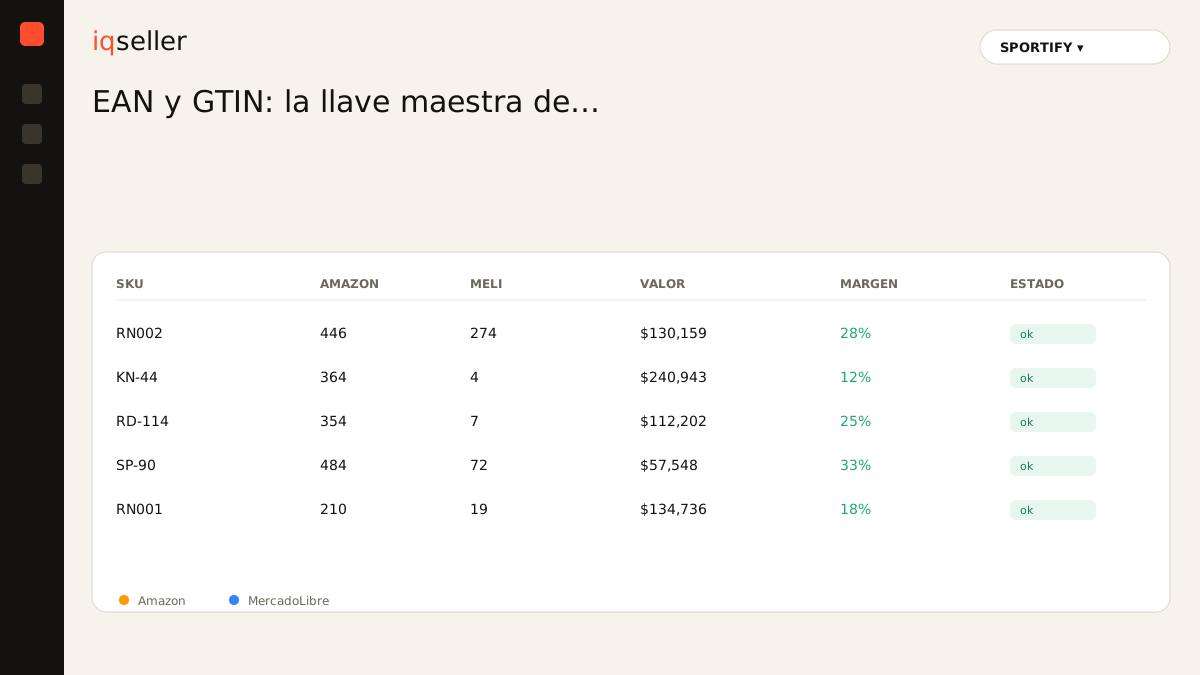
Think of a table where each row is a real product in your business and the columns are your channels. The GTIN is the first column, the one that gives the row its identity. From there, each channel contributes its own reference: ASIN on Amazon, MLM on MercadoLibre, handle on Shopify, SKU in the 3PL. All of those references reconcile against the same GTIN.
The practical effect is that you stop maintaining four parallel catalogs that have to be synced by hand. You maintain one, and each marketplace is a projection of that catalog. You change a product’s cost once and it shows up wherever it should. You detect that the same item is duplicated across two Amazon listings because both share a GTIN. You know the “black 750 ml” on one channel and the one on another are the same unit, because the number confirms it.
Dictionary: a unified catalog keeps a single real product to which all of each channel’s listings are linked.variants: where the GTIN becomes indispensable
The thorniest case is variants. A T-shirt that comes in three sizes and two colors is six distinct sellable products, each with its own inventory, its own price, and —this is key— its own GTIN. The classic mistake is to treat the T-shirt as “one product” and forget that every size-color combination needs its unique identifier.
When each variant has a GTIN, the system can keep stock separated by size and color without mixing them, prevent you from selling “red M” when what you have left is “blue M,” and map each variant correctly to its listing on each channel. Without a GTIN per variant, combinations blur together and you end up overselling some while others gather dust. If you manage catalogs with many combinations, it is worth reading size and color variants: how not to lose control, because the correct identifier at the variant level is what makes everything else add up.
the right GTIN feeds true availability
A well-set identifier does not just tidy the catalog: it makes trustworthy the number that actually matters, your real availability. If two Amazon listings share the same GTIN, the system knows the stock backing both is one single pool, not the sum of two columns. Without that consolidation, it is easy to believe you have twice as many units as physically exist, and that is the origin of most oversells.
When availability is computed against the real product —identified by its GTIN— rather than against each listing, the number reflects what you can truly promise the customer. That is the difference between committing stock with confidence and committing it with your fingers crossed.
Dictionary: real availability is the stock you can actually sell right now, consolidated per product and net of what is already committed.GTIN hygiene: mistakes that cost dearly
Having GTINs is not enough if they are entered badly. The most common problems we see in multichannel operations are four. First, a miscalculated check digit: the last digit of an EAN-13 is not arbitrary, it is derived from the previous twelve, and a number that does not validate will be rejected by the marketplace. Second, reused or invented GTINs, which sooner or later collide with another seller’s and cause your listing to attach to the wrong product.
Third, the same GTIN stuck to different variants, which breaks the inventory separation just mentioned. Fourth, products with no GTIN that someone “solved” by creating a loose record on each channel, perpetuating exactly the fragmentation you wanted to eliminate. The discipline here is simple to state and hard to sustain by hand: each product and each variant, a valid and unique GTIN, captured once and reused across all channels.
from three dashboards to a single source of truth
Everything above converges on one idea: the GTIN is the technical condition that makes it possible to stop operating on Excel and memory. As long as each channel has its own way of naming your products and no one cross-references them, you will keep opening three tabs, copying quantities by hand, and deciding on yesterday’s information. The uncertainty does not come from missing data; it comes from data that is scattered with no key to join it.
With the GTIN as the backbone, each marketplace’s listings stop being islands and become views of a single catalog. Stock consolidates, pricing is managed once, sales reconcile against the real product, and availability reflects the reality of your warehouse in real time. It is not magic or a software trick: it is what happens naturally when each product finally has a single name that every system understands. That master key is the first thing worth putting in order before anything else in your multichannel operation.