
Unified catalog: one real product, many listings
April 20, 2026
You have one physical product sitting in your warehouse: one box, one SKU, a number of units you can count by hand. But that same product lives as five different things depending on where you look at it. On Amazon it’s an ASIN with its optimized title. On MercadoLibre it’s a listing with its own ID, its color variation, and an EAN someone typed in by hand eight months ago. In your 3PL it’s an inventory line with yet another internal code. And in your master spreadsheet it’s a row you swear is up to date, even though you can’t quite remember the last time you touched it.
That is the core problem of the multichannel seller: you don’t sell on one channel, you sell the same product spread across many listings, and each listing carries its own version of the truth. Drop the price on Amazon and MercadoLibre keeps the old one. Sell down to ten units and both channels keep offering as if nothing happened, because neither knows what the other sold. You end up with three or four tabs open, copying numbers into a spreadsheet, and making today’s decisions with yesterday’s data. The uncertainty isn’t from missing information; it’s that the information is broken into pieces that don’t fit together.
The idea of a unified catalog is simple to say and hard to pull off by hand: have one real product at the center, and have every listing on every marketplace hang off it as a representation of the same thing. This isn’t a presentation trick. It’s changing the unit you think in: you stop reasoning “listing by listing” and start reasoning “product and its channels.”
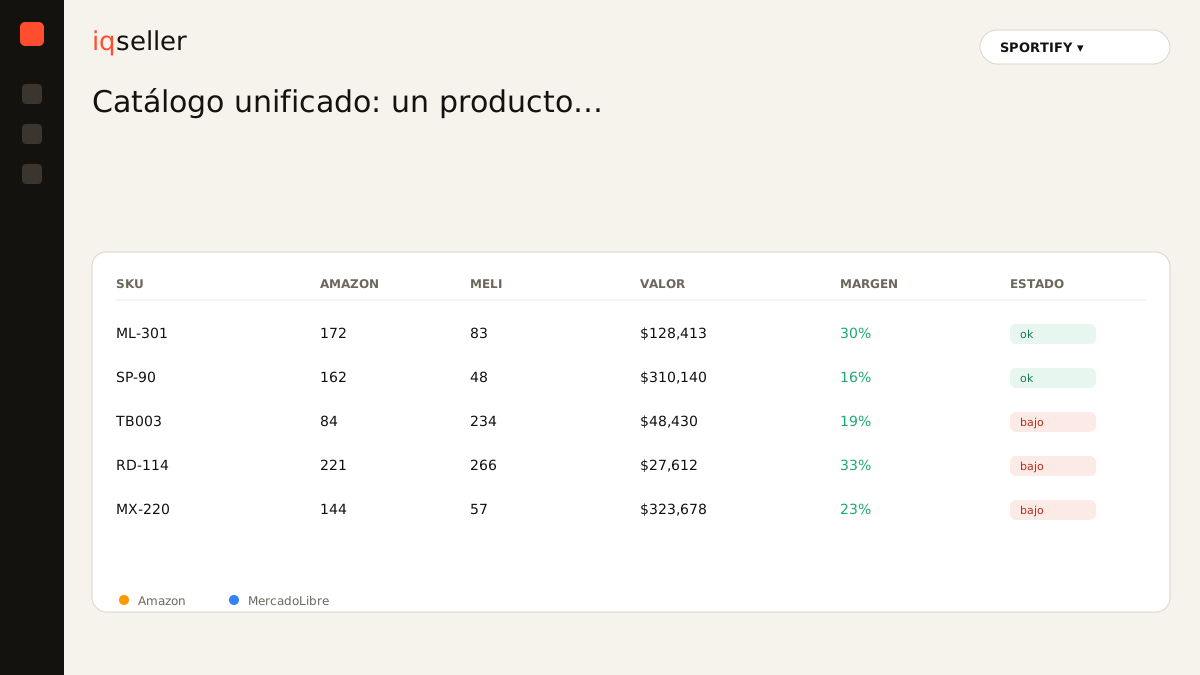
what “one real product” actually means
Before linking anything, it helps to define what counts as the product itself, separate from how you advertise it. A real product is the physical entity you ship: it has your master SKU, dimensions, a cost, a packaging unit, and ideally a stable external identifier like an EAN or GTIN. None of that changes because you publish it somewhere else. The title, the photos, the category, and the price do change from one marketplace to another, and that’s fine.
The classic mistake is treating the listing as if it were the product. When you do, every time you open a new listing you accidentally create a new product in your head. You lose track of how many real variants you actually have, you count inventory that doesn’t exist, and you find out too late that two listings you thought were independent actually share the same box in the warehouse.
Dictionary: the unified catalog is the model where a physical product is the central entity and each marketplace listing is just one of its representations.the link: how a listing connects to its product
Linking is the act of saying “this MercadoLibre listing and this Amazon ASIN are, in fact, this SKU of mine.” The most reliable bridge is the external identifier: if the EAN matches across channels, the link almost suggests itself. The trouble is that in practice it rarely matches that cleanly. One channel has it captured with an extra zero, another left it blank, another inherited it from a supplier who reused the code.
That’s why the link can’t rely on a single signal. It’s better to cross the external identifier with your internal SKU, the normalized title, and the specific variation (size, color, presentation). When several signals point to the same product, confidence rises. When they contradict each other, you need to review it by hand before merging, because linking wrong is worse than not linking: you start adding the stock of two different products as if they were one.
If the identifiers across your channels don’t line up, that mess has its own chapter; we cover it in EAN and GTIN mismatches across channels, because it’s the number one cause of broken links.
stock: “real available” versus available per channel
This is where the unified catalog stops being a nice idea and turns into money. If you have 40 physical units and you publish on two channels, how many do you offer on each? The naive answer is 40 and 40, and that’s exactly how you oversell: you sell 30 on Amazon, you have 10 left, but MercadoLibre still shows 40 because it never found out.
With a central product, stock is computed once over the physical total and then distributed or synced toward each listing. The number that matters is the real available: what you can truly promise right now, after subtracting what’s already committed across all channels and what’s reserved for pending shipments. That number is a single one, even if it shows up across several listings.
Dictionary: the real available is the inventory you can sell right now, once you subtract what’s committed across all channels, not the sum of what each listing displays.why the spreadsheet falls short
It’s not that the spreadsheet is wrong. It’s that the spreadsheet is a snapshot, and you’re watching a movie. For your sheet to reflect reality, you’d have to update it every time a sale lands on any channel, every time goods arrive at the 3PL, every time you change a price. Since that’s impossible by hand, what you end up with is a document that was true last Tuesday and that you trust on faith it hasn’t earned.
A living unified catalog flips the relationship: instead of you carrying data into a sheet, the channels report their events to the central product and you read a single source that’s already reconciled. You stop being the human integrator copy-pasting between dashboards. That constant reconciliation is also what feeds other decisions: the inventory forecast in depth only works if it starts from real inventory, not from the inflated sum of four listings.
pricing and fees: same box, different math
One product, many listings, also means many cost structures layered on top of the same purchase cost. Amazon charges you one set of fees, MercadoLibre another, and if you use the marketplace’s fulfillment, you add storage and handling. The sale price can and should differ per channel, but margin has to be read against the same base cost of the real product.
When the cost lives on the central product and the fees live on each channel, you can answer the question that actually matters: for this SKU, which marketplace earns me more per unit after commissions? That comparison is impossible when each listing is an island with its own cost typed in by eye. With the box at the center, pricing stops being guesswork and becomes arithmetic.
Dictionary: the EAN and GTIN are the product’s standard barcodes; captured correctly, they’re the most reliable bridge for linking the same item across marketplaces.variants: when one real product is several
It gets more complicated when you sell something with size and color. A SPORTIFY t-shirt isn’t a product: it’s a family. Each size-color combination is a distinct real product, with its own EAN and its own stock, even if the title shares almost everything. If you treat the family as a single block, you oversell size M while the XL piles up; if you treat each combination as disconnected, you lose the picture of the whole product.
The unified catalog solves this with hierarchy: the parent product groups, the variants are the real products that move inventory, and each channel’s listings point to the correct variant. That way the “real available” is computed per combination, not per family, and you stop promising sizes you no longer have.
what the work looks like once the catalog is unified
The practical change isn’t that you see more data, it’s that you see fewer screens. Instead of sweeping Seller Central, the MercadoLibre listing, and the 3PL panel to assemble the story of one SKU, you open the product and there they all are: its listings, its reconciled stock, its margin per channel, and its alerts. When you adjust a price or fix an identifier, you do it on the product and it propagates, instead of repeating the change four times and forgetting the fourth.
This doesn’t remove the marketplaces or spare you from understanding their rules. What it removes is the glue work: those hours every week that drain away assembling by hand what the system could reconcile on its own. You decide with today’s situation, not yesterday’s, and you stop discovering problems only after they’ve already cost you a canceled sale or a scratched reputation.
Unifying the catalog isn’t a project that ends; it’s a way of working that keeps one real product at the center and lets the channels be what they are: many storefronts for the same box. When that idea is set up right, uncertainty drops on its own, because you no longer have five truths competing: you have one, and the listings simply reflect it.