
EAN and GTIN mismatches across channels
April 16, 2026
The same physical product, the same packaging, the same barcode printed on the box. And yet, when you open Amazon Seller Central that item shows one EAN; when you go into MercadoLibre it carries a different number in the universal code field; and in your 3PL portal it’s registered with a third one, or worse, with the field empty. Three channels talking about the same SKU as if they were three different products. That is an EAN and GTIN mismatch, and it’s one of those silent problems that doesn’t blow up until it has already cost you sales, blocked a listing, or thrown your inventory out of balance.
The catch is that the EAN and GTIN are not a decorative field: they are the key each marketplace and each warehouse uses to recognize that two records refer to the same real-world object. When that key doesn’t match across channels, you stop having a catalog and start having several parallel lists that nobody can cross-reference automatically. And when they can’t be cross-referenced, you fall back to the usual routine: download a report from each platform, paste it into Excel, and reconcile by hand a column of codes that should have matched on its own.
For a multichannel seller the pain is concrete. You think your hero product has 400 units, but the inventory is actually split between two records the system doesn’t know are the same. You push a price change and it only lands on “half” the product. And at month’s end you sit down to investigate why your sales numbers don’t square with warehouse outflows. This article is about why these mismatches appear, what they cost you, and how they get resolved once you have a single source of truth that normalizes identifiers in real time.
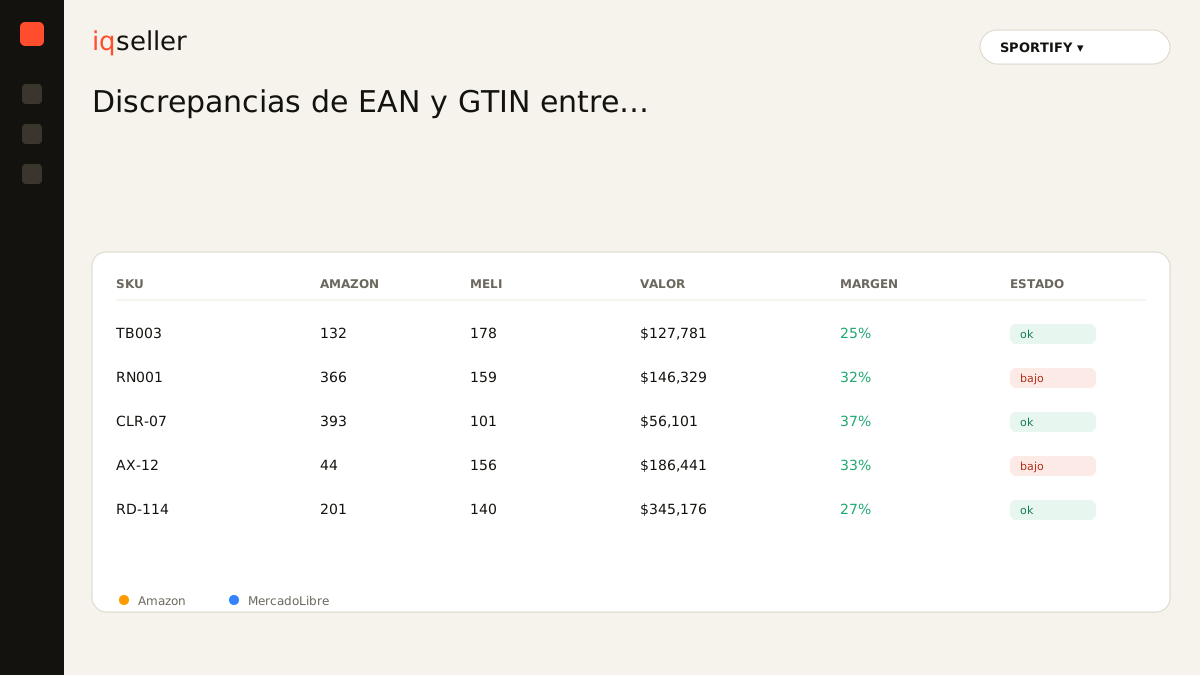
what exactly is an EAN and GTIN mismatch
It’s worth separating the concepts before we talk about the problem. The GTIN (Global Trade Item Number) is the universal identifier of a commercial product; the EAN-13 you see printed as a barcode in Mexico and Europe is, in practice, a 13-digit GTIN. The 12-digit UPC that dominates in the United States is the same concept at a different length. They all belong to the same family: a number that, in theory, uniquely identifies that item anywhere in the world.
A mismatch happens when the same physical product is registered with different —or inconsistent— identifiers across your channels. It’s not a single symptom, it’s several: one channel has the full EAN and another has it truncated or with a miscalculated check digit; one uses the 12-digit UPC and another stored it without the leading zero; one listing inherited the manufacturer’s GTIN and another the GTIN of a kit or bundle; or someone simply keyed the number in by hand and dropped a digit.
Dictionary: the EAN and GTIN are a product’s universal identifier; when they differ across channels, the system stops recognizing that two listings are the same item.The underlying issue is that each marketplace treats that field its own way. Amazon uses it to match your offer to an existing ASIN in its catalog; MercadoLibre asks for it to validate the listing and, in certain categories, to activate Catálogo; your 3PL uses it for physical picking in the warehouse. Three different uses of the same piece of data, and if that data isn’t identical across all three, each system goes its own way without telling you.
why these mismatches appear
The most common cause isn’t bad faith or gross carelessness: it’s the accumulated history of how your catalog got built. You started selling on one channel, created the listings there, and months later opened the second channel by uploading a different file, with another template and another owner. Each onboarding brought its own version of the code.
There are several typical mechanisms behind the gap. The check digit of an EAN-13 is calculated from the first twelve digits; if someone copies only twelve, or the system recalculates it differently, the final number doesn’t line up. Leading zeros vanish the moment a code passes through an Excel cell formatted as a number, and a UPC that started with zero ends up turned into something else. Bundles and kits sometimes inherit the GTIN of the individual unit and sometimes get one of their own, depending on who created the record. And there’s the classic: the manufacturer handed you a list of codes, you uploaded another one you had saved, and nobody checked that they matched.
On top of this comes synchronization. Even if your codes are correct today, each platform updates at its own pace. You fix an EAN on Amazon, but MercadoLibre keeps showing the old one until the next time you reprocess the listing, and the 3PL never finds out because that field doesn’t travel in your inventory integration. The mismatch isn’t a one-time event: it’s a state that reopens every time you touch the catalog from a single side.
the real cost of codes that don’t match
This is where the problem stops being technical and turns into money. The most expensive damage is split inventory. If Amazon and your 3PL identify the product with different codes, your system believes they are two items and divides stock between them. Result: one record reads a stockout and stops selling while the other “has” units that are really the same physical pieces counted twice. You undersell on one side and risk overselling on the other.
The second cost is pricing and promotions that apply only halfway. You push a new price or activate a Hot Sale discount pointing at one identifier, and because the other channel uses a different code, the change never arrives. You end up with the same product at two different prices without having decided that, giving away margin or sitting too expensive against the competition at the worst possible moment.
The third is the blocked listing. When the GTIN you send doesn’t match what the marketplace expects, the publication is rejected, sent to review, or loses its chance to compete for Catálogo and the Buy Box. Days of a product that can’t sell while you have no idea why. And the fourth, the most insidious, is human time: every month-end someone sits down to manually cross three different reports’ code columns to understand why sales don’t match warehouse outflows. That work generates not a single peso; it just patches the hole left by poorly synchronized data.
what the problem looks like when everything lives in one place
The root of all these symptoms is the same: you don’t have a layer that says “this EAN, this UPC, this GTIN, and this listing from each channel are all the same real product.” Without that layer, every platform is an island and you are the manual bridge. That’s why the approach that solves this doesn’t start by fixing codes one by one, but by building a single source of truth where each physical product exists once and all its identifiers hang from it.
When you work with a unified catalog where one real product groups many listings, the EAN stops being a loose field in each channel and becomes an attribute of the master product. Amazon, MercadoLibre, Shopify, and the 3PL hook into that master through their code, and if one brings the UPC without its leading zero or with a wrong check digit, the system detects it as a variant of the same identifier instead of treating it as another item.
Dictionary: a unified catalog is a single real product to which all of its per-channel listings are linked, with their identifiers normalized in one place.That shift in model is what turns a reconciliation nightmare into an automatic validation. Instead of discovering the mismatch at month-end, you see it the moment a channel comes in with a code that doesn’t line up, and you fix it before it splits your inventory or knocks down a listing.
what iqseller does with your identifiers
In practice, iqseller does three things with your codes. First, it normalizes: it strips leading zeros, recalculates and verifies the EAN-13 check digit, recognizes when a 12-digit UPC and a 13-digit EAN are the same number, and leaves every identifier in a consistent format before comparing them. That way, two codes that looked different out of pure formatting stop flagging a false mismatch.
Second, it detects and links. As it pulls listings from Amazon Seller Central, MercadoLibre, Shopify, and the 3PL, the system looks for the identifier they share and proposes joining those listings under one master product. When two channels declare genuinely different codes for what appears to be the same item, it raises that as a conflict to resolve instead of merging blindly. You decide which code is the right one, and the rest aligns.
Third, it keeps coherence in real time. Once the master is resolved, stock is counted once over the real product rather than over each record separately, so your real-time inventory reflects what you can actually sell. If an order or a restock comes in tomorrow, the number updates for every channel hanging off that identifier, without you having to touch three dashboards.
Dictionary: available-to-sell is what you can sell right now; with identifiers unified, it’s calculated once per product, not inflated by duplicate records.The result isn’t a prettier report, it’s a faster decision made with less fear. You stop wondering whether yesterday’s numbers are still true and stop losing entire mornings cross-referencing code columns in a spreadsheet.
how to start cleaning up your EAN and GTIN
You don’t need to rebuild the catalog all at once. The most profitable move is to start with your best sellers, because that’s where a mismatch costs more and faster. Take your list of top SKUs and check that the same item carries the same identifier across all three channels; that exercise alone, done once with good eyes, already surfaces most of the serious cases.
From there, set a simple rule: no physical product should exist in more than one master record, and every new onboarding must bring its EAN or GTIN validated before it goes live. It’s far cheaper to prevent two records from being born separate than to merge them back together after they’ve split stock and sales for a month. That discipline, backed by a layer that normalizes and links on its own, is what keeps your catalog speaking a single language across Amazon, MercadoLibre, Shopify, and your 3PL.
In the end, EAN and GTIN mismatches are the perfect example of a multichannel problem that looks tiny —a number that doesn’t line up— and that actually governs whether your inventory, your pricing, and your listings work together or fight each other. Solving it isn’t about typing codes more carefully: it’s about no longer treating each channel as a separate truth and building a single one.