
Impressions vs clicks: what each measures and which one drives sales
August 10, 2026
In plain terms: an impression counts every time your ad or listing appears in front of a shopper, whether they actually looked at it or not; a click counts only when that person chose it and entered your listing. Impressions measure reach —how many saw you—; clicks measure interest —how many decided to go in—. They are two different rungs of the same funnel, and confusing them leads you to make the wrong calls on price, photo, or budget.
The distinction seems obvious until you have three dashboards open at once. Amazon reports impressions and clicks with its definition, MercadoLibre with its own, and if you run Sponsored Products on both, each measures a “view” slightly differently. You end up, once again, copying figures into a spreadsheet to understand whether the problem is that nobody sees you or that they see you and don’t come in. Because those two failures are fixed in opposite ways, and choosing wrong costs money.
This article separates the two metrics precisely, tells you what each reveals about the health of your ad, and why the comparison —impressions vs clicks— is more useful than either one alone. The number that comes from comparing them, the CTR, is the one that actually tells you whether your product hooks.
what an impression is and what it really measures
An impression is recorded every time your listing or ad is shown in a search result, on a product page, or in a recommendations carousel. It does not imply the shopper read it, compared it, or even consciously saw it: they may have scrolled right past. That is why an impression is an exposure metric, not an intent one.
Impressions tell you one very concrete thing: how much visibility your product is earning for the keywords and categories where it competes. If you have few impressions, the diagnosis is almost always upstream of the click: your bid is low and you don’t win the ad slot, your organic relevance is weak, or you’re competing for terms with very little search volume. Upgrading the photo or dropping the price fixes nothing if the problem is that nobody sees you; you have to solve exposure first.
An important nuance for the multichannel seller: an impression on Amazon is not equivalent to an impression on MercadoLibre. The placements differ, the competition for position differs, and so does the audience. Comparing “raw” impressions across channels without context is misleading. What you can compare is each channel’s trend against itself, and the CTR each one produces.
what a click is and why it weighs differently
A click happens when the shopper, after seeing you among many options, chose you and entered your listing. There is a decision there: your thumbnail, your title, your visible price, and your review stars convinced them to spend the second it takes to click. That is why a click measures real interest, one rung deeper into the funnel than the impression.
A click has a direct advertising cost —in Sponsored Products you pay per click, not per impression— which is why it weighs differently on your wallet. Every click that doesn’t convert into a sale is spend that leaves with no return. So the click is the hinge between “they see me” and “they buy from me”: many clicks with few sales point to a problem inside the listing (uncompetitive price, photos that don’t sell, slow shipping, incomplete detail page), not to an exposure problem.
Clicks are also the foundation of ACoS: your ad spend accumulates click by click, and that spend is only justified if enough of those clicks end in a purchase. That is why looking at clicks without looking at conversion and margin is half the picture. The click is necessary to sell, but it is not enough.
Glossary: ACoS is ad spend divided by the sales attributed to those ads; it is built click by click, so expensive clicks with no conversion inflate your ACoS.impressions vs clicks: CTR is the real question
Comparing the two metrics produces the number that actually matters: the CTR (Click-Through Rate), which is clicks divided by impressions. If you had 10,000 impressions and 200 clicks, your CTR is 2%. CTR answers the question that neither the impression nor the click answers on its own: of everyone who saw me, what share was interested enough to come in?
A low CTR with many impressions is a crystal-clear diagnosis: you get seen a lot and chosen little. It’s almost always your thumbnail, your price against the competition visible in the result, or your reviews. A high CTR with few impressions says the opposite: your ad hooks very well but lacks exposure —you should raise the bid or broaden keywords to bring that good CTR to more people. And a high CTR with many impressions but few sales moves the problem inside the listing: the detail page, shipping, or availability.
That diagnostic chain —impressions → clicks (CTR) → sales (conversion)— is a funnel. Each rung tells you where people are dropping off. And it is exactly the reading you lose when you view each metric in its own tab, unable to cross them by SKU and by channel within the same time window.
the same SKU, two stories in two channels
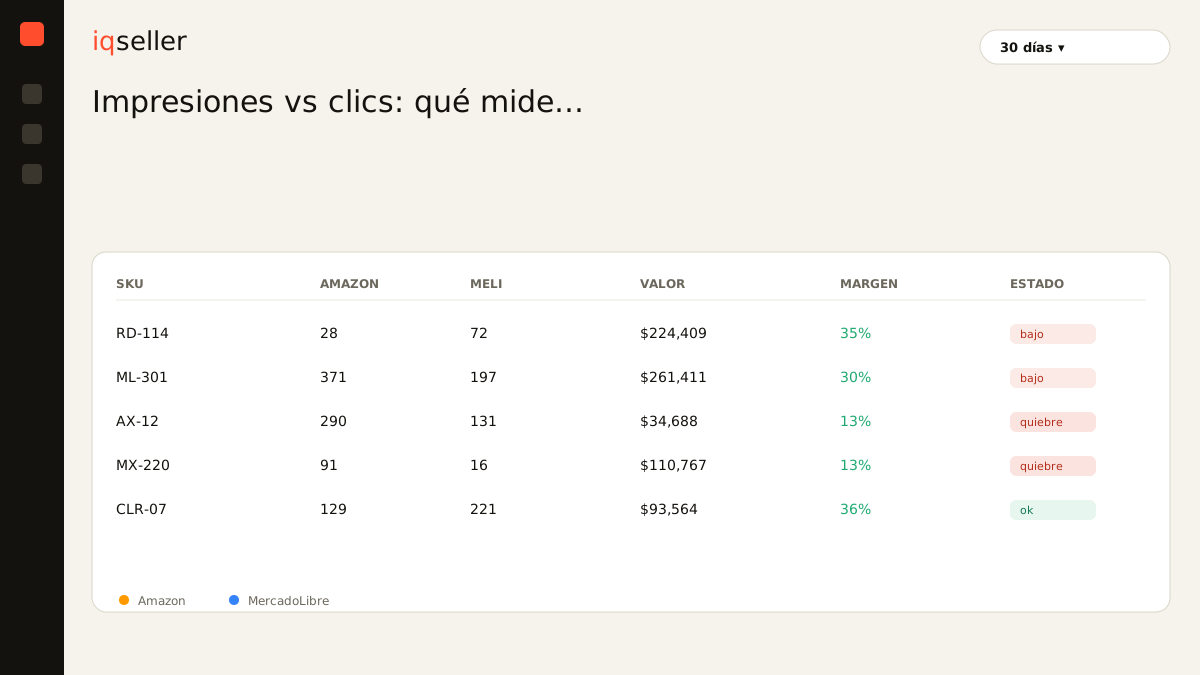
This is where the multichannel seller suffers most. The same product can have an excellent CTR on MercadoLibre and a poor one on Amazon, or vice versa. The reasons are structural: on each marketplace you compete against different supply, your price is shown next to different rivals, and the way the thumbnail and stars display changes. An ad that “isn’t working” on Amazon may be working perfectly on MELI —and you’d never know looking at a single dashboard.
Without a unified view, the typical reaction is to treat both channels as one: you drop the price on both because “sales are soft,” when in reality one channel had an exposure problem (few impressions) and the other a conversion problem (good CTR, bad detail page). You fixed what wasn’t broken and left the real issue untouched. Comparing impressions vs clicks by channel avoids exactly that expensive mistake.
MercadoLibre clicks in particular have their own nuances worth reading carefully; we develop that in Clicks per listing on MercadoLibre: how to read them and what they reveal. The principle is the same everywhere: a click without its reference impression doesn’t mean much.
the hidden cost of stitching it by hand
The real bottleneck isn’t missing data, it’s that the data is scattered and misaligned in time. You download Amazon’s campaign report, export MELI’s metrics, match SKUs that are named differently on each channel, and build a table to compute CTR per product. By the time it’s ready, it’s already yesterday’s: bids kept running, stock moved, and today’s impressions aren’t in your sheet.
Deciding on stale data in advertising means overpaying for days before you correct. If your CTR collapsed this morning because a competitor dropped their price and now your thumbnail looks expensive next to them, you want to know today, not Monday when you finish the spreadsheet. A single source of truth in real time turns the question from “how many impressions did I get last month?” into “why did my CTR drop in the last few hours, and on which channel?”. That immediacy is the difference between reacting and guessing.
Glossary: real net margin is what’s left after ALL costs —product, fees, shipping, tax, and advertising—; a high CTR that brings expensive clicks can eat that margin even when sales rise.from metrics to the decision
Impressions and clicks don’t compete for your attention: they’re read in order. First you ask whether you have enough exposure (impressions). If you do, you ask whether your ad hooks (CTR). If it hooks, you ask whether the listing converts (sales over clicks). Each answer sends you to a different adjustment: low impressions call for bid or keywords; low CTR calls for thumbnail, price, or reviews; low conversion calls for detail page, shipping, or availability.
That reasoning crosses with the rest of the business. A high CTR that doesn’t convert may be because you ran out of the best-selling color and the shopper enters, doesn’t find it, and leaves —which is why you should read ad metrics alongside your real availability, not in isolation. And since every click costs, this analysis connects directly to how much you spend per campaign: we go deeper in How ACoS relates to each Amazon Ads campaign type.
Glossary: real available stock is sellable stock net of reservations and in-transit units; if it drops, your clicks keep arriving but don’t convert, and the problem isn’t the ad.what you should be able to see at a glance
To govern this chain, a useful panel shows you per SKU and per channel, in real time, at least this: impressions, clicks, CTR, conversion, and the resulting ACoS. With those five figures together, the diagnosis stops being late-night intuition in front of a spreadsheet: you see immediately whether the failing step is exposure, interest, or closing, and on which marketplace. That is what turns “impressions vs clicks” from a glossary definition into a tool to sell more while spending better.
The conclusion is simple. The impression tells you whether you exist for the shopper. The click tells you whether you mattered enough for them to come in. The sale tells you whether you closed. None is enough alone, and none reads well in its own tab: they read together, up to date, and by channel. There, and only there, do you stop mistaking a visibility problem for a conversion one —and stop paying for the mistake.