
A January With No Sales and December's Bills
November 14, 2026
There’s a very particular moment in the life of a seasonal seller: the first week of January. The bank account looks better than it has all year, because December’s deposits are still landing. Daily sales, meanwhile, have collapsed to a third. And there are five payments waiting in the inbox.
That contrast is the trap. The fat January 1 balance isn’t available profit: most of it already has an owner. The supplier balance on the season purchase, the provisional tax payment and the VAT on the peak period, the returns that will reverse, storage on leftover inventory, and the deposit on the first-quarter restock if you want product on the shelf in February.
On the other side, January is the leanest month of the year in almost any consumer category. Demand drops off a cliff after Reyes, the Mexican consumer arrives stretched thin, and any attempt to force sales in that context happens through discounts, which means through margin.
The combination — the lowest-revenue month receiving the highest-sales month’s bills — is why so many profitable businesses spend February selling inventory at panic discounts. This article is about projecting that month before it arrives and sizing the cushion that makes it crossable. It is not financial or tax advice: your accountant calculates the tax amounts.
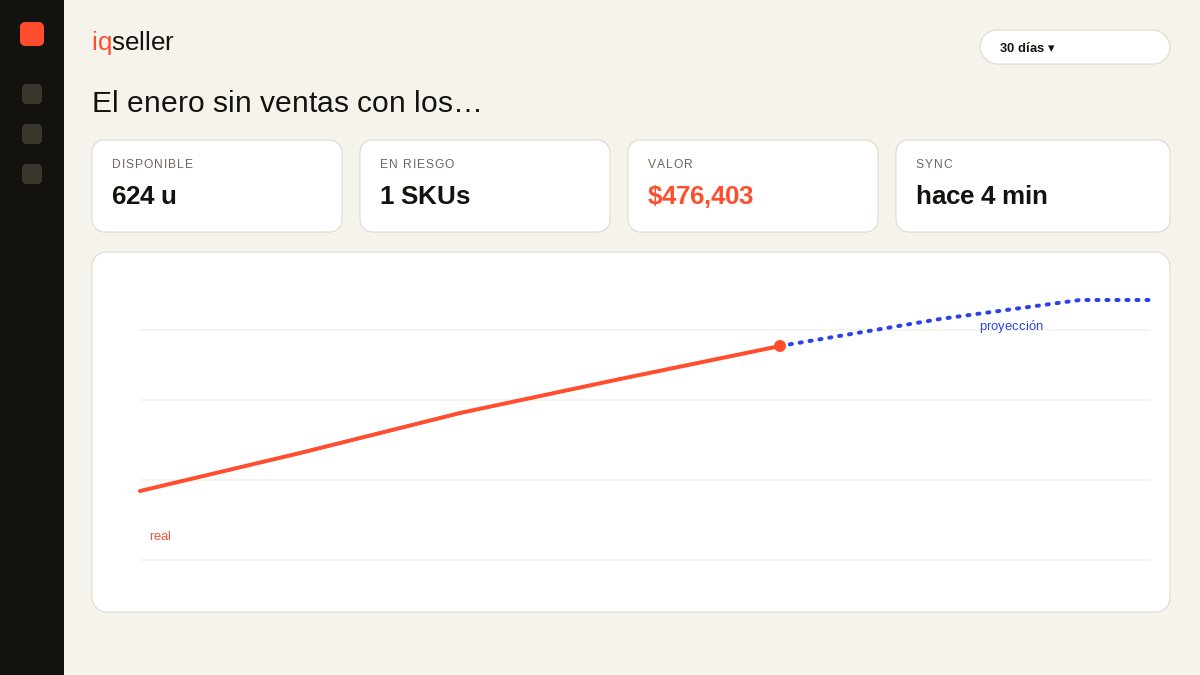
January collects December’s bills
The structure of the problem is the same as the start of the season, reversed. In September and October you pay for inventory you’ll collect on in December. In January you collect December’s tail while paying everything the season left pending.
The difference is that October’s squeeze is visible in advance: there’s an order, a shipment, a date. January’s squeeze is disguised, because the opening balance is high and the outflows are many and small instead of one big one. It feels like the money “drained away,” when in fact it was committed back in November.
There’s a second effect that makes it harder to see. In December everyone is operating, not analyzing. Nobody sits down on December 20 to project January, so the projection doesn’t exist and the month gets lived reactively. The work in this article gets done in November, while there’s still time to move purchasing and spending decisions.
the six outflows that land in January and February
Worth listing, because most of them aren’t in a normal monthly budget:
The season purchase balance. If you negotiated terms, the final payment lands in January. It’s the largest outflow and the easiest to forget, because the purchase has “felt” paid since October.
Closing obligations with seasonal staff. The people you hired for the season get settled when it ends, and that lands in the first or second week of January.
The provisional payment and VAT on the peak period. The highest-sales month generates the year’s largest payment, and it’s paid afterward. The exact amount is your accountant’s calculation based on your regime; what matters for cash is that it’s large and it has a date.
Season returns. Units delivered in November and December carry an open return window for weeks. The charge reverses against your platform balance, so it doesn’t arrive as an invoice: it arrives as a thinner deposit.
Storage on leftover inventory. What didn’t sell keeps paying rent, and on several platforms rates are higher for slow-moving inventory. It’s a cost that starts in January and doesn’t stop until the product moves.
The deposit on the first-quarter restock. If you want product on the shelf in February and March, the order leaves in January. This is the outflow that turns an uncomfortable January into an impossible one, and it’s the only one fully under your control.
To those six, add the usual: payroll, rent, software, accountant, utilities, and baseline advertising.
Glossary: forecast, what it is and what it’s actually for →why the early-January balance lies
The bank balance is a true number that answers the wrong question. It answers “how much money is there,” when the operational question is “how much money is mine and free.”
Turning one into the other is a fifteen-minute exercise almost nobody does:
- Take today’s available balance.
- Subtract the VAT you charged and will remit for the period. It was never yours.
- Subtract already-committed payments with known dates: supplier, settlements, renewals.
- Subtract your estimate of season returns that haven’t reversed yet.
- Subtract the estimated provisional payment for the period.
- What’s left is your real free balance.
In most cases the real free balance is a fraction of the bank balance, and seeing it written down changes decisions. The most important one: the size of January’s restock order stops being decided by optimism and starts being decided by capacity.
the exercise: projecting January week by week
Invented example, with explicit assumptions and the arithmetic adding up. It is not a benchmark for anything.
A seller closes the season with 3 million in gross sales across November and December. Normal monthly sales are 600 thousand, and in January they fall to 400 thousand. On January 1 there are 980 thousand pesos in the account and a sense that the year went well.
January inflows:
- Tail of December deposits landing in January: 380 thousand.
- January sales of 400 thousand gross, at a 70 percent net deposit rate, give 280 thousand net; because of the collection lag, 60 percent lands in January: 168 thousand.
- Total inflows: 548 thousand pesos.
January outflows:
- Final supplier balance on the season purchase: 280 thousand.
- Fixed costs for the month: 150 thousand.
- Settlement of seasonal staff: 60 thousand.
- January advertising: 40 thousand.
- Provisional payment and VAT on the peak period, estimated by the accountant: 190 thousand.
- Season returns reversing in January, estimated at 4 percent of the 3 million: 120 thousand.
- Storage on leftover inventory: 45 thousand.
- Deposit on the first-quarter restock: 400 thousand.
- Total outflows: 1,285,000 pesos.
Closing January balance: 980 thousand plus 548 thousand minus 1,285,000, equal to 243 thousand pesos.
Now the part that matters. Recurring obligations are 150 thousand fixed plus 40 thousand advertising, meaning 190 thousand a month, which works out to roughly 43,900 pesos a week. So:
- 243 thousand divided by 43,900 equals 5.5 weeks of cushion.
The seller who had 980 thousand pesos on January 1 and felt relaxed ends the month with five and a half weeks of oxygen. Not in crisis, but with no room for a stumble: a platform hold, a stuck shipment, or a wave of returns leaves February tight.
And the alternate scenario is worth more than the whole example. If instead of 400 thousand that seller had chosen a restock deposit of 700 thousand — a perfectly reasonable call after a good season — January would close at 980 plus 548 minus 1,585,000, equal to minus 57 thousand pesos. In the red, with the season won, having done nothing wrong except size the order against the bank balance instead of the free balance.
how much cushion: measured in weeks, not pesos
“I need about 300 thousand of cushion” is a meaningless sentence, because it doesn’t say against what. The useful way to express it is in time:
Cushion in weeks equals real free balance divided by weekly obligations.
Weekly obligations are your fixed costs, your baseline advertising, and already-committed payments, divided by the weeks in the period. It’s a number you can calculate in fifteen minutes and refresh every month.
How many weeks it should be isn’t decided by an article. It depends on how seasonal your business is, how concentrated your sales are in one channel or a few SKUs, how long your restock lead time runs, and what fixed commitments you carry. A business with a twelve-week lead time and one dominant channel needs far more cushion than one with a local supplier and spread-out sales.
What applies to everyone is that the number should be explicit, written down, and reviewed, not a feeling. And that the time to define it is before the season, not in January, because by January it isn’t a decision anymore: it’s a consequence.
A practical way to size it: the question “how many weeks can I operate if my deposits stop tomorrow?” is more useful than any percentage. If the answer is less than one full restock cycle, any interruption forces you into the decision that destroys the most margin.
the temptation to force sales, and what it costs
When January gets tight, the apparent way out is obvious: cut price and move inventory. Cash comes in, storage frees up, the problem feels solved. It’s worth seeing the full arithmetic first.
A 25 percent discount on a product with 11 percent net margin doesn’t take margin to 11 minus 25. It takes it far below zero, because the discount comes entirely out of profit. In cash terms it can still make sense — selling below target margin to recover capital beats selling nothing and paying storage — but it’s a liquidity decision, not a profitability one, and it deserves to be called by its name.
The costs that almost never get counted:
- The reference price drops. What you sold at a discount in January is the price your buyers remember in March.
- Cross-channel price alignment breaks if you discount on only one, with consequences on the channel where you didn’t.
- Competitors react, and a January clearance can become a February price war.
- The inventory you liquidate first is usually the good stuff, because that’s what moves. The slow part is still there, paying rent.
The alternative doesn’t always exist, but when it does it’s better: liquidate selectively what genuinely doesn’t rotate, at a price that recovers cost, and hold price on what does move. That requires knowing per SKU what rotates and what earns, which is exactly the data that’s missing when the decision is made in a hurry.
Glossary: inventory valuation, the capital sitting still →what gets decided in November so January doesn’t hurt
Everything above is diagnosis. These are the decisions still available now:
Negotiate the season balance terms today. Moving the final payment from January to February or March is the cleanest lever there is, and the best moment to ask is right after placing the year’s largest order.
Set the maximum amount for the restock order before you know the season result. A number decided cold holds up far better against early-January optimism.
Estimate season returns with your own historical rate, not a normal month’s rate, and subtract it from the expected balance starting now.
Ask your accountant for an estimate of the peak-period payment before December ends. Having that number a month early changes the size of January’s order.
Review which part of your season purchase risks being left over. If a SKU is going to be surplus, it’s better to move it in the second half of December, with demand still alive, than in January with demand dead.
Write down your target cushion in weeks and use that number as the floor for any January reinvestment decision.
how this reads in iqseller
iqseller is not a treasury system, it doesn’t project your bank balance, and it doesn’t calculate your taxes. What it delivers are the inputs to the projection, which is exactly where the exercise breaks when you have to pull reports from each panel and paste them by hand in December.
The Forecast module gives demand projection, coverage in weeks, and days of inventory per SKU and per channel. With that you can see, before January arrives, which part of your inventory will still be there in March. That’s the list the selective-liquidation decision comes from.
The Inventory module gives real-time valuation at cost by warehouse and in transit: how much capital is sitting still after the season. It’s the number that turns “I have leftover product” into a figure you can compare against the free balance.
The Profitability module gives net margin per SKU with everything deducted: COGS you loaded, commissions from the Amazon settlement and MercadoLibre orders, FBA and Full fees, shipping, advertising, and the VAT and withholding breakdown. That’s what tells you how much discount each product can absorb before you’re selling below cost.
The Pricing module lets you schedule price moves and see them against each SKU’s margin, instead of applying one blanket percentage to the whole catalog.
And Alerts flags when a number deviates from its pattern: a return rate that spiked, a fee that appeared, a margin that fell.
What iqseller does not do is tell you how much cushion you need or when each platform will deposit. Those depend on your business and on the platform, respectively.
the conversation with your accountant
Three January topics are theirs, and it’s worth pulling them into December rather than waiting.
The first is the estimate of the provisional payment and the VAT on the season period, with the detail of the withholdings each marketplace already applied. That number determines the size of your January.
The second is the treatment of leftover inventory and how it shows up in your result for the year, especially if you’re going to liquidate part of it below cost.
The third is what’s worth leaving inside the business as working capital for next season versus what to draw out, and what your regime implies for that.
None of the three is solved by reading. What you can do today is show up with January projected week by week, your real free balance calculated, and your cushion expressed in weeks. With those three numbers the conversation is short, concrete, and gets you into February deciding instead of reacting.