
After the spike: raise prices and recover margin
February 27, 2026
The spike is over. El Buen Fin, the holidays, Hot Sale, or that launch that caught fire: you sold hard, moved units like never before, and your product climbed in the rankings. But once the dust settles and you finally open the report, you notice something uncomfortable. You sold a huge amount at a promo price that no longer has any reason to exist, and weeks later you are still selling there. The spike brought you volume; what came afterward is quietly costing you margin.
For the multichannel seller the problem is twofold. Dropping your price for a high season is the easy part; everyone does it. The hard part is the return: raising it back, at the right moment, without killing the sales momentum you worked so hard to build, and doing it in a coordinated way across Amazon and MercadoLibre at the same time. Almost nobody designs that second half. It stays at “I’ll raise it later,” and that “later” turns into a month of margin given away for free.
The root of the pain is the usual one when you sell across several marketplaces: the information lives on separate screens. You changed the promo price in Seller Central, you built the MercadoLibre promotion in another tab, the 3PL shipping costs are sitting in an email, and to figure out whether you are still making money you end up dumping everything into a spreadsheet that was already stale the moment you opened it. You decide the price increase with yesterday’s data and a gut feeling. This article is about turning that second half — the recovery — into something you design, not something you improvise.
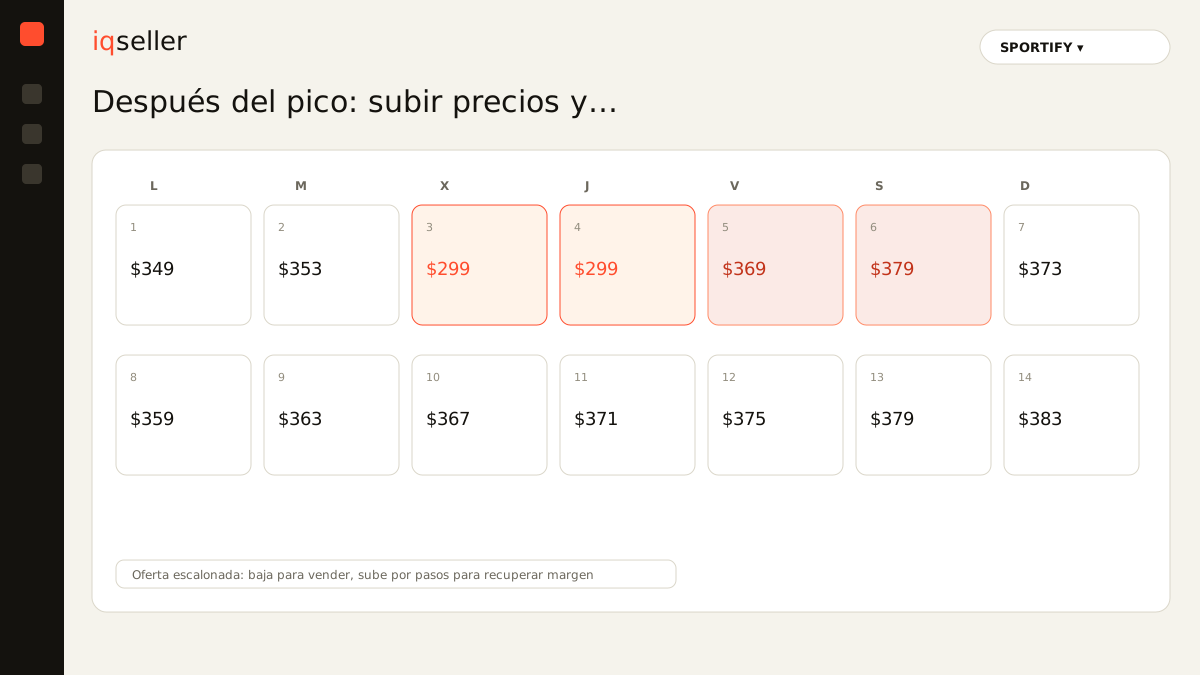
why the promo price gets stuck
Nobody leaves a low price on purpose. It gets stuck because reverting it is work, and work that has no owner and no reminder simply does not happen. Think about it: to raise the price of a single SKU after a season you have to log into each channel, remember what the “normal” price was, check that it does not collide with an active promotion, and repeat that for every product you put on sale. Multiply that by dozens of SKUs and two or three channels, and you understand why the increase keeps getting pushed back.
Meanwhile, every day that passes you sell at the promo margin at a moment when you no longer need that discount to sell. Seasonal demand has dropped, but your product is still well positioned and people buy it anyway — you are just leaving money on the table on every unit. It is the quietest leak there is: it never shows up as a loss anywhere, it is simply profit that never arrived.
Dictionary: what a laddered offer is and how it helps you recover margin step by step →raising it all at once kills the momentum
The temptation, once you remember, is to snap the price back to its original level in one jump. From a $399 promo straight to $549. Bad idea. The marketplace algorithm and the buyer both react just as badly to an abrupt jump: sales velocity collapses, your product loses the traction it gained during the spike, and the position you fought to win starts to slide. You just threw away the real benefit of the high season, which was never the sales themselves but the momentum.
The alternative is to raise it in steps. Instead of jumping from $399 to $549, you move through $429, $459, $499, $529 over several days or weeks. Each step is small and the buyer does not feel it as a jump; the algorithm sees that you are still selling and does not punish you. You recover margin without abruptly stalling the machine. The key is that each step is measured: how many units did this step move? Did margin hold? At what point did velocity drop? That measurement turns the increase into a controlled experiment instead of a bet.
the right moment lives in the data, not the calendar
“I raise the price one week after the season” is a comfortable rule, but an arbitrary one. The real moment to raise depends on how your demand is cooling, not on a date. If your sales velocity is still high three weeks after the spike, you are leaving margin behind by raising too early. If it cooled off after four days, raising too late has you giving away profit. The signal lives in the curve of your own demand, compared against your baseline from before the spike.
This is where having a single source of truth in real time changes everything. When you see today’s sales velocity — not the one from three days ago in a spreadsheet — next to available inventory and net margin per channel, the decision stops being a hunch. You see demand falling back toward its normal level and inventory starting to tighten: the two signals telling you it is time to start laddering up.
Dictionary: how the forecast anticipates when demand cools down after the spike →recovering margin without running out of stock
Price recovery and inventory are tied together in a way many people ignore. After a spike, your stock is low — you sold hard — and the replenishment is still on its way. That is exactly the scenario where it pays most to raise the price: you have fewer units, demand is still decent, and every unit you sell should earn you as much as possible. Selling the last of a batch at a promo price is the worst of both worlds.
That is why the price step should read your days of inventory. If you have few units left and the replenishment is slow, raising faster protects both margin and availability: you sell more slowly and at a better price, which buys you time until the next batch arrives. If, on the other hand, you have leftover seasonal product, you can raise more slowly to keep moving volume. A single screen showing price, sales velocity, and inventory together is what lets you fine-tune this without doing the math by hand every morning.
Dictionary: days of inventory and why they guide the speed of your price increase →why the increase is calculated per channel
A costly trap is raising the price “flat” everywhere. Amazon and MercadoLibre fees are different, and so are FBA or Full costs. A price that leaves you 24% margin on one channel can leave you 9% on the other. When you recover margin after the spike, the right step is not the same number on both listings: it is the number that returns the same net margin on each channel. If you calculate the increase off a nice flat price, you will recover too little on the expensive channel and too much on the cheap one, without realizing it.
This becomes impossible to do by hand once you manage several SKUs. You need the system to know, per product and per channel, what your real net margin is with everything subtracted — commission, shipping, storage, advertising — and to express the step in terms of that margin, not the sticker price. It is the difference between “I raised both by $40” and “I recovered six points of margin on each channel.”
turning recovery into a repeatable process
The most valuable thing about treating the post-season as a process is that every spike teaches you for the next one. If you measured how demand cooled, at which step velocity dropped, and how much margin you recovered, the next Buen Fin you do not start from scratch: you start with an increase template you already know works for that product family. Uncertainty drops season after season.
That learning also helps when you go to open a new channel without doubling the work: the logic of dropping for the spike and laddering up afterward is the same on any marketplace, only the fees and the pace change. If you already have it designed and measured on one channel, replicating it is a matter of adjusting numbers, not reinventing the strategy.
from reacting to designing
The real shift is not “remembering to raise the price.” It is to stop treating the offer as an event that ends when the season ends, and to start treating it as a complete sequence: you drop to capture the spike, and you design from the start how you will ladder back up to recover margin. The second half is what separates “I ran a promo” from “I designed a profitable season.”
For the seller who sells on Amazon, MercadoLibre, and ships with a 3PL, the difficulty was never the strategy — it is executing it without losing sight of the three dashboards at once. When price, sales velocity, inventory, and per-channel margin live on a single screen in real time, raising the price after the spike stops being a task you postpone and becomes what it always should have been: the part where you actually earn the season’s money.