
Scaling from 100 to 1,000 SKUs without losing control
February 26, 2026
With 100 SKUs the business still fits in your head. You know your ten best sellers, you remember the cost of the items that move fastest, and when something runs out of stock someone notices before it becomes a problem. You manage Amazon Seller Central, MercadoLibre, and your 3PL report as three tabs you check by hand, and while it isn’t elegant, it works. The control exists because the catalog is small, not because you have a system.
The trouble starts when that same business grows to 500, 700, 1,000 SKUs. Memory stops being enough. You can no longer recall the margin on every variant, or spot by eye that the green bottle ran short while the blue one is piling up. The three tabs you used to check turn into half a day of work: you export from each channel, paste it all into Excel, normalize names that don’t match, and by the time you’ve built the picture it’s already from yesterday. The catalog grew tenfold, but the way you look at it is the same as when you had 100. That’s where control slips away: not all at once, but data point by data point.
Scaling SKUs isn’t just adding rows to a sheet. It’s a change in kind: you go from a business that fits in your head to one that demands a system. This article explains what exactly breaks when you grow, why Excel stops working long before you’d expect, and why a single source of truth in real time is what separates growing with order from growing in chaos.
what breaks first when you grow
The first thing to give way isn’t inventory or pricing: it’s your ability to know what’s going on. With 100 SKUs you catch a sales dip because you know your numbers. With 1,000, a product can go two weeks without selling a single unit and you won’t even notice, because it’s buried among hundreds of rows. Problems stop shouting and start hiding. The stockout you used to catch in a day now takes a week to surface, and by then you’ve already lost the buy box and your ranking position.
The second thing to break is consistency across channels. With a small catalog it’s easy for the same product to carry the same price and description on Amazon and on MercadoLibre. With a large catalog, the divergences multiply: you raised the price on one channel and forgot the other, a variant stayed active where you no longer have stock, a listing is dragging an old photo. Each inconsistency is small, but a thousand products generate hundreds of them, and together they erode margin and reputation without anyone watching them appear.
why excel stops working before you’d expect
Excel doesn’t fail for lack of capacity: it holds a thousand rows without breaking a sweat. It fails because it’s a photo, and what you need is a film. Every export you paste is the state of the business at the moment of the cut, not at the moment you decide. With 100 SKUs the lag barely matters because changes are slow and few. With 1,000, between the morning cut and your afternoon decision dozens of prices have already moved, several products have sold out, and orders have come in that shift what’s available.
There’s a quieter cost: the work of maintaining the Excel grows faster than the catalog. Normalizing names across channels, tagging families, reconciling periods that don’t line up, checking that nothing got pasted wrong. At 100 SKUs that’s an hour; at 1,000 it’s a person dedicated nearly full time to copying and pasting, adding no value at all. And because it’s manual work, it’s also fragile: one shifted cell and an entire report lies. The question isn’t whether Excel breaks, but how much it costs you to sustain it right when you most need to trust the data.
Dictionary: days of inventory tells you how long your current stock lasts at today’s selling pace — with hundreds of SKUs it’s impossible to track by hand, and it’s exactly the number that keeps your best seller from hitting zero.inventory is where scaling hurts most
When you grow, inventory goes from being a list to being a system of constant pressure. Every SKU competes for the same purchasing capital and the same space at the 3PL. Over-buying one line leaves you without liquidity to restock the one that actually moves; under-buying your strong product leaves you selling at zero right in your best week. With a small catalog you strike that balance on intuition. With a large catalog, intuition runs out: there are too many lines and too many conflicting signals to hold them all in your head.
This is where the forecast stops being a luxury and becomes the only way to buy with order. You need to know, by SKU and by channel, how much you’ll sell in the coming weeks and when you’ll hit bottom, not for the whole catalog on average but for each line at its own velocity. That’s the heart of inventory forecast in depth: projecting real demand per product instead of ordering evenly and praying. When that calculation is live and unified across channels, scaling the catalog stops multiplying your stockouts.
Dictionary: the forecast is the projection of how much you’ll sell in the near future based on your history and your season — the foundation for buying on time when you have hundreds of SKUs to restock.pricing at scale: from manual tweaks to rules
With 100 SKUs you can review prices one by one every week. With 1,000 that’s impossible, and the temptation is to freeze prices and forget them. That’s the worst mistake: you leave margin on the table for the products where demand can bear more, and you stay overpriced on the ones that no longer compete. Pricing at scale isn’t solved by looking more, it’s solved by changing the method: you move from manual SKU-by-SKU tweaks to rules applied to whole families and to seasonal calendars.
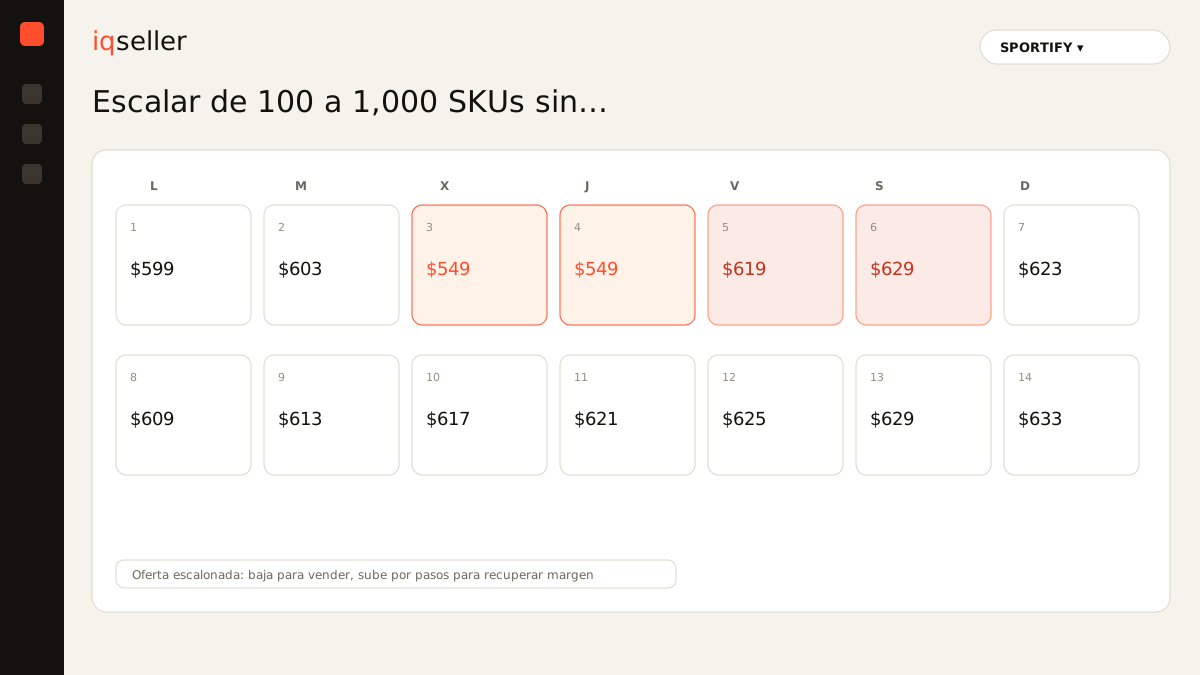
A well-set rule does for a thousand products what you used to do for ten. You define that a certain family rises when its high season starts, that another drops to move inventory edging toward dead stock, that none falls below your minimum margin. Tiered offers by volume, price floors, promotion windows stop being one-by-one decisions and become policy. You set the criterion once; the system executes it across the entire catalog.
Dictionary: a tiered offer gives a better price at higher purchase volume — at scale it’s best defined by rules rather than product by product, so it applies on its own across the whole catalog.a single source of truth is the system that replaces your memory
The real leap when you scale isn’t operational, it’s a change of method: stop depending on your memory and on yesterday’s photo, and start deciding on data that’s live, clean, and unified. A single source of truth joins Amazon, MercadoLibre, and 3PL by product identifier, groups each SKU into its family, and keeps everything updated in real time. What used to take half a day of exporting and pasting becomes a view you open and read. The catalog can grow to 1,000 or 5,000 SKUs without your way of looking at it breaking, because the system scales where memory cannot.
That also changes your relationship with suppliers. When you have real sales data per SKU and per channel, you stop negotiating on feel and start negotiating with numbers: how fast each line actually turns, how quickly you pay for it, what volume justifies a better cost. That’s exactly the ground covered in negotiating with your supplier using sales data, and at scale it becomes indispensable because you can no longer remember the behavior of every product.
scaling with control, not with luck
Growing from 100 to 1,000 SKUs is the goal of nearly every seller, but few prepare the method before the volume overtakes them. The catalog grows fast; the way of looking at it almost never does. The result is a bigger business the owner controls less: more products, more channels, more decisions, and the same Excel sheet from when everything fit in your head.
Control isn’t lost by growing, it’s lost by growing without changing systems. When the data is unified in a single source of truth, in real time and grouped by family, scaling the catalog stops multiplying chaos. Inventory watches itself, pricing applies by rules, cross-channel inconsistencies surface the same day, and the decision goes back to being based on what’s happening today, not on yesterday’s photo. That’s the difference between scaling with control and scaling with luck.