
December: the month that defines your year and your inventory
March 2, 2026
For a multichannel seller in Mexico, December is not just another month: it is the month that decides whether the year closes in the black or in the red. Between the Buen Fin that just passed, the weeks before Christmas, Reyes, and the first wave of January returns, a huge slice of your annual revenue gets squeezed into a few weeks. What you sell — and what you fail to sell because you ran out of stock — in that stretch weighs more than almost any decision you made the rest of the year.
The trouble is that December is also the month when your operation breaks most easily. Demand spikes unevenly across channels, replenishment lead times stretch out, seasonal fees change, and you end up trying to understand what is happening by staring at three screens at once: Amazon Seller Central on one side, MercadoLibre on another, and your 3PL panel or FBA report on a third. Each one tells you part of the story, none tells you the whole thing, and the number you see is almost always from yesterday.
So the real question is not “how do I sell more in December?” It is “how do I see, in one place and in real time, what is selling, what is running out, and which decision I have to make today before a stockout or an overstock costs me the month?” December rewards whoever decides fast with good data and punishes whoever decides late with old data.
why December breaks the way you work
For eleven months of the year you can survive by piecing the information together by hand. You download the Amazon report, export the MercadoLibre one, paste them into a spreadsheet on Mondays, and decide from there. It is slow and clumsy, but it works because demand is stable and a one-day error rarely costs you much.
In December that routine falls apart. When a product that normally sells 8 units a day starts moving 40, your Monday spreadsheet no longer describes Wednesday’s reality. By the time you notice a SKU is running out, you have been selling blind for two days or, worse, you are already out of stock in the middle of peak season. The cost of a December stockout is not just the lost sale: it is the lost sale multiplied by the peak, plus the ranking your listing loses, plus the advertising you kept paying to send traffic to something that could no longer be bought.
Dictionary: days of inventory, your countdown to a stockout in the middle of peak season →the real enemy: information split into pieces
The real pain for the multichannel seller in December is not a lack of sales, it is the lack of a single picture. You have sales happening in Amazon FBA, sales happening in MercadoLibre Full, maybe shipments leaving your own warehouse or a 3PL, and each platform measures things its own way: different names for the same product, different time windows, different definitions of “available.”
To assemble one single picture you have to download, clean, and cross-reference everything by hand. And in the month when you have the least time, you end up spending your mornings copying and pasting instead of deciding. The result is that you decide with uncertainty: you do not know whether the stock you see in one channel is already committed to sales from the other, you do not know whether today’s sell-through holds until your next replenishment, and you do not know which product is worth pushing harder. A single source of truth, one that joins the channels and shows you the real number in real time, is what turns December from a gamble into an operation.
inventory matters more than price
In the low season, price is your main lever. In December, inventory rules. A well-stocked product at an average price beats a product with a perfect price that ran out mid-season. That is why December’s number-one priority is protecting the availability of your hero products across every channel at the same time.
This changes how you read your numbers. It is not enough to know how much stock you have; you need to know how many days of inventory you have left at today’s sell-through, not last month’s. A product with 200 units looks healthy, but if the season is moving it at 50 a day, you have four days left, not a month. That is the kind of number a real-time dashboard puts in front of you and that a Monday spreadsheet hides until it is too late.
Dictionary: demand forecast, to anticipate the stockout before it happens →anticipate, don’t react: the seasonal forecast
The difference between a good December and an excellent one is in anticipating. An automatic price calendar and a solid forecast let you see the curve before you live it: when each product family’s peak will hit, how much stock you need so you do not run dry, and at what point it makes sense to step the price upward as inventory falls.
A seasonal forecast is not about guessing; it is about reading your own history. How did this SKU behave last December? How fast did it accelerate after Buen Fin? How long did your replenishment take to arrive? With that data cross-referenced across channels you can decide today how much to order and when, instead of reacting once you are already selling without a net. And when the time comes to scale from 100 to 1,000 SKUs without losing control, that forecast stops being a luxury and becomes the only way not to drown.
January’s hidden cost: returns and overstock
December does not end on the 31st. Its shadow stretches into January in two ways. The first is the wave of returns: part of what you sold comes back, which reopens inventory, shifts your real availability, and eats into the margin you thought you had earned. The second is overstock: if you bought too much out of fear of running dry, you start the year with capital frozen in product that now sells at normal speed.
Both are handled better with the same source of truth you used in December. If you see returns by channel in real time, you know when a product is available to sell again instead of over-ordering. And if you see your real days of inventory after the peak, you know which SKUs to slow replenishment on and which to discount to free up capital. December defines your year; January defines how much of that year you keep.
raising prices after the spike to recover margin
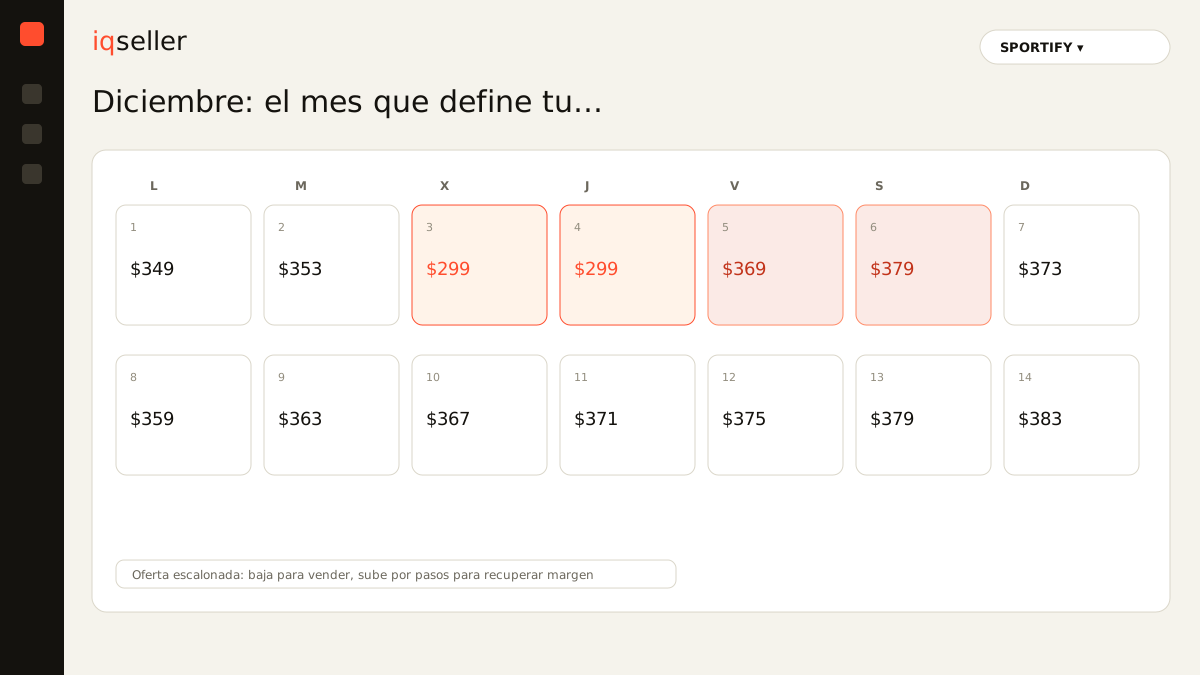
The last piece is the exit. During the peak it is reasonable to sacrifice some margin for volume and ranking. But once demand drops, holding promo prices is giving away profit. The clean play is to step the price upward — in stages, not all at once — as inventory falls and the season cools, in each channel according to its own commission structure.
This is exactly where a laddered offer shines: you capture the peak cheaply and recover margin on the way down, without having to remember to raise each price by hand across two or three different platforms. The classic mistake — leaving the promo price up a month too long — is precisely the kind of money that slips away quietly when you work by hand across several dashboards.
Dictionary: laddered offer, lower to sell and step up to recover margin →from a gamble to an operation
December will remain the most intense month of the year; no tool changes that. What does change is which side of uncertainty you live it on. With information split across three screens and a Monday spreadsheet, December is a gamble: you get it right sometimes and pray the rest. With a single source of truth that joins Amazon, MercadoLibre, and your 3PL in real time, December becomes an operation you can pilot day by day.
The seller who closes the year well is not the one with the best product, but the one who saw the stockout coming, stepped their prices up in time, and walked into January without frozen capital. That difference is not decided in December: it is decided by how you see your business when December arrives.