
Mercado Envíos Flex: what it is and which seller it actually suits
November 18, 2026
Logistics conversations on MercadoLibre usually collapse into two choices: send inventory to Full and let the platform ship it, or ship it yourself through Mercado Envíos and let the package travel the platform’s network. There is a third option that gets far less airtime and that changes the physics of the business: Mercado Envíos Flex, where the package never enters any network at all. It leaves your warehouse, goes onto a motorcycle or a van you control, and reaches the buyer the same day.
The appeal is obvious the first time you hear it. Same-day delivery earns the “Llega hoy” badge on the listing, and that badge moves conversion in a way no title rewrite ever will. But Flex is not a toggle you flip in settings. It is a daily operational promise, with a compliance threshold measured every week and with costs that never appear on a MercadoLibre invoice because they live in your payroll and your fuel bill.
The underlying mistake is that most sellers evaluate Flex as a marketing decision — more exposure, more orders — when it is an operations and unit-cost decision. If your warehouse is already underwater at six in the evening, Flex will not help you; it will expose you. And if you do not know what it genuinely costs you to hand a package to a buyer in your own city, you cannot know whether the extra sale leaves anything behind.
This piece walks through the mechanism, what MercadoLibre publishes about the program in Mexico, which seller profile benefits, how Flex and Full coexist on the same SKU — the part where most people trip — and what to measure before switching it on.
what Flex is, and what it is not
With standard Mercado Envíos you pack the order and MercadoLibre’s network picks it up or receives it at a drop-off point. With Full, you ship inventory ahead of time to a fulfillment center and they pick, pack and dispatch. With Flex, you do all of it: you store, you pack, and you hand the package to the buyer at their door, the same day, inside a coverage zone you configure yourself.
Three consequences deserve saying out loud:
- The last mile is yours. MercadoLibre does not come to collect. Without your own driver, contracted motorcycles or a local courier that charges per drop, Flex is not viable.
- The stock stays with you. No advance shipment to someone else’s warehouse, no storage fees. The capital tied up in inventory stays on your floor, with everything good and bad that implies.
- The promise to the buyer is hard. The buyer pays expecting the package today. A delay under Flex is not an abstract logistics slip: it is a complaint with a name and an address attached.
What Flex is not: it is not a commission discount, it does not replace Full for nationwide coverage, and it is not a program you can switch on Monday and off Tuesday without reputational cost. The exposure it granted leaves with the first week you miss.
what MercadoLibre publishes about Flex in Mexico
Precision matters here, because Flex conditions change and vary by country and by city. What MercadoLibre’s own seller-center page describes for the program, at the time of writing, includes the following:
- Listings with Flex offer same-day shipping in Mexico City, and from the settings the seller can add more coverage zones and set a maximum number of shipments per day, within a range of 10 to 100.
- Same-day shipments enter the “Llega hoy” filter and are highlighted in search results. That exposure is the program’s real consideration.
- On new products from $299 shipping is free for the buyer and MercadoLibre subsidizes up to 10% of the rate. The “up to” matters: per the same source and third-party guides, the percentage depends on distance and on your reputation.
- To keep listings highlighted you have to hit at least 97% correct shipments every week. Fall below it and you lose exposure, and you may stop offering “Llega hoy” the following week.
- The money for both the sale and the shipping is credited two days after you deliver the package, and extra costs from rescheduling or weather are on you.
MercadoLibre’s developer documentation additionally lists the enabled coverage areas per country, and for Mexico it mentions the Valle de México metropolitan area and Mérida. I could not find a single published rate per zone, nor a reputation requirement confirmed by an official Mexican source: several third-party guides mention yellow or green reputation being required, but that is not something I could verify in MercadoLibre Mexico’s help pages. Before you plan around any of these figures, confirm them in MercadoLibre Mexico’s help center and in your own seller panel, because the program is adjusted often and coverage expands city by city.
Glossary: real available stock, what you can truly sell right now →the seller profile that gets value from it
Flex rewards a very specific way of operating. If you recognize yourself in this list, it is worth evaluating seriously:
- Your demand concentrates in one metro area. If 60% of your orders land in the Valle de México, Flex hits your majority dead center. If demand is spread nationwide, the share you can serve same-day is small and the effort does not scale.
- Your product is bulky or fragile. Furniture, tires, aquariums, glass: things that take punitive rates in a parcel network, get handled roughly and generate returns. Delivering yourself removes handoffs.
- You already have a fleet or a courier you trust. If you deliver for another channel — your own store, wholesale, WhatsApp orders — the marginal cost of adding Meli orders to a route that already leaves is low.
- Your average ticket can absorb a dedicated drop. Delivering a $350 item with a dedicated motorcycle rarely works. A $4,000 item almost always does.
- You compete against someone on Full in your category. If you cannot win on nationwide delivery time, winning on “today, in your city” is a differentiator the buyer sees before opening the listing.
And the opposite profile, the one that should not turn it on: a long catalog of small, cheap items, dispersed national demand, a warehouse with one person packing, and nothing resembling a routing process. There, Flex turns into a promise you break on day three.
how it coexists with Full on the same SKU
This is where the most money gets lost through misunderstanding, and it is purely a data problem.
MercadoLibre’s API documentation is explicit: Full stock and local stock — Flex, cross docking and other self-dispatch modes — are independent of each other. A sale through Full draws down the inventory sitting in the fulfillment center; a sale through Flex draws down the inventory sitting in your warehouse. Two separate buckets, even for the same SKU on the same listing.
That sounds reasonable until you cross it with physical reality: your 100 units of a model are not 100 in Full plus 100 in your warehouse, they are 100 split between them. If you sent 70 to Full and kept 30, and your source of record — a spreadsheet, an ERP, your own store — still believes there are 100 available, at some point you sell a Flex unit that no longer exists. That is overselling, and under Flex it hurts twice, because the buyer was expecting it today.
Integration guides recommend keeping a separate Flex stock field rather than deriving one from the other. The exact mechanics, the field names and what the buyer sees on the listing when both modes are active vary by country and configuration, and third-party sources contradict each other on this. Verify it in your own panel with a controlled test before opening Flex across the whole catalog: publish one SKU, split the stock on purpose, and watch what happens.
The operating rule that always holds is easier to state than to follow: whatever you reserved to deliver today is not available for anything else. If you have no way to see that reservation, Flex will teach you the lesson the expensive way.
what Flex demands from your operation daily
The 97% weekly correct-shipment figure decides whether the program works for you, and good intentions do not deliver it. Process does:
- A hard order cut-off time. If the route leaves at 15:00, anything arriving at 15:10 ships tomorrow. Without an explicit cut-off, the route waits and then runs late on everything.
- Picking prioritized by promise time, not by arrival order. Flex orders get packed first, every time.
- An honest declared capacity. The daily shipment maximum you configure is not a sales target, it is your real capacity on the worst day of the week. Setting 100 because one good day you did 90 is a recipe for failure.
- A plan B for the day the bike breaks. Backup courier, agreed rate, a phone someone answers. Without it, one flat tire costs you next week’s exposure.
- A log of every failed delivery with a cause. Buyer absent, bad address, inaccessible zone, weather. Without causes you cannot fix anything, and you pay for the reschedules.
One cash-flow detail gets forgotten constantly: the money arrives two days after delivery, not after purchase. Under Full the cycle is set by MercadoLibre’s dispatch; under Flex you set it. Delivering fast is not only reputation, it is working capital.
how to work out whether Flex leaves you margin
This part is your own arithmetic and it does not accept borrowed benchmarks. The cost of a delivery in your zone depends on your route, your order density and what you pay per run. What follows is an invented example to show the mechanism, not a market figure:
Say you contract a motorcycle at $900 per day and a good route delivers 12 packages. Cost per delivery is $75. Add $8 of packaging and $12 of allocated fuel and you are at $95 per package. Now take a $1,200 product with free shipping for the buyer: if MercadoLibre subsidizes 10% of the rate and the reference rate were, say, $140, the subsidy is $14. Your net delivery cost lands at $81 on a $1,200 sale, or 6.75%.
Compare that 6.75% against what the same SKU costs through Full — fulfillment fee plus allocated storage — and against standard Mercado Envíos. That is where the decision lives, and it flips per product: the same math on a $350 item gives 23% delivery cost, and no category margin survives that.
Two things wreck the calculation if you ignore them. The first is density: a 12-stop route costs the same as a 5-stop one, so cost per delivery spikes on slow days. The second is the cost of a failed delivery: a reschedule means paying twice for one sale, and that loss has to be spread across every delivery rather than hidden.
Glossary: real-time sync, why the lag costs you sales →when Flex is not for you
Better to switch it off in time than to drag it along. Clear signals it does not fit:
- Most of your order mix falls outside the coverage zone, and what falls inside does not fill a route.
- You cannot say, without opening three tabs, how many units of each SKU are in your warehouse today.
- Your average ticket cannot absorb a double-digit percentage delivery cost.
- Your bottleneck is packing, not shipping. Flex does not pack faster.
- You are weeks away from peak season and have never run your own route. Buen Fin is not the time to learn.
None of this is permanent. Flex is a capability you build: start with a small zone and a conservative daily maximum, then expand. What does not work is turning it on across the board to see what happens.
which part of this iqseller solves
Worth saying plainly: iqseller does not deliver packages or build routes. It does not contract motorcycles, print local courier labels, or tell you which street to take. That part is your operation, and no dashboard replaces it.
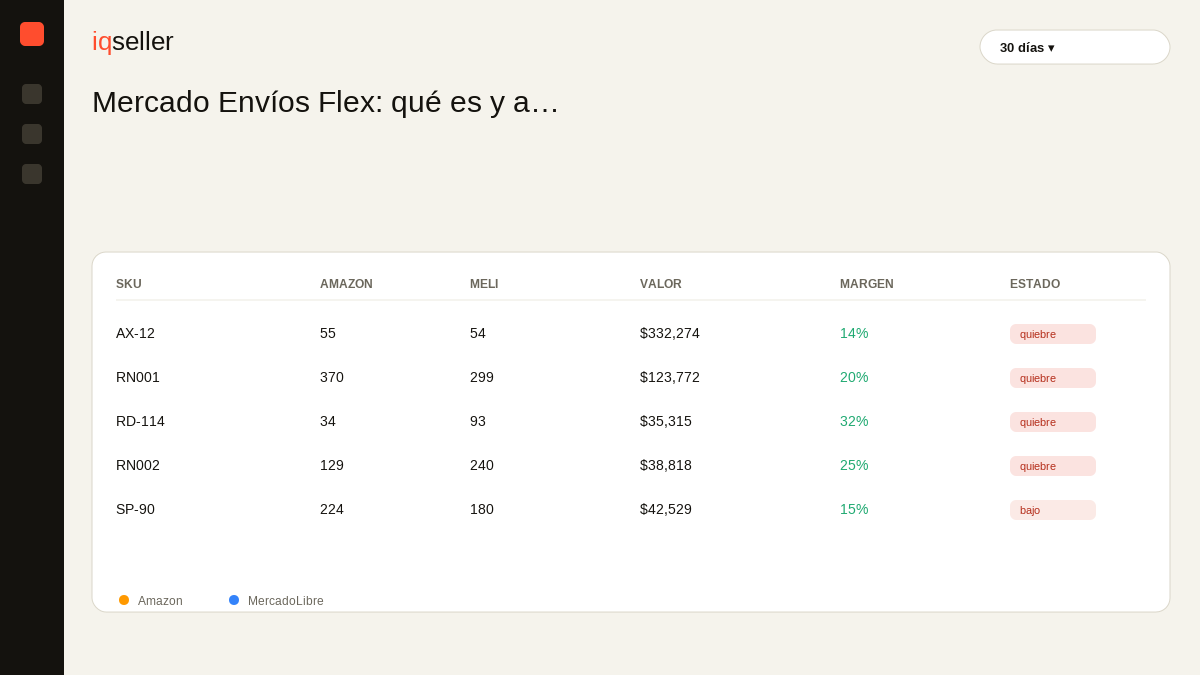
What iqseller does solve is the numbers side, which is exactly where the Flex decision gets made. In Profitability you see net margin per SKU using the COGS you load, net of the commissions that come through MercadoLibre orders, Full fees when the SKU ships that way, shipping, advertising, and the VAT and withholding breakdown. If you load your self-delivery cost as part of the SKU’s cost, that margin stops being an estimate and becomes comparable against the same product through Full.
In Inventory, stock is shown per warehouse, with the modes kept separate — Full, FBA, your own warehouse, 3PL — instead of a single total that hides where the units actually are. That separation is what prevents overselling when Flex and Full share a SKU, because your warehouse availability reads as what it is: what you can deliver today. The Parent → Model → SKU tree shows whether the problem is a whole model or a single size.
Forecast projects replenishment from real per-channel sales velocity, and Alerts fires when a warehouse’s availability drops below a threshold you set, which in a self-delivery setup is the signal that matters. Pricing lets you hold different prices per channel when the cost to serve differs, which is precisely the Flex case.
What it does not do, again: it does not enable Flex for you, does not adjust your daily shipment maximum, and does not measure your correct-shipment percentage, which lives inside MercadoLibre. What it does is remove the excuse of not knowing what it costs.
before you switch it on
Flex is one of the few MercadoLibre levers you cannot buy with money: you earn it with operations. The “Llega hoy” exposure is real and so is the conversion it moves, but it charges for it in the form of a weekly commitment that does not forgive.
The healthy order is this: measure your order concentration by zone, calculate your real cost per delivery on your own route, confirm you can read your warehouse availability without guessing, and start with the smallest zone and the lowest daily maximum that still lets you learn. If after four weeks cost per delivery came down and your correct-shipment rate held, expand. If not, switch it off without drama.
And as always with MercadoLibre: the coverage conditions, subsidies and thresholds cited here change, and they vary by city and by category. Confirm every figure in MercadoLibre Mexico’s help center and in your own seller panel before you commit to a delivery promise.