
FBA vs Full: costs, data and a real comparison
April 28, 2026
When a Mexican seller sits down to choose between Amazon FBA and MercadoLibre Full, they almost always start with the wrong question: “which one is cheaper?” The honest answer is that neither is cheaper in absolute terms. Each program charges differently —by weight, by dimensions, by category, by days in storage— and each connects you to a different buyer. Lining up the two fee tables side by side, as if they were phone plans, produces a clean conclusion that is almost always wrong.
The real problem is not missing data. It is scattered data. FBA fees live in Amazon Seller Central, Full fees in the MercadoLibre dashboard, your product cost in a separate sheet, and the number of days your SKUs have been sitting in a warehouse… nowhere obvious. To actually compare, you end up exporting reports, pasting them into Excel, wrestling with formulas, and deciding with numbers that are a week old. Your best product might be bleeding margin in one channel while you stare at a frozen table from last Monday.
This article will not tell you “FBA is better” or “Full always wins.” It will explain what each one actually costs, which data point you need to compare them product by product, and why the only comparison worth making is the one done on a single source of truth, in real time —not on two separate screens and a half-finished spreadsheet.
what each program actually charges
FBA and Full share the same idea —you ship inventory to their warehouse and they store, pack and ship— but they charge with logics that are not comparable as-is.
With Amazon FBA you pay, at minimum, two things on top of your cost: the referral fee (a percentage of the sale price that depends on the category) and the FBA fulfillment fee, calculated by the package’s weight and dimensions. On top of that comes monthly storage and, if your product doesn’t turn, the dreaded long-term storage. A light, expensive item absorbs these fees well; a bulky, cheap one can eat your entire margin in logistics alone.
With MercadoLibre Full the structure is different: a sale commission that varies by listing type and category, plus the per-unit Full cost, plus storage. MELI’s big lever is shipping: free-shipping eligibility and product weight meaningfully change what you keep. Two programs, two completely different mental spreadsheets.
The trap is that neither fee table makes sense in isolation. What matters is not “FBA charges X for logistics,” but how much lands in your pocket per unit sold in each channel, with everything already deducted. That number only appears when you put commission, fulfillment fee, storage, product cost and taxes in the same row.
why the fee table is not the comparison
Imagine comparing one SKU: in FBA logistics come out “cheaper” than in Full. Easy conclusion: sell on Amazon. But that table doesn’t know that on Amazon this product fights for the Buy Box against three other sellers and ends up selling 9% lower, while on MercadoLibre, with interest-free installments, it holds a higher price. The lower fee didn’t win: net margin per channel told a different story.
Comparing isolated fees ignores three things that move the needle: the real price you sell at in each channel (not the list price), the turnover speed (a fast-moving product barely pays storage; a slow one drowns in it), and the cost of running out of stock mid-campaign. The useful comparison is not about fees; it is about real profitability per unit, per channel, weighted by how much you sell in each one.
Dictionary: what the Buy Box is and how it affects the real price you sell at →the data point almost nobody joins: days of inventory
There’s a cost that hides from both tables and completely changes the comparison: storage tied to how many days your product has been in the warehouse. Both FBA and Full penalize inventory that doesn’t turn. A SKU that looks identical across channels in a fee table can be profitable in Full and a money pit in FBA simply because on Amazon it turns more slowly and racks up long-term storage.
To see this you need to cross two things that live in different places: how many units you hold in each warehouse and how fast you sell them. Doing it by hand, SKU by SKU, month after month, is exactly the kind of task nobody keeps up. That’s why most people compare FBA vs Full while ignoring the cost that distorts the result the most.
the invisible cost: your time in Excel
There’s a cost that shows up in no Amazon or MercadoLibre table, and it’s the most expensive of all: the hours you spend rebuilding the comparison by hand. Export the fees report from Seller Central, download the MELI one, paste them into a sheet, normalize formats, plug in your product cost, remember to deduct tax… and by the time you finish, prices have already changed.
Deciding with yesterday’s data is not a detail. If you dropped a price in FBA on Tuesday and your comparison is from Monday, you’re choosing a channel with false information. The uncertainty doesn’t come from FBA and Full being complicated; it comes from your snapshot of reality always arriving late. That’s why the reports that truly matter —the ones reflecting current price, commission and fee— are worth far more when someone joins them for you, as we explain in depth in the Amazon SP-API reports that actually matter.
Dictionary: what a unified catalog is and why it’s the basis for comparing channels →a real comparison: one row per product
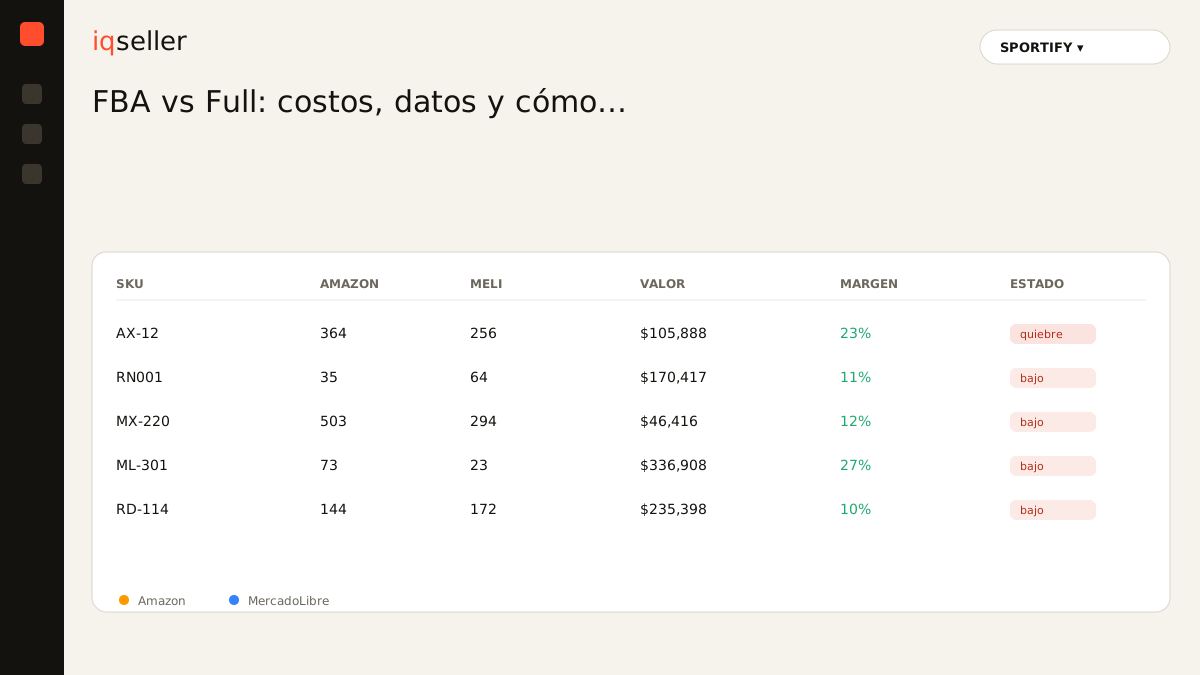
The comparison that works fits in a single row per product and shows, side by side, the real net margin FBA leaves you and the one Full leaves you —with commission, fulfillment, storage, cost and taxes already subtracted, at the real price you sell at today in each channel. That row answers the only question that mattered: for this specific SKU, which channel leaves me more money, given how it turns?
For that row to exist, the same product must be identified as one even though it lives in two marketplaces. If your Amazon SKU and your MercadoLibre listing aren’t linked by their identifier, no comparison is possible: they’re two loose products in two systems. Linking them by their code is the foundation for everything else.
Dictionary: how the EAN/GTIN links the same product across Amazon and MercadoLibre →a concrete case: when the answer changes by SKU
Picture a store like SPORTIFY, with two products. The first is light, branded, with its own search demand and repeat purchase: on Amazon it turns fast, pays little logistics for its weight, and holds price. The comparison clearly says FBA. The second is bulky, mid-priced, the kind people buy in installments: in FBA weight punishes it and it turns slowly (long-term storage); in Full, with free shipping and financing, it flies. The comparison clearly says Full.
Had SPORTIFY decided “everything to FBA because the fee table looked better,” it would be bleeding margin on the second product without noticing. The lesson is not that one channel wins: it’s that the answer changes by SKU, and you only see it when you compare real profitability, product by product, on live data.
the deeper answer: it’s not FBA or Full, it’s measuring
The best strategy for almost any multichannel seller is not to pick a program, but to be in both and move inventory and ads toward where each product performs best. But that’s only possible if the comparison is always current and doesn’t depend on you sitting down on a Sunday to rebuild the Excel.
The deeper shift is going from comparing two screens and a stale spreadsheet, to having a single view that joins your channels, deducts all real fees, and shows you, per product, where you earn more today. The decision stops being an annual hunch and becomes a reading you can take whenever prices, commissions or your cost change. FBA versus Full stops being a battle of tables and becomes what it always should have been: a data point, per SKU, in real time.