
Pricing Strategy Against a Price War Without Hitting Bottom
August 18, 2026
Your pricing strategy against a price war is not about cutting faster than the other seller: it is about deciding, with data, how far down you will go and exactly when you stop. A price war is that spiral where a competitor cuts their price, you match, they cut again, and within days you are both selling the same thing at half the margin. Winning it is not reaching the bottom first; it is not falling to the bottom at all. The golden rule is simple: never drop below your profitability floor, and never make that call from memory, but with your real net margin per channel in front of you.
For the multichannel seller, the problem is that the war is rarely fought on one side only. Your price drops on Amazon, someone copies you on MercadoLibre, and the same SKU changes value depending on each marketplace’s fees. Without a single view, you end up adjusting one listing at a time, several dashboards open, stitching the data together by hand in Excel, and finding out too late that you have spent two weeks selling your hero product at cost. The uncertainty is not just “do I drop or not?” — it is “how much is this fight already costing me?”.
The good news: a price war is won with discipline, not speed. Differentiation, a calculated price floor, and the deliberate decision to stop cutting when the number no longer makes sense. That is what separates the seller who defends their margin from the one who gives it away until they disappear.
what a price war actually is
A price war is a chain of reactive cuts between two or more sellers competing for the same buyer. It almost always starts from one of three causes: a new competitor buying market share, an automated repricer badly calibrated to chase the lowest price with no floor, or a seller with excess stock liquidating for cash. None of those three has anything to do with your product: they are the other seller’s decisions, which is exactly why reacting on autopilot is so dangerous.
The damage is not only today’s margin. When a category’s price drops, it tends to stay down: buyers learn that price as “normal,” and raising it again costs sales. A badly managed price war does not just take profit this week — it resets your product’s price ceiling for months. That is why the first question is never “how much do I cut?” but “is this fight even worth fighting?”.
first, know your floor: real net margin
You cannot defend what you do not measure. Before responding to any cut you need your price floor, and that floor comes from net margin: price minus marketplace commission, minus product cost, minus logistics (FBA or Full), minus prorated advertising, minus returns. The pretty gross-margin number lies in the middle of a war, because the fees eat precisely the slice you think you are keeping.
And here is the multichannel trap: the floor is different per channel. A price that leaves you 22% margin on one channel can leave you 9% on the other, because commissions and logistics are not the same. Responding to a price war with a single flat number across both channels is how most sellers end up at cost without noticing. The floor is calculated per channel, with everything deducted, and that line is the one you do not cross.
Glossary: real net margin, everything deducted →differentiate to leave the price comparison
The only way to truly win a price war is to not fight it on price. When your offer is identical to the competitor’s, all that is left is the number, and there the seller willing to lose more always wins. The way out is to give buyers reasons to pay your price: faster shipping, a bundle the other seller does not have, better listing content, extended warranty, reviews that back you up. Every element of differentiation is permission to stop following the competitor down.
This is not abstract marketing. In pricing terms it means you can hold a difference of a few pesos above the cheapest seller and still convert, because the buyer perceives more value. Measuring that — how much price premium your product tolerates before conversion drops — is what tells you whether you have room to stay out of the war or are genuinely forced to move.
when NOT to drop the price
The most profitable move in a price war is often to do nothing. Do not cut when the competitor has little stock: their aggressive price ends when their inventory does, and if you hold for a few days you recover the market without sacrificing margin. Do not cut when their price is already below your floor: following them there is selling to lose, and it is better to give up units than give up profit. Do not cut if your differentiation sustains conversion: if you keep selling at a reasonable premium, the war is theirs, not yours.
You should move when you lose visibility or the Buy Box in a sustained way, when you have excess inventory you do want to liquidate, or when a small, temporary adjustment recovers traction without breaking the floor. The key is that every move is a decision, not a reflex. A repricer chasing the lowest price with no floor is exactly what turns an isolated cut into a war nobody wanted.
Glossary: laddered offer, step by step →if you decide to drop, do it in steps and with a return date
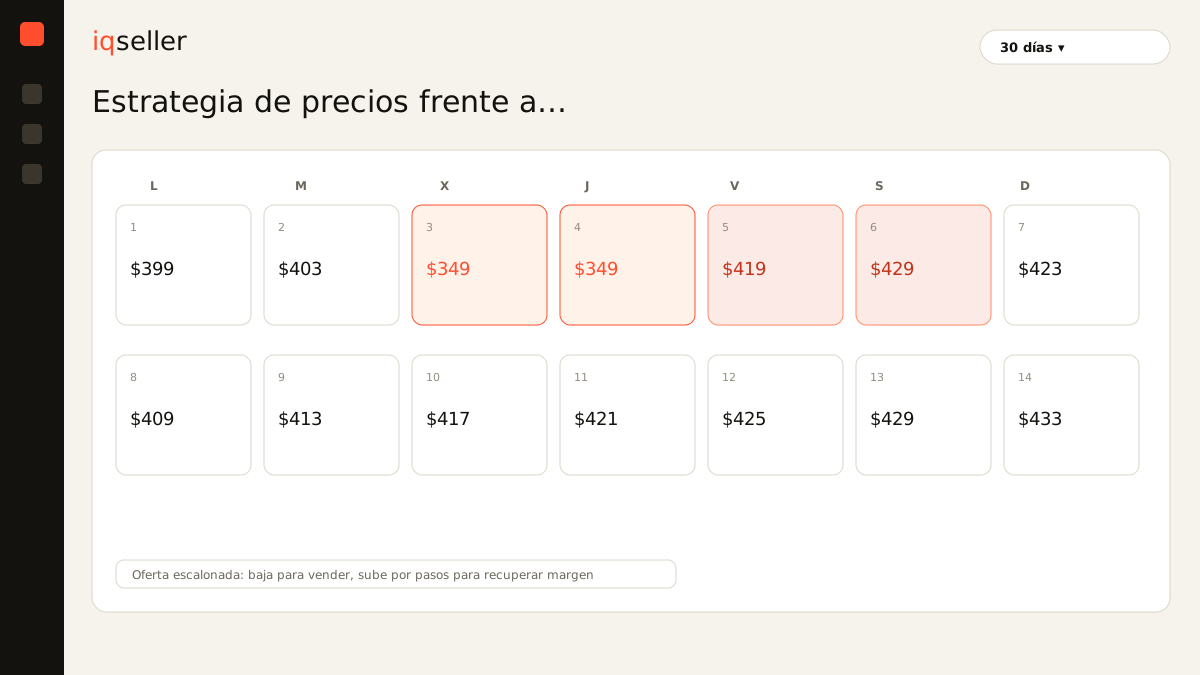
When you do have to respond, the worst way is a deep, permanent cut. Better a laddered offer: you drop just enough to recover traction, and you schedule the stepped return of the price up front so you do not get trapped at the war value. The classic mistake is not dropping; it is dropping and forgetting to raise. Weeks later your best product is still at war pricing and the margin evaporated in silence, while the competitor who started it all has already raised theirs.
This is where an automatic price calendar changes the game: you define the sequence once — how much you drop, how many days, how you step back up — and the system runs it, measures it, and alerts you. Your response to the war stops depending on your memory and becomes a plan with an exit date. Dropping with a plan is defense; dropping without one is slow surrender.
the single view that wins the war
All of the above collapses if you do not see both channels together and in real time. A price war moves by the hour, and if you learn about the cut when you are already two days into selling below the floor, the decision arrived late. What you need is an alert when a competitor’s price — or your own, from a catalog change — crosses a threshold, with your net margin per channel already calculated beside it, so you respond with a number, not a hunch.
That is the underlying shift real time solves: moving from rebuilding the picture by hand in Excel, several dashboards open, to a single view where price, fees, stock, and margin talk to each other. In a price war, the seller who sees first and sees completely decides better. And deciding better — not cutting faster — is the only thing that keeps you far from the bottom.