
Real net margin: everything Amazon and MELI deduct
May 21, 2026
There is one number almost every seller thinks they know and almost nobody has right: how much money actually stays in your pocket after a sale. You look at the listing price, subtract what the product cost you, see a difference that looks healthy, and move on with your day. The problem is that between that price and your bank account sits a long line of deductions that neither Amazon nor MercadoLibre ever shows you in one place. Each marketplace reveals a piece, on different screens, under different names, and the final total only appears when it is too late to react.
The pain multiplies when you sell across several channels at once. You open Amazon Seller Central to check referral commissions and FBA fees, then jump into MercadoLibre to see Mercado Envíos costs and the reputation-tied fee, then ask your 3PL how much they charged for prep and storage, and you end up pasting everything into a spreadsheet that was already stale the moment it was born. You decide tomorrow’s price with yesterday’s data, sometimes last week’s. In that gap between what you think you earn and what you actually earn hide the products you are selling at a loss without knowing it.
This article takes that number apart piece by piece: what each platform deducts, why the order matters, and why a single real-time source of truth completely changes how you set prices. This is not about selling more; it is about finally knowing how much of each sale is yours.
what amazon deducts before it pays you
On Amazon, the first bite is the referral fee, a percentage of the sale price that changes by category. On top of that comes the FBA fee for picking, packing, and shipping each unit, calculated by weight and dimensions, so two products at the same price can leave you very different margins simply because of box size. Then there is monthly storage, which feels minor until a SKU sits still and the long-term storage charge kicks in.
To those line items you have to add two that almost everyone forgets when they do the math: shipping your inventory into Amazon’s center (inbound) and a returns provision. A return is not a rare exception; it is a recurring cost you must prorate across all your sales. And if you run Amazon Ads, your ACoS comes straight out of margin, not from some separate budget. Once you stack referral, FBA, storage, inbound, returns, and advertising, that clean “price minus cost” shrinks far more than you expected.
Dictionary: real net margin is what remains after ALL channel deductions —commissions, fulfillment, storage, shipping, returns, advertising, and tax— not just price minus cost.what mercadolibre deducts, which is not the same thing
MercadoLibre has its own logic and its own names, which is exactly why comparing channels by eye leads to mistakes. Here the sale commission depends on the listing type: a Classic charges less than a Premium, but Premium includes interest-free installments whose financing cost also ends up coming out of your pocket. There is also a fixed per-unit charge on low-price products, a threshold that punishes precisely the cheap items where margin is already thin.
Add to that the cost of Mercado Envíos. If your reputation forces you to offer free shipping, you absorb that subsidy, and it varies by weight, destination, and account level. Selling the same product at the same price on Amazon and on MELI can leave you two completely different margins, and the only way to know is to compute each channel with its own rules. That is why an average is useless: you need the number per product and per marketplace, not a blended figure that hides your losses behind your winners.
the order of the deductions really does change the result
Many people build the calculation as a flat subtraction and call it done. But the order and the base of each calculation matter. The commission applies to the sale price, in some cases tax included; the 16% VAT must be handled correctly so you neither double-count nor forget it; the financing cost of interest-free installments is calculated on the financed amount, not on your cost. Mix up the bases and the result looks “reasonable” but is wrong, and you price off a mistaken figure.
This is where a spreadsheet stops being enough. Not because the formula is impossible, but because fees change, categories get reclassified, your reputation rises or falls, and storage depends on how many days each SKU has been sitting. Keeping that sheet current for hundreds of products across three channels is a full-time job that is always behind. Useful profitability is the one you see today, with everything already deducted, not the one you reconstruct at month’s end when the damage is done. If you want to see how this fits with restocking, we go deep in the inventory forecast.
why real margin changes your pricing, not just your bookkeeping
Knowing your real net margin is not an accounting exercise you file away: it is what should decide your price. When you see a product leaving 4% on MELI and 18% on Amazon, you stop subsidizing it blindly and start moving the price where it actually makes sense. When you discover a low-ticket SKU loses money to MELI’s fixed fee, you raise it, bundle it, or pull it from that channel. Real margin turns pricing from a hunch into a decision.
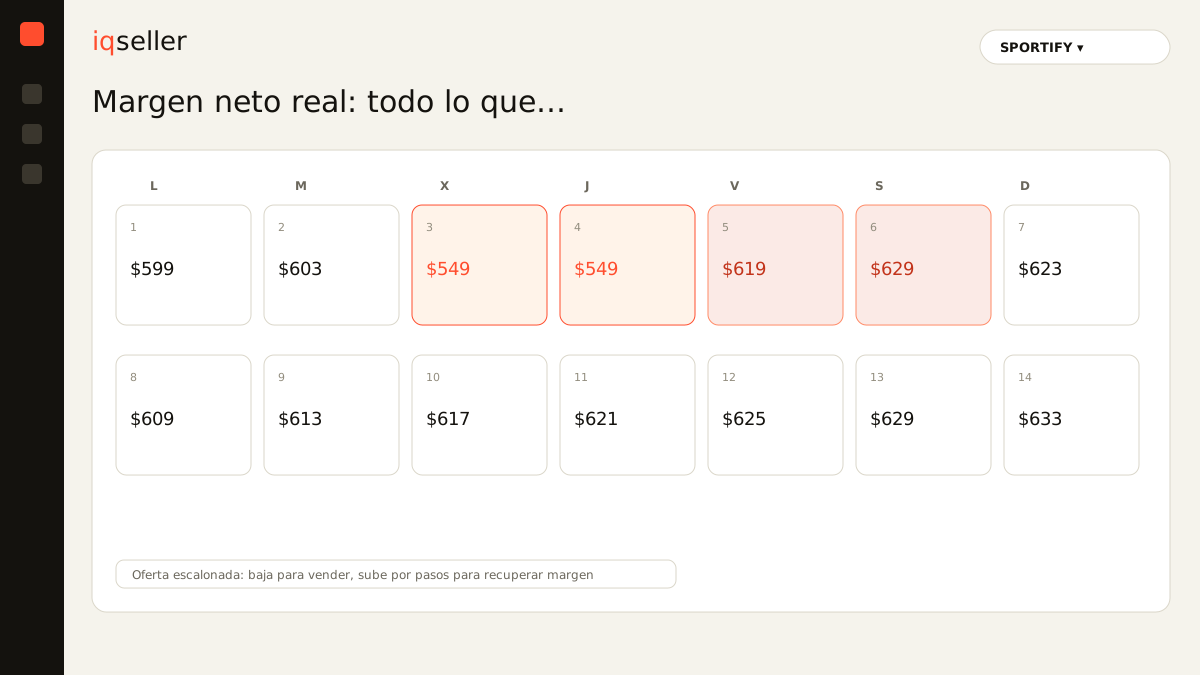
This connects directly to how you ladder your offers. Dropping the price to gain selling speed only makes sense if you know how far you can go without slipping into a loss, and you only know that with margin already deducted. We develop it in laddered offers: drop to sell, raise to win margin. The underlying idea is the same: price does not move on cost, it moves on real margin.
Dictionary: a laddered offer adjusts price in steps according to demand and margin, instead of a flat discount that often sells more but earns less.one source of truth, in real time
The real shift is not a new formula; it is to stop assembling the information by hand. When data from Amazon, MercadoLibre, and your 3PL live in one place and update on their own, real net margin stops being a number you reconstruct and becomes a number you check. Each sale arrives with its commissions, its fulfillment, its prorated storage, and its returns provision already applied, per product and per channel.
That is what iqseller does: compute the real net margin of each SKU on each marketplace, with each platform’s own rules, without you touching a spreadsheet. A seller like SPORTIFY, which sells the same catalog on Amazon, MELI, and through its own Shopify with a 3PL, can see at a glance which products win where and which only appear to win. That clarity is what lets you raise a price without fear or cut what bleeds before the quarter charges you for it.
the routine that costs you your real margin
The last point is about habit. Without a single source, your routine is reactive: you find out a product is losing money when the statement does not add up. With real margin visible per product, the routine flips: you check the number before changing a price, before launching a promotion, before restocking. The decision stops being based on the listing price and starts being based on what truly stays with you.
That is the practical takeaway of all this. Amazon and MELI will keep deducting what they deduct; you cannot change that. What you can change is whether those deductions take you by surprise or whether you see them before you set the price. Real net margin, calculated in real time and per channel, is what moves the decision from “I think I’m earning” to “I know exactly how much I earn and where.”
Dictionary: the price calendar schedules price changes by date and channel, so you can anticipate seasons and events without editing each listing by hand.