
Laddered offers: drop to sell, raise to win margin
May 28, 2026
Almost every multichannel seller has lived the same scene. You drop the price on your best product to kick off a promo, sales light up, and then daily operations take over: orders, buyer messages, a stockout on another listing, a dispute on the other marketplace. The promo did its job a while ago, but the price is still down. Days pass, sometimes weeks, and one morning you open the report and discover your best product has been selling at the promo price for a month. Every unit you were so proud to move went out at half the margin.
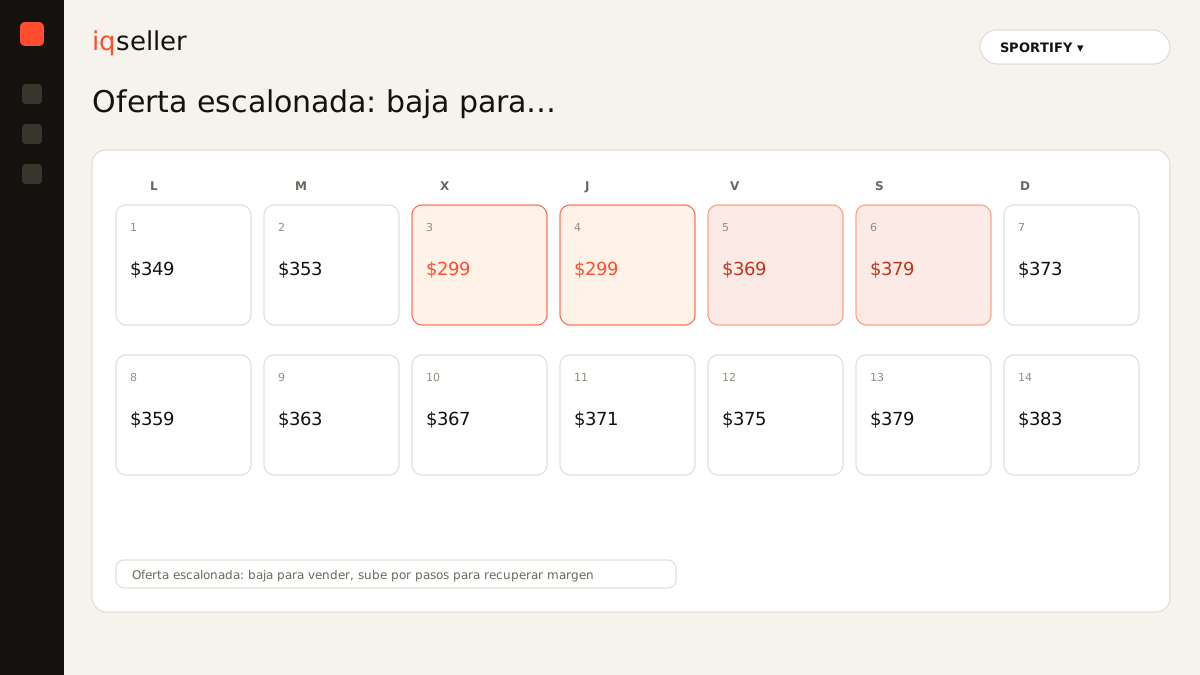
The real problem isn’t the promo. The promo worked. The problem is that we treat price like a switch —on or off, sale or normal— when it’s actually a sequence over time. A laddered offer starts from that idea: you drop to sell, but you raise in steps to win back margin, and you do it on a plan instead of relying on yourself to remember.
This gets especially hard when you live across several dashboards. Amazon Seller Central on one side, MercadoLibre on another, the 3PL system on yet another. Each with its own pricing screen, its own promotions, its own fees. Coordinating a price sequence across channels, by hand, for dozens of SKUs, is exactly the kind of task that ends up in a hacked-together spreadsheet and, worse, in decisions you make with yesterday’s data.
what a laddered offer actually is
A laddered offer isn’t “a discount you take away later.” It’s a price plan with three chained moves, each with a clear purpose.
First, the entry rung: you drop the price enough to gain traction. The goal isn’t just to sell more units today, it’s to buy positioning —climbing the search results, accumulating reviews, building the sales velocity that the marketplace algorithm rewards—. It’s an investment, not a markdown.
Second, the upward rungs: this is the heart of the method. Instead of jumping straight from the promo price to the target price, you climb in stages. From $399 to $429, then $459, then $489. Each step is small, nearly imperceptible to the buyer, and it keeps much of the sales momentum you earned at the bottom. Jump up all at once and you kill the velocity you worked so hard to build.
Third, the ceiling and the hold: the last rung leaves you at —or above— your normal price, with the product better positioned than before the promo. You sell at a better price than you had and with more visibility. That’s the whole trick: the promo didn’t drag you back to square one, it left you higher.
Dictionary: laddered offer, the three moves step by step →why you raise in steps and not all at once
Intuition says “I sold what I wanted, back to the normal price.” But the buyer doesn’t compare your price against your cost sheet; they compare it against what they saw yesterday. A sharp jump feels like a penalty and breaks conversion right when the product was hot.
Raising in steps solves two things at once. On one hand, it smooths perception: nobody notices they paid $30 more than last week if the change came in two stages. On the other, it gives you information. Each rung is a small elasticity experiment: you see how many units the product holds at each price before velocity drops. That curve —how much you sell at each level— is gold for designing the next campaign.
A big sales event is the clearest case. The seller who improvises drops the whole catalog, sells a ton at minimum margin, and the following Monday snaps back to list price in one move, losing the wave. The seller who ladders rides the peak, and over the next two weeks climbs in stages while demand is still above normal. They end up collecting the event twice: in volume during, and in margin after.
price is designed per channel, not flat
Here’s one of the costliest traps for the multichannel seller: putting the same price everywhere because “it looks tidy.” It isn’t. Amazon and MercadoLibre commissions are different, FBA and Full costs don’t match, and shipping that one channel absorbs is shipping you pay for on the other.
A price that leaves you 27% real net margin on Amazon can leave you 12% —or less— on MercadoLibre. If you design your ladder on a tidy flat number, you’re laddering blind: the same upward rung that recovers margin on one channel barely pulls you out of the red on the other. The ladder has to be calculated on each channel’s real margin, with every fee deducted. That’s why it pays to understand why one flat price loses money before you program any sequence.
Dictionary: real net margin, with commissions and logistics deducted →the danger of laddering without watching inventory
A laddered offer is, by design, a machine for accelerating sales. And that’s its silent risk: if the entry rung doubles your sales velocity and you’re not watching stock, you run out mid-campaign. A stockout during a promo is the worst thing that can happen —you’re paying for ads to send traffic to a listing that can’t be bought, and the algorithm punishes the drop—.
That’s why the price ladder and replenishment have to talk to each other. If your product has 14 days of inventory and the promo doubles velocity, that cushion becomes one week. The right play is to align all three pieces: low price while there’s plenty of stock, upward rungs as inventory falls (the increase slows velocity a bit right when you need it), and replenishment already on the way before the campaign demands you sell hard. Keeping real-time inventory stops being a luxury and becomes the condition for the ladder not blowing up in your hands.
tracking is the other half of the job
Programming the sequence is only half. The other half is measuring the effect while it happens, not three weeks later in a spreadsheet. How many units did the $429 rung move? Did margin hold when you climbed to $489? At what exact point did velocity drop? Without that tracking, you repeat promos on intuition and make the same mistakes every season.
This is where the multichannel seller really suffers. Amazon’s data lives on one screen, MercadoLibre’s on another, your 3PL’s on yet another, and to “see” your full campaign you end up exporting everything to Excel and pasting columns at midnight. By the time you’ve built the report, the chance to adjust has passed. Deciding with yesterday’s data, scattered across three dashboards, is deciding blind with extra steps.
The alternative is a single source of truth in real time: your channels in one panel, each rung with its units and margin beside it, and an alert when something drifts from the plan —a price drop you didn’t schedule, a competitor who took the Buy Box, a rung that killed conversion—. With that, every campaign teaches you something concrete for the next.
Dictionary: price calendar, where the ladder lives →from reacting to designing
The deeper shift a laddered offer proposes isn’t technical, it’s a mindset. It’s moving from reacting —drop, forget, remember to raise someday— to designing the sequence once and letting the system execute it, measure it, and alert you when it drifts. Margin stops depending on your memory and on how many dashboards you managed to check that day.
For the seller running Amazon and MercadoLibre at the same time, where each channel has its own costs and pulls its own way, the price ladder is one of the few tools that improves profitability without selling a single extra unit: it simply stops giving away margin between the day you dropped the price and the day you remembered to raise it. And when the sequence is calculated on each channel’s real margin and executed with inventory in view, the promo stops being a gamble and becomes a plan you know how it ends.