
Price tracking and its effect on real margin
May 26, 2026
Almost every seller on Amazon Mexico and MercadoLibre believes they know what they sell their product for. You know the list price by heart, you repeat it when someone asks, and you use it to do mental margin math. The problem is that this number is almost never the price you actually collected. Between coupons, volume discounts, marketplace promotions you joined without quite realizing it, Buy Box adjustments, and that markdown you set three months ago and forgot to turn off, the price in your head and the price that ended up on the customer’s receipt can differ by 15 or 20 percent. And in a business that runs on single-digit margins, that 15 percent is the difference between making money and losing it.
Price tracking sounds boring. It sounds like a spreadsheet where you jot down what you sold for each week. But doing it well is one of the highest-impact things you can do for your real profitability, precisely because price is the only lever in your business that goes straight to profit without passing through any cost. Drop your price by five pesos and those five pesos come straight out of your margin. Raise your price by five pesos without losing sales and those five pesos go straight in. No other operational adjustment has that direct a relationship with what you keep at the end of the month.
The real pain shows up when you sell on several channels at once. Seller Central shows you one thing, the MercadoLibre panel shows you another, your shipping system or 3PL gives you costs in a third place, and you end up pasting everything into Excel on a Sunday night trying to figure out what happened. By the time the picture is assembled, the data is already a week old and the decision you meant to make no longer applies. That is the trap: you decide with yesterday’s information while believing you are deciding with today’s.
list price is not selling price
The first thing that changes when you start tracking seriously is that you stop looking at list price and start looking at realized price: what actually came in per unit after everything. A single SKU can carry five different realized prices in one week, depending on the channel, the active promotion, the coupon the customer applied, and whether the sale fell inside an event like Hot Sale or Buen Fin.
When you only look at list price, you assume a margin that does not exist. You believe each unit of your hero product leaves you, say, 90 pesos, but if half that week’s sales went out with a 12 percent coupon you left running, your real average margin was far lower. Multiply that across hundreds of units and the leak is serious. Price tracking is not data vanity: it is the only way to know whether the profit you report in your head matches the profit that exists in your bank account.
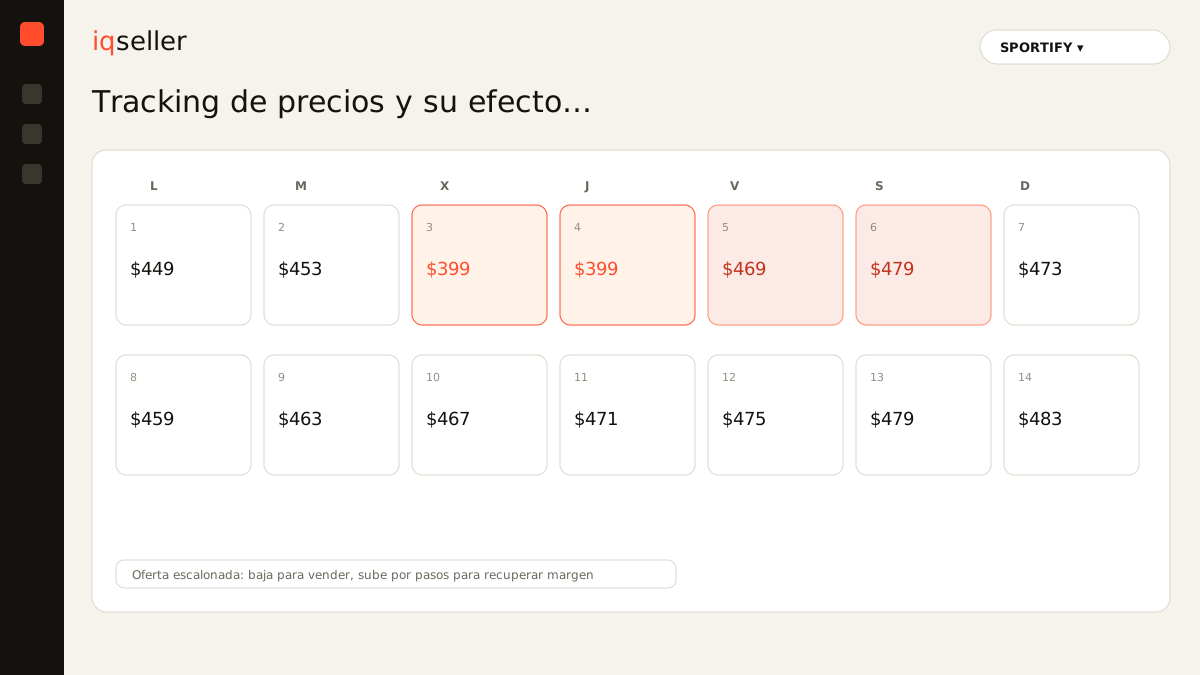
Dictionary: the price calendar is the timeline where you see every price change per SKU and per channel, with the exact date it started and ended.why history matters more than today’s snapshot
Knowing what you sell for today is worth little if you do not know how you arrived at that price. The value of tracking lives in the history: being able to see a SKU’s price curve over months, cross it with units sold, and understand which price moves actually moved the needle and which ones only cost you margin without bringing volume.
Many sellers cut prices in a panic when they see sales cooling, and never raise them back. Months pass and that SKU stays anchored to an emergency price that no longer has any reason to exist. With a clear history you catch these anchors: you see the step where you dropped, you see that sales barely changed, and you realize you gave away margin for nothing. History also teaches you your own real seasonality, not the one you assume. You may swear December is your strong month, but the data shows your real peak is the second half of November because of Buen Fin, and that by December you already sell at higher prices with less effort.
the hidden cost of poorly measured promotions
Promotions are where the most margin leaks while nobody keeps count. You join a marketplace campaign because it is offered to you, you set a coupon “to move inventory,” you schedule a markdown for the weekend, and each of these decisions is made in isolation. Nobody adds up the total effect. When you finally do, you discover that you sold more units than ever that month yet earned less than the month before.
Done right, tracking connects each promotion to its effect on realized margin, not just on units. That is the difference between scheduling promotions blind and scheduling them with your eyes open. If you want to go deeper into structuring campaigns that do not eat your profit, we cover it in scheduling promos without destroying profitability. The core idea is simple: a promotion is only worth it if the extra volume it generates outweighs the margin you sacrifice, and you only know that if you measure both sides.
Dictionary: a tiered offer is a discount that grows in quantity brackets, designed to lift the ticket without giving away margin on the first unit.one source of truth against the Sunday Excel
The real enemy is not price itself, it is fragmentation. When each channel lives in its own dashboard, assembling the full picture depends on your memory and your patience for copy-paste. That manual work does not just cost you hours: it introduces errors. One mispasted cell, an old exchange rate, a fee cost you never updated, and the entire analysis you are about to decide on is contaminated.
Having a single source of truth means the realized price of each SKU, on each channel, already comes unified and current, without you assembling anything. Instead of reconstructing the past every week, you open the panel and the past is already there, in order. The time you used to spend gathering data you now spend deciding what to do with it. And you decide with today’s numbers, not numbers from seven days ago. That closeness to the data changes the kind of decisions you make: they stop being reactive and start being deliberate.
This principle does not live in pricing alone. The same fragmentation problem affects your inventory, and the logic of unifying to decide better is exactly what applies to the inventory forecast in depth: a single place where raw data becomes decision.
from realized price to real net margin
Realized price is the first step, but the final goal is real net margin: what truly remains after subtracting product cost, marketplace fees, shipping cost, your 3PL commission, return costs, and any applied discount. It is very different from the gross margin most people use to reassure themselves.
This is where price tracking stops being a pricing exercise and becomes a profitability exercise. When you cross your realized price with the full cost structure per channel, you discover uncomfortable things: that a SKU you love selling actually loses money on MercadoLibre because of the commission, while it earns healthily on Amazon; that another product is only profitable above a certain price and that every promotion pushes it below that line; that your unit-volume “best seller” is your worst seller in profit. Those truths do not appear in the list price. They appear only when you measure real net margin, SKU by SKU and channel by channel.
Dictionary: real net margin is what remains per unit after subtracting product, fees, shipping, and returns from the realized price, not from the list price.how to start without losing your mind
You do not need to track everything from day one. Start with your ten highest-volume SKUs, because that is where most of your profit lives and any margin leak gets multiplied. For each one, define your price floor: the number below which the sale stops making sense once all costs are subtracted. That floor is your line of defense against impulsive promotions and against panic price cuts.
Then review the history of those SKUs and hunt for the anchors: emergency prices that stuck around, coupons you never turned off, campaigns that renewed themselves. Each one is margin you recover without selling a single extra unit. Finally, make it a habit: a short weekly review where you check realized price against your floor and against the previous week, instead of the Sunday Excel marathon. Done right, price tracking is not more work, it is the same work done once and well, instead of done badly every week. When the data lives in one place and updates itself, you stop managing spreadsheets and start managing your margin.