
Scheduling promos without destroying profitability
May 22, 2026
A promo looks great on paper: you drop the price, units climb, the listing moves up in the rankings, and the sales chart turns green. The problem is that almost no multichannel seller knows, at the moment of scheduling it, how much margin will be left once Amazon or MercadoLibre apply their fees. The promo gets decided with the sale price in mind and the true cost recalled “more or less” from memory. When the accounting cutoff arrives, the discount that seemed aggressive but healthy turns out to have been a sustained loss-making sale for five straight days.
The pain compounds because promos don’t live in one place. You’ve got a lightning deal in Amazon Seller Central, a campaign in MercadoLibre with its own bonus percentage, and a shipping cost that shifts with the 3PL and the season. Each platform shows you its own version of reality, and none of them tells you what happens to your profit when all three combine. You end up exporting reports, pasting them into Excel, cross-referencing fees by hand, and deciding tomorrow’s discount with the numbers from two days ago.
Scheduling promos without destroying profitability isn’t a matter of discounting less. It’s a matter of seeing, before you hit the button, the net margin that will remain in each channel at each price, and of having that calculation live in a single real-time source of truth instead of in your memory and yesterday’s spreadsheet.
why a “profitable” promo ends up losing money
The most common mistake isn’t discounting too much, it’s discounting blind. A seller calculates the discount off the list price, but real profit isn’t measured against list price: it’s measured against price minus marketplace commission, minus per-sale fee, minus fulfillment cost, minus product cost, minus tax where it applies. A 20% discount that feels conservative can completely erase a margin that was already a tight 25%.
The second mistake is treating every SKU the same. You have products with comfortable margin that can absorb a deep promo, and low-ticket products where five points of discount are the difference between earning and subsidizing. When you apply the same percentage across the whole catalog “to keep it even,” you’re giving away margin where it wasn’t needed and risking a loss where it actually hurt. The promo becomes an instrument with no aim.
Dictionary: real net margin is what’s left after ALL marketplace deductions, not the sale price minus the product cost.the promo price is decided against net margin, not list price
The right question before scheduling a deal isn’t “how big does the discount look?” but “what net margin am I left with at this price, in this channel?”. That’s a different question for Amazon and for MercadoLibre on the same product, because commissions, per-sale fees, and shipping cost are not the same across platforms.
When the real net margin calculation is built into the moment you set the promo, you stop guessing. You see that the same promotional price leaves 14% in one channel and barely 3% in another, so you can choose to promo hard where it holds up and gently where it doesn’t. The promo stops being a global percentage and becomes a per-SKU, per-marketplace decision, which is how it should have been all along.
This also protects your floor. If you define a minimum acceptable margin per product, the system can warn you when a proposed discount falls below that floor, before you publish it, not after you’ve sold it.
stepping the offer: drop to sell, raise to recover
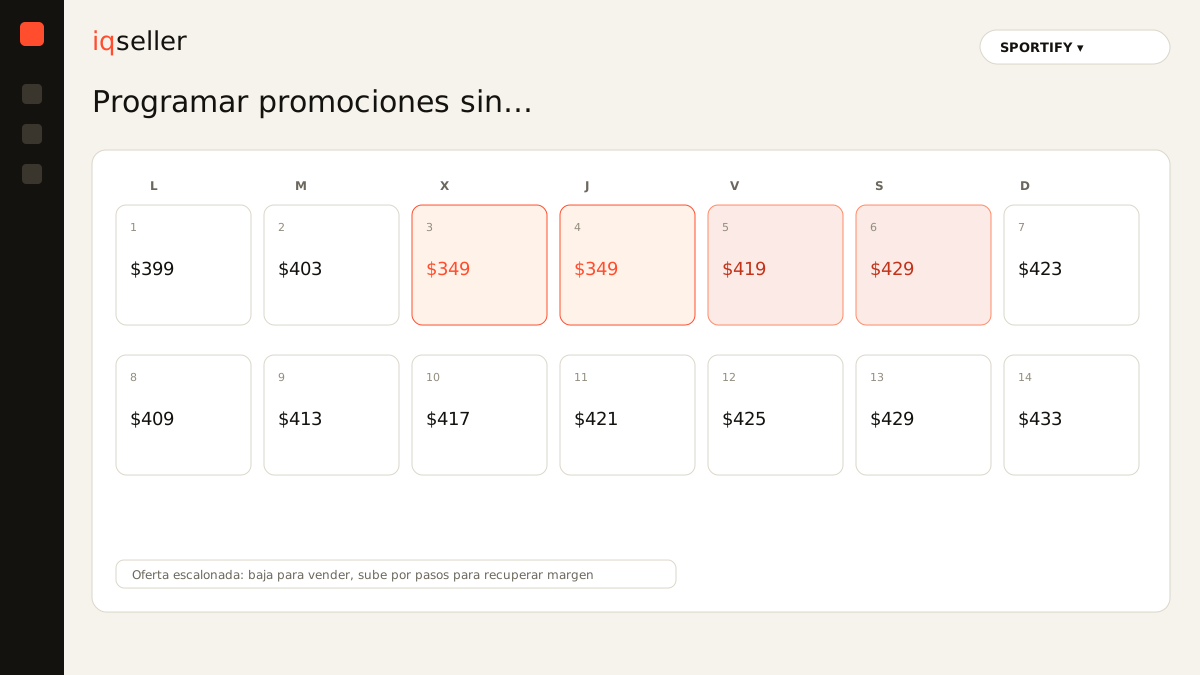
A promo doesn’t have to be a single flat price for the entire period. A stepped offer starts at the lowest price when demand is hottest, the campaign launch, the first day of Hot Sale, the traffic peak, and then rises in steps as the period advances. You capture volume when it matters and recover margin during the tail days, without losing the ranking momentum the listing earned.
Dictionary: a stepped offer drops the price to push sales and then raises it in steps to recover margin without killing the listing’s momentum.The problem with stepping by hand is the usual one: it requires you to remember to raise the price on the right date, in each channel, for each SKU. It’s exactly the kind of task that falls through the cracks. A promotional price you forgot to revert is a margin leak that bleeds silently, every day, until someone notices it in the monthly report. Scheduling the whole sequence in advance, with the step-up dates already defined, eliminates that leak.
Dictionary: the price calendar is the timeline where you schedule what price each product has in each channel and on what date it changes automatically.promos and stock: the crossover nobody schedules together
A successful promo is an inventory accelerator, and that’s the trap. The discount that triggers sales also drains stock faster than expected. If the product runs out mid-campaign, you don’t just lose sales: the listing loses ranking, and the investment you made in positioning during the promo evaporates right when it was starting to pay off.
That’s why scheduling promos and watching real-time inventory are the same conversation, not two separate tabs. Before launching an aggressive offer, you need to know how many days of coverage you have at the expected sell-through with the discount, and whether your 3PL can restock in time. When stock and the promo calendar live in the same dashboard, you can calibrate discount depth against available units instead of discovering the stockout when it’s already too late.
The reverse crossover matters too: excess slow-moving inventory is exactly the ideal candidate for a stepped promo, because there the goal isn’t to maximize margin but to free up working capital trapped in the warehouse.
promo and Buy Box: when discounting is competing and when it’s giving it away
Dropping the price for a promo and dropping the price to win the Buy Box look similar, but they’re not the same. Sometimes a small price correction recovers the Buy Box without needing a full campaign; other times you’re in a price war where discounting only invites the competitor to discount further, and both lose margin without moving the needle. Knowing how to tell the two situations apart prevents defensive promos you shouldn’t have launched.
The logic of winning the Buy Box without a price war applies directly to promo planning: before scheduling a discount “to compete,” it’s worth seeing whether the current price is already competitive and the problem is something else, availability, seller rating, shipping time. A promo doesn’t fix a problem that isn’t about price; it only gives away margin.
one source of truth for the whole calendar
The thread connecting everything above is to stop operating on yesterday’s data scattered across three dashboards. As long as commissions live in Seller Central, campaigns in MercadoLibre, and shipping costs in the 3PL portal, every promo will be a manual reconstruction in Excel, prone to error and always a step behind reality.
When sales, fees, costs, and stock from Amazon, MercadoLibre, Shopify, and your 3PL converge into a single real-time dashboard, scheduling a promo stops being an act of faith. You see the projected net margin at each price and in each channel, you define the stepped sequence with its automatic step-up dates, you check discount depth against inventory coverage, and you leave everything scheduled to execute and revert on its own. The promo is still your decision, but made with today’s numbers, not the ones from two days ago, and without forgetting to raise the price back.
That’s the difference between a promo that moves volume and one that moves volume without destroying the profitability you worked so hard to build.